
Loading, please wait...
LOT 1201
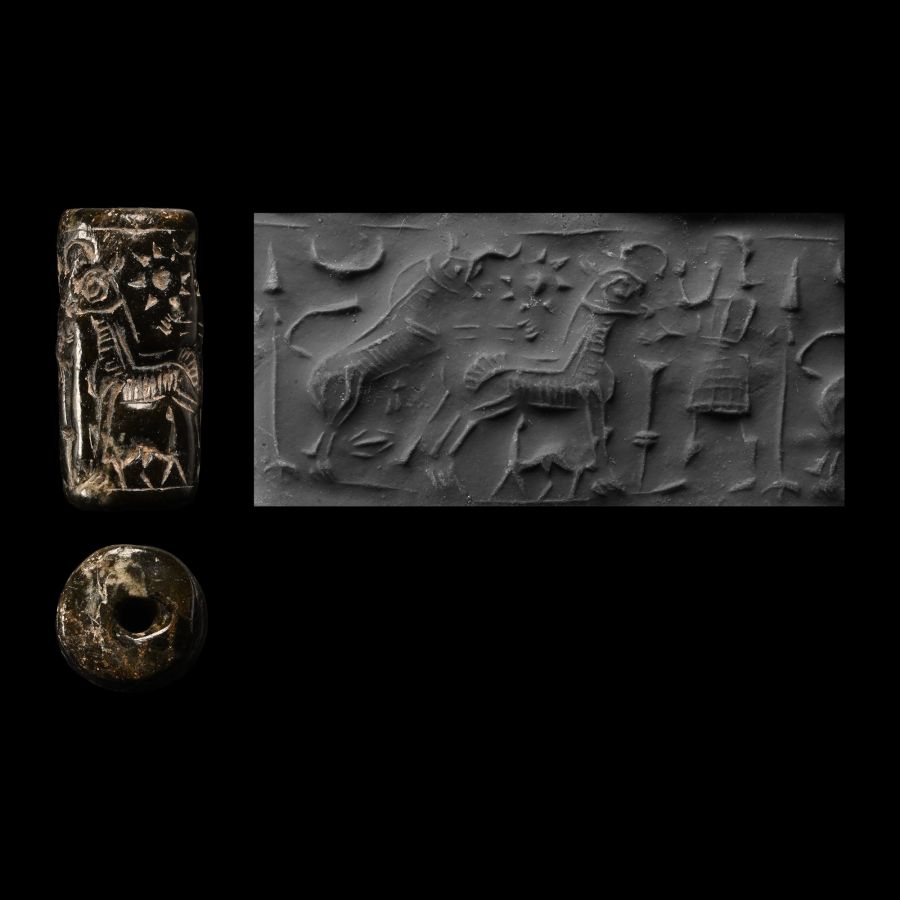
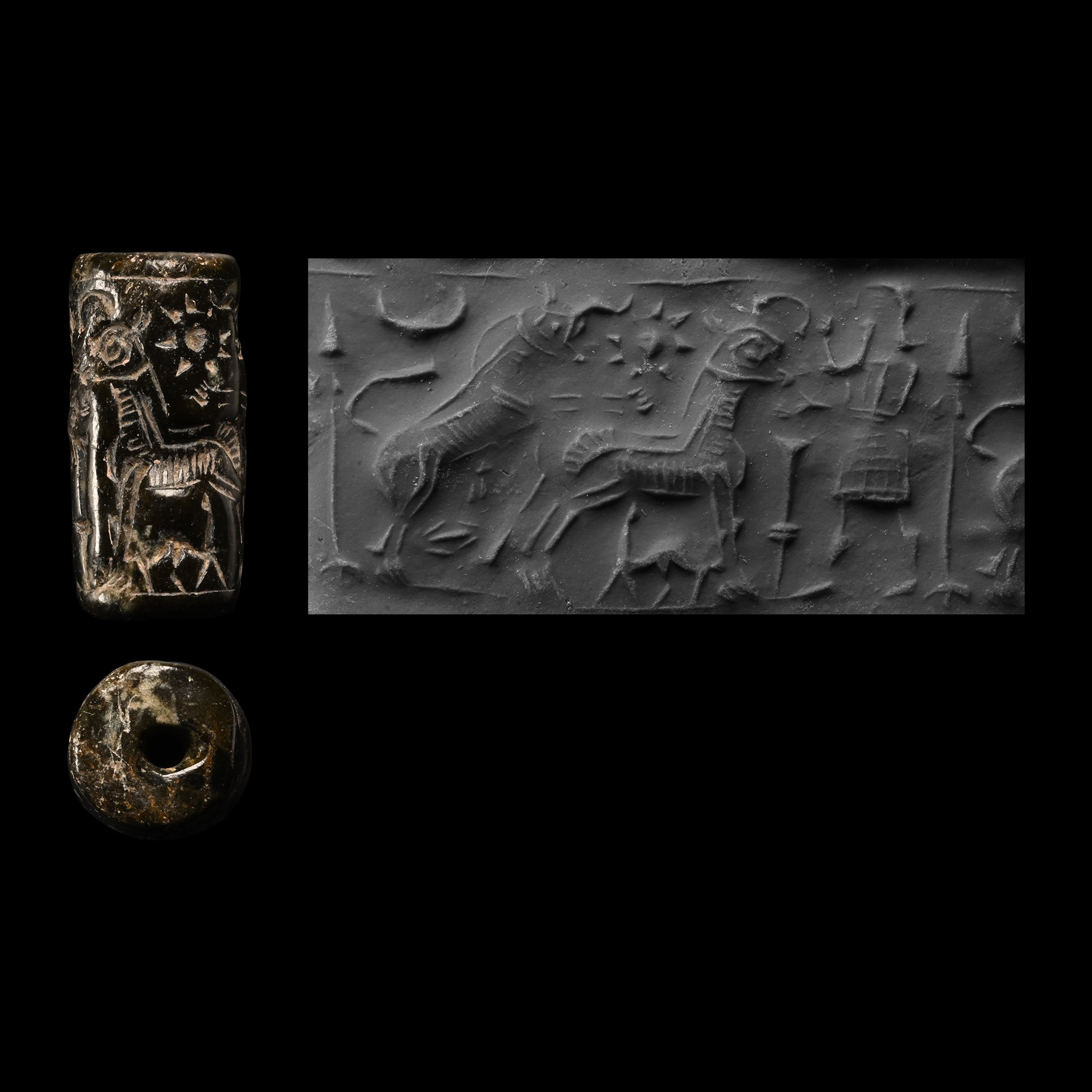
Neo-Assyrian Black Stone Cylinder Seal with Bull and Cow
CIRCA 900-700 B.C.
1 in. (5.28 grams, 23 mm).
Accompanied by a copy of an old scholarly note, typed and signed by W.G. Lambert, late Professor of Assyriology, University of Birmingham, 1970-1993, which states: 'Cylinder Seal of Black Stone 22.5 x 12mm. The design, which is put between upper and lower rulings, shows a mounting a cow from behind as it suckles its young. A farmer stands in front holding out his hands. In the sky there is a lunar crescent and a solar disc. The stylus, symbol of the god Nabû, appears within the scene, and the spade of Marduk serves as a terminal. This is a Neo-Assyrian seal, c. 900-700 B.C. It is a rare type of Neo-Assyrian seal, but is somewhat worn.'; supplied with a museum-quality impression.
ProvenanceFrom the private collection of a North American lady, formed 1970s-early 1990s, with collection reference no.590/1.
Accompanied by a copy of a scholarly note, typed and signed by Professor Wilfrid George Lambert.
This lot has been cleared against the Art Loss Register database, and is accompanied by an illustrated lot declaration signed by the Head of the Antiquities Department, Dr Raffaele D'Amato.
TimeLine Auctions follows a vetting process to ensure the authenticity and legality of all items, reinforcing our commitment to integrity and responsible trading. Each antiquity, antique, and coin lot undergoes thorough examination by a vetting committee of at least ten external specialists, professional trade association members, scientists, and archaeologists: Our Vetting Process
AUCTIONS:
TimeLine is a leading auction house specialising in antiquities, ancient art, collectables, natural history, coins, medals, and books. Our auctions offer museums, collectors, historians, and enthusiasts the opportunity to acquire unique and historically significant pieces.
LOT 1201
Neo-Assyrian Black Stone Cylinder Seal with Bull and Cow
Sold for (Inc. bp): £260
-
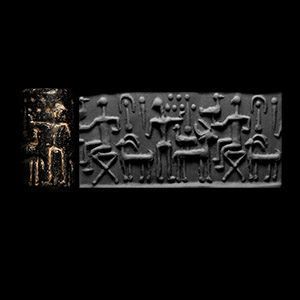
Anatolian Black Stone Cylinder Seal with Seated Deity
Circa 1200-1000 B.C.Sold for (Inc. bp): £442
Cylinder with cord and bead handles; accompanied by a copy of an old scholarly note, typed and signed by W.G. Lambert, late Professor of Assyriology, University of Birmingham, 1970-1993, which states: 'Cylinder seal of soft black stone, 29 x 16 mm. Condition fine. Seated deity with bird on wrist, facing horned quadruped with bird on hind quarters, standing human figure behind horned quadruped; fillers: seven dots, two swords(?), unidentified item. From North Syria or Anatolia, c. 1200-1000 B.C. The god holding the bird is probably the storm god, Teshub, though he could be known at this period by another name.'; supplied with a museum-quality impression. 14.7 grams, 28 mm
UK private collection, acquired 1980-1983. Accompanied by a copy of a scholarly note, typed and signed by Professor Wilfrid George Lambert in January 1989. This lot has been cleared against the Art Loss Register database, and is accompanied by an illustrated lot declaration signed by the Head of the Antiquities Department, Dr Raffaele D'Amato. -
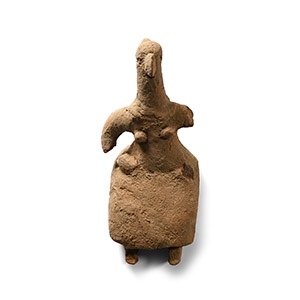
Chalcolithic Seated Terracotta Figure
3rd millennium B.C.Estimate: £300 - 400 (+bp*)
Opening Bid: £150
Modelled in the round seated figure with looped arms and applied collar, pinched nose. 128 grams, 13 cm high
Ex important collection of a late gentleman, 1980s. This lot has been cleared against the Art Loss Register database, and is accompanied by an illustrated lot declaration signed by the Head of the Antiquities Department, Dr Raffaele D'Amato. -
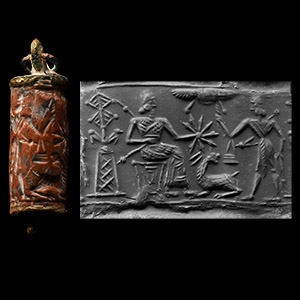
Levantine Jasper Cylinder Seal with Figures
Circa 1000-500 B.C.Sold for (Inc. bp): £1,430
Accompanied by a copy of an old scholarly note, typed and signed by W.G. Lambert, late Professor of Assyriology, University of Birmingham, 1970-1993, which states: 'Cylinder Seal of Red Stone with some Black and White Patches, 36 x15 mm., held in Ancient Bronze Mount with Ring, Total Height: 53 mm. The design shows two figures, the one on the left seated on a stool narrower at floor level than at the seat, he has a bare head, wears clothing down to his ankles, holds a mace in the right hand, a second mace projects above his shoulders, while in his left hand there is a revolving weapon (a sling?). Facing him is a standing figure with clothes to the knees, holding up an unidentified small object in his right hand, holding down a mace in the left hand. Something is suspended by a cord from his extended elbow, and a bow is attached to his shoulders. Between the two figures is a recumbent feline with head turned back. In the sky there is a winged solar disc. For a terminal there is an elaborate stand supporting what is apparently a divine standard. The whole design is put between upper and lower rules. This is a Levantine seal dating to c. 1000-500 B.C. of an extremely rare type. The closest parallel is a cylinder seal in the Louvre, L. Delaporte, Musee du Louvre, Catalogue des Cylindres Orientaux II (1923) A 958, found at Neirab, near Aleppo. The two figures owe something to Old Babylonian seals, the revolving weapon and the dress of the standing figure. The feline, however, and the general 'feel' of the piece are clearly of later and more westerly origin. This is an important piece for its size and rarity; supplied with a museum-quality impression. 20.4 grams, 58 mm
From the private collection of a North American lady, formed 1970s-early 1990s, with collection reference no.P9. Accompanied by a copy of a scholarly note, typed and signed by Professor Wilfrid George Lambert dated June 1992. This lot has been cleared against the Art Loss Register database, and is accompanied by an illustrated lot declaration signed by the Head of the Antiquities Department, Dr Raffaele D'Amato.
