
Loading, please wait...
_900x900.jpg "Near Eastern Terracotta Vessel of an Ox")
_200x200.jpg "Near Eastern Terracotta Vessel of an Ox")
.jpg "Near Eastern Terracotta Vessel of an Ox")
LOT 1248
Near Eastern Terracotta Vessel of an Ox
10TH-9TH CENTURY B.C.
6 1/2 in. (522 grams, 16.5 cm long).
Hollow-formed model bull with funnel between the shoulders, applied ropework halter to the neck (part absent), traces of pigment.
ProvenanceShlomo Moussaieff collection, Herzliya Pituah, Israel.
European private collection.
TimeLine Auctions follows a vetting process to ensure the authenticity and legality of all items, reinforcing our commitment to integrity and responsible trading. Each antiquity, antique, and coin lot undergoes thorough examination by a vetting committee of at least ten external specialists, professional trade association members, scientists, and archaeologists: Our Vetting Process
AUCTIONS:
TimeLine is a leading auction house specialising in antiquities, ancient art, collectables, natural history, coins, medals, and books. Our auctions offer museums, collectors, historians, and enthusiasts the opportunity to acquire unique and historically significant pieces.
-
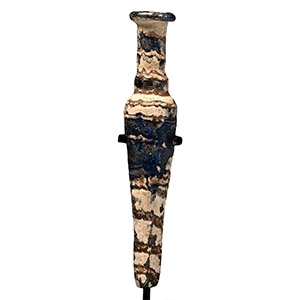
Achaemenid Glass Flask
Circa 5th century B.C.Sold for (Inc. bp): £468
Comprising a tapering square-section body, square base and rounded shoulders; dragged trail ornament to each face narrow neck and everted rolled rim; mounted on a custom-made stand. 76 grams total, 14.6 cm including stand
From an important collection of glass, London, UK, 1990s. -
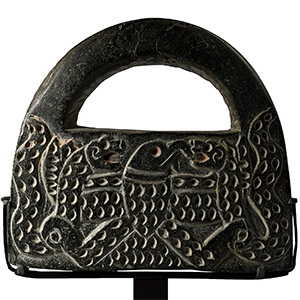
Bactrian Black Chlorite 'Hand Bag' Ceremonial Weight
3rd millennium B.C.Sold for (Inc. bp): £9,750
D-shaped in profile with void below the curved edge, obverse with reserved serpent and lion opposed, the lion's claw grasping the serpent; reverse with spread eagle flanked by rearing serpents; all bodies with sockets to accept coloured inserts; mounted on a custom-made stand. 2.95 kg total,18.5 cm (22.5 cm including stand)
with Gallery Rosen Ancient Art, Tel Aviv, 1960s. Ex London, UK, gallery, 1971-early 2000s. London, UK, collection. This lot has been checked against the Interpol Database of stolen works of art and is accompanied by a search certificate no.12774-237878.
The object could have been carried or swung in ceremonies or processions. On one side is a bird of prey, with its claws surrounded by the writhing bodies of two serpents, whose heads flank the bird's head. This symmetrical scheme probably renders a version of the enmity of eagle and serpent, which must have been an important theme of ancient Iranian art; the motif was later diffused throughout the world. -
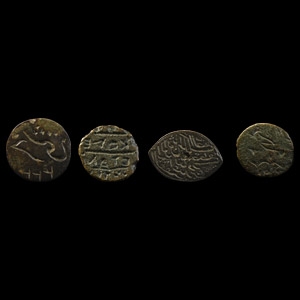
Western Asiatic Bronze Seal Matrix Group
17th-18th century A.D.Sold for (Inc. bp): £59
Comprising four seal matrices, each with an inscribed matrix. 14 grams total, 19.6-25.3 mm
Ex German art market, 2000s. Acquired from an EU collector living in London. From the collection of a Surrey, UK, gentleman.
