
Loading, please wait...
LOT 2208
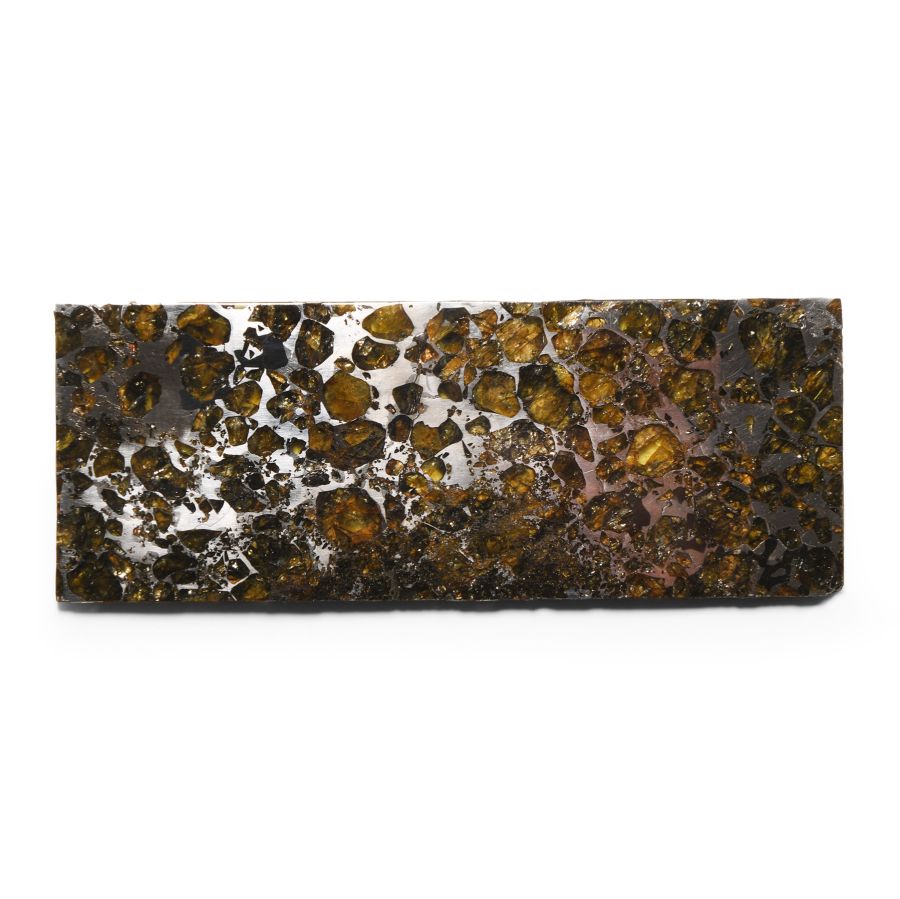
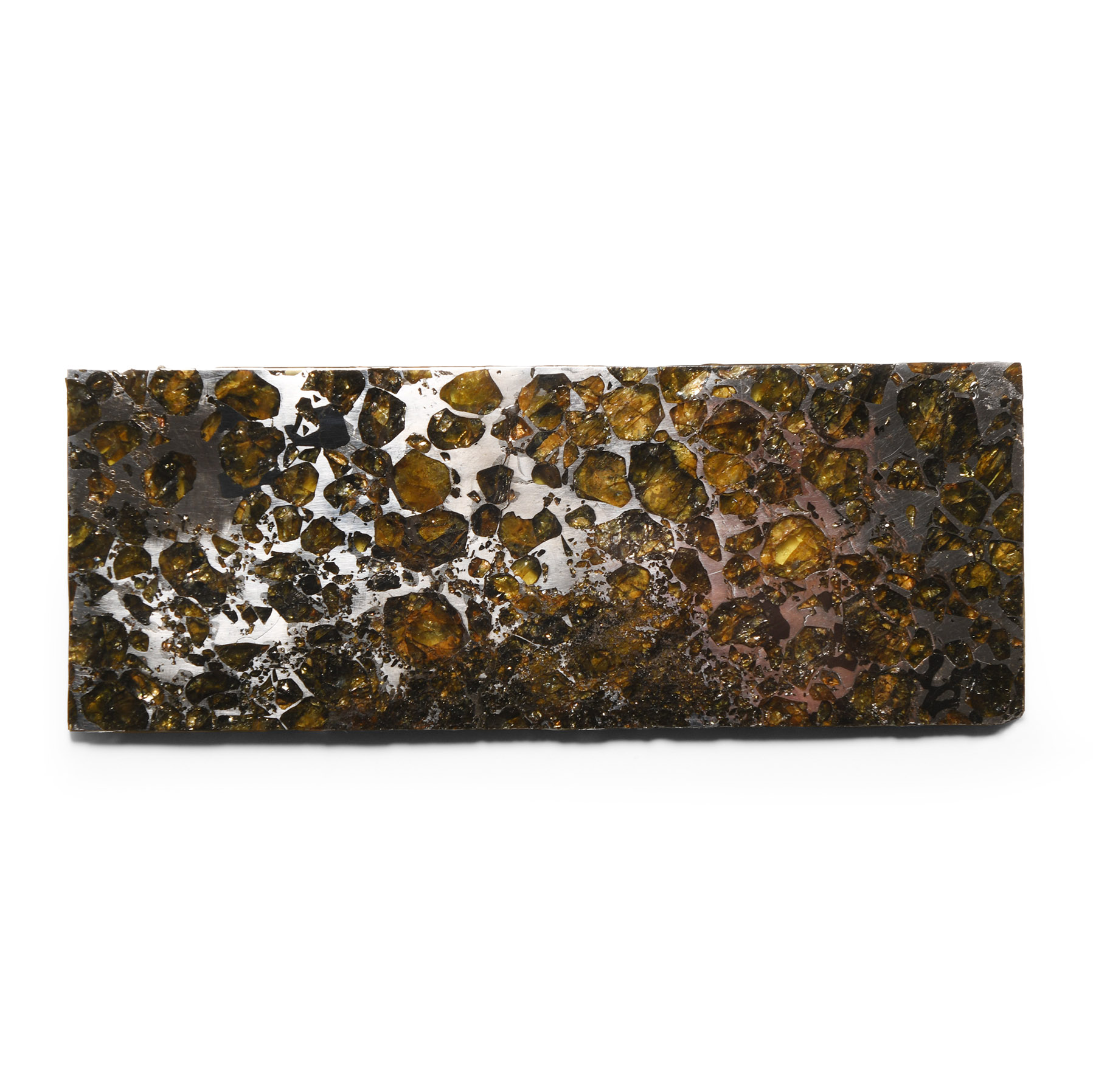
Natural History - Polished Seymchan Meteorite Slab
FOUND JUNE 1967 A.D.
4 3/4 in. (62.4 grams, 12 cm).
A highly polished rectangular slice of the Seymchan meteorite with an exceptional number of transparent olivine inclusions, repaired. [No Reserve]
ProvenanceFrom the private collection of a London gentleman, from his grandfather's collection formed before the early 1970s.
LiteratureSee Graham, A.L., Bevan, A.W.R. & Hutchison, R., Catalogue of Meteorites, London, 1985, p.323; report of geologist F. A. Mednikov (Magadan, USSR) in a letter, VIII 15, 1967 and of V. 1. Zvetkov (Moscow, USSR) in a letter X 17, 1967; see also Meteoritical Bulletin No.43, Moscow (1968) and database.
FootnotesThe main mass of 272.3 kilograms was found during a survey in June 1967 by geologist F. A. Mednikov. The mass was a triangular-shaped thumb printed meteorite lying among the stones of the brook bed. A second specimen of 51 kilograms was found with a mine detector at a distance of 20 meters from the first in October 1967 by I. H. Markov. During a new expedition in 2004, Dmitri Kachalin recovered about 50 kilograms of new material. Remarkably, about 20% of the new specimens were found to contain olivine crystals, and so revealed the silicate nature of the meteorite. The pallasitic structure was not previously discovered during studies on small metal-only sections of the original mass. The distortion of the Widmanstatten patterns is interpreted as shearing of the superheated meteorite as it broke up in the Earth's atmosphere.
CONDITIONTimeLine Auctions follows a vetting process to ensure the authenticity and legality of all items, reinforcing our commitment to integrity and responsible trading. Each antiquity, antique, and coin lot undergoes thorough examination by a vetting committee of at least ten external specialists, professional trade association members, scientists, and archaeologists: Our Vetting Process
AUCTIONS:
TimeLine is a leading auction house specialising in antiquities, ancient art, collectables, natural history, coins, medals, and books. Our auctions offer museums, collectors, historians, and enthusiasts the opportunity to acquire unique and historically significant pieces.
-
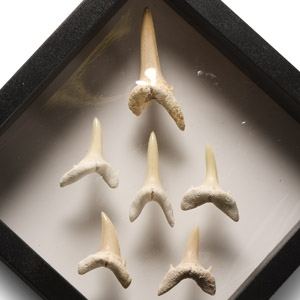
Natural History - Sand Shark Tooth Display
Eocene Period, circa 70-50 million years B.P.Sold for (Inc. bp): £3
Comprising six extinct sand shark teeth; supplied in a display frame. 4.12 grams total, 19-33 mm (40 grams total, 13 cm high including case)
From a Norfolk, UK, collection. Property of a Cambridgeshire, UK, gentleman. -
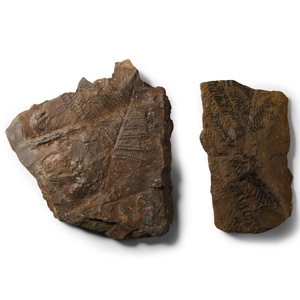
Natural History - Fossil Permian Plants and Ferns on Matrix
Permian Period, 298-252 million years B.P.Sold for (Inc. bp): £33
Comprising two irregular matrices, each with multiple plant and fern fossils. 318 grams total, 10.6-20 cm
From Saxony, Germany. From a Cambridgeshire, UK, collection. Property of a Cambridgeshire, UK, gentleman. -
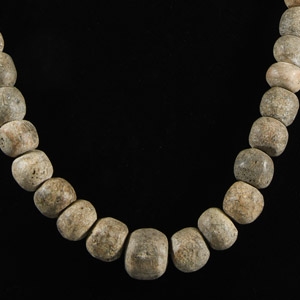
Natural History - Woolly Mammoth Bone Bead Necklace String
Devensian Period, 110,000-12,000 years B.P.Sold for (Inc. bp): £85
Restrung using recently polished Mammuthus primigenius bone beads. 182 grams total, 64 cm long
Ex London collection, 2000s.
