
Loading, please wait...
_900x900.jpg "Natural History - Polished Goniatite Jewellery Box")
_200x200.jpg "Natural History - Polished Goniatite Jewellery Box")
.jpg "Natural History - Polished Goniatite Jewellery Box")
LOT 2657
Natural History - Polished Goniatite Jewellery Box
DEVONIAN PERIOD, CIRCA 417-354 MILLION YEARS B.P.
5 x 2 7/8 in. (646 grams, 12.6 x 7.3 cm).
A rectangular lidded jewellery or trinket box, polished and cut from a single block containing multiple Goniatite sp. and other fossil specimens. [No Reserve]
ProvenanceFrom Morocco, North Africa.
From a Cambridgeshire, UK, collection.
TimeLine Auctions follows a vetting process to ensure the authenticity and legality of all items, reinforcing our commitment to integrity and responsible trading. Each antiquity, antique, and coin lot undergoes thorough examination by a vetting committee of at least ten external specialists, professional trade association members, scientists, and archaeologists: Our Vetting Process
AUCTIONS:
TimeLine is a leading auction house specialising in antiquities, ancient art, collectables, natural history, coins, medals, and books. Our auctions offer museums, collectors, historians, and enthusiasts the opportunity to acquire unique and historically significant pieces.
-
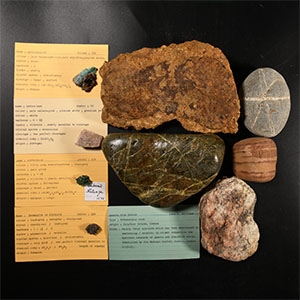
Natural History - Mixed Mineral Specimen Group
Sold for (Inc. bp): £46
Comprising: quartz mica schist from Skiathos Island, Greece, collection number 515; orthoclase from Portugal, collection number 20; aurichalcite from Mexico, collection number 451; torbernite from Katanga, Congo, collection number 478; kermesite on stibnite from Romania, collection number 436; and four larger mineral samples. 3.5 kg total, 2-18 cm
Acquired on the UK mineral and fossil market, since 1970. From the historic mineral collection of Richard Valentine Cain, London, UK, thence by descent. Five specimens accompanied by an original historic index file card. -
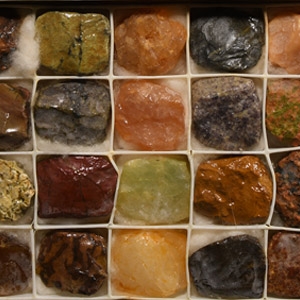
Natural History - 'Gem & Rock Centre, Zimbabwe' Mineral Specimen Sample Collection
Sold for (Inc. bp): £59
Supplied in the original box with typed label, comprising: calcrete, serpentine, yellow fluorspar, banded jasper, pink dolomite, rainbow jasper, pyrite, rose quartz, lipidolite, unakite, paisley agate, coral jasper, aventuring, yellow fire jasper; grey granite, carnelian, zebra jasper, white quartz silica, petrified wood and pink limestone. 300 grams total, 15 x 12 cm including box
Acquired on the UK mineral and fossil market, since 1970. From the historic mineral collection of Richard Valentine Cain, London, UK, thence by descent. -
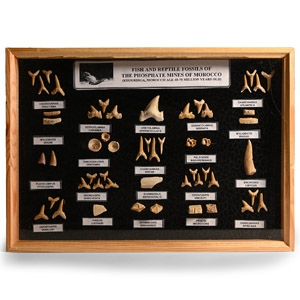
Natural History - Mixed Fossil Shark and Fish Teeth Display
Cretaceous-Eocene Period, 70-45 million years B.P.Sold for (Inc. bp): £65
A glazed display case with mounted specimens of various teeth, vertebrae and ray palates, with identifying labels. 916 grams, 34.6 x 24.5 cm
From a Cambridgeshire, UK, collection.
