
Loading, please wait...


LOT 2731
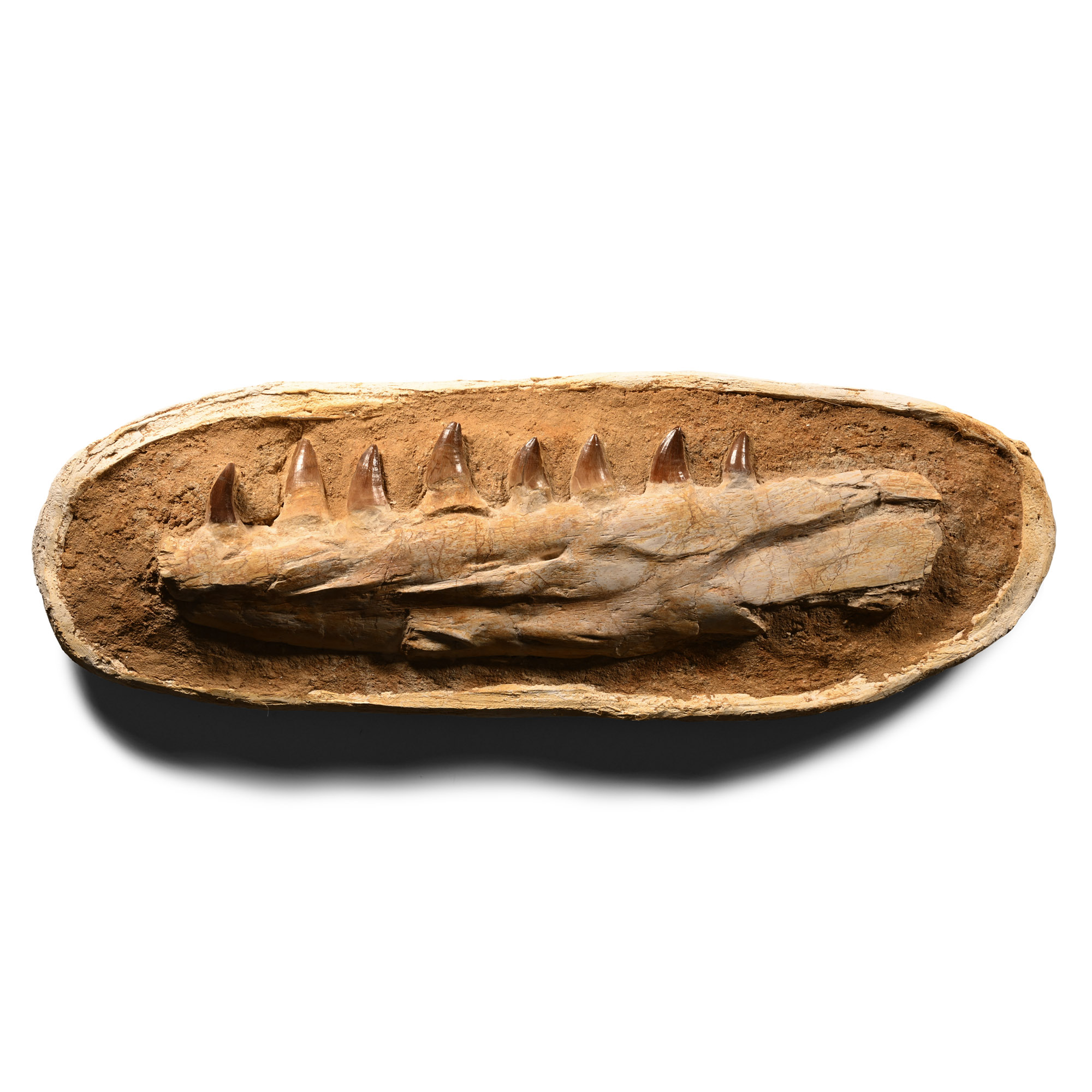
Natural History - Fossil Mosasaur 'Marine Dinosaur' Jaw on Composite Matrix
CRETACEOUS PERIOD, 145-65 MILLION YEARS B.P.
19 in. (2.32 kg, 48 cm).
A large section of Mosasaur prognathodon jaw with eight teeth, set in a composite matrix with applied plaster reinforcement.
ProvenanceFrom a Cambridgeshire, UK, collection.
FootnotesThe Mosasaur is an extinct, large marine reptile dinosaur with a snake-like body, long snout and paddle-like limbs. found worldwide, they competed with other well-known sea predators of the Late Cretaceous, such as plesiosaurs and ichthyosaurs, for food, existing primarily on a diet of ammonoids, cuttlefish and fish.
CONDITIONTimeLine Auctions follows a vetting process to ensure the authenticity and legality of all items, reinforcing our commitment to integrity and responsible trading. Each antiquity, antique, and coin lot undergoes thorough examination by a vetting committee of at least ten external specialists, professional trade association members, scientists, and archaeologists: Our Vetting Process
AUCTIONS:
TimeLine is a leading auction house specialising in antiquities, ancient art, collectables, natural history, coins, medals, and books. Our auctions offer museums, collectors, historians, and enthusiasts the opportunity to acquire unique and historically significant pieces.
LOT 2731
Natural History - Fossil Mosasaur 'Marine Dinosaur' Jaw on Composite Matrix
Sold for (Inc. bp): £338
-
.jpg)
Natural History - Polished Copal Pair with Insects
Over 3 million years B.P.Sold for (Inc. bp): £39
Comprising two polished specimens containing several insects and other inclusions. 39 grams total, 7.8-11.2 cm
From Madagascar. Acquired 1950s-1960s. From an old Bristol, UK, palaeontological collection. -
Natural History - Historic Collection of Mineral Specimens
Sold for (Inc. bp): £39
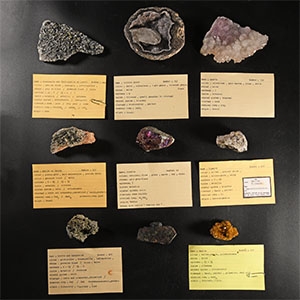
Comprising: bismuth from Czechoslovakia, collection number 417; barite from Colorado, USA, collection number 570; pyrite on baryte from Brazil, collection number 122; bournonite and chalcopyrite on quartz from Peru, collection number 442; bornite from Mexico, collection number 62; pyrite and sphalerite from Silvermine, Tipperary, Ireland, collection number 413; cut calcite geode half from Brazil, collection number 247; chalcopyrite from North Transvaal, South Africa, collection number 193; quartz from Brazil, collection number 114. 1.57 kg total, 4.9-11 cm
Acquired on the UK mineral and fossil market, since 1970. From the historic mineral collection of Richard Valentine Cain, London, UK, thence by descent. Eight specimens accompanied by an original historic index file card. -
.jpg)
Natural History - Large British Pleuroceras Fossil Ammonite Multi Display
Jurassic Period, circa 180-178 million years B.P.Sold for (Inc. bp): £390
Showing specimens of Pleuroceras paucicostatum or Pleuroceras hawskerensefossil ammonites in a matrix, together with other inclusions; accompanied by a display stand. 2.4 kg, 17 cm
From Hawsker, North Yorkshire, UK.
