
Loading, please wait...
.JPG_900x900.jpg "Natural History - Carbonaceous CK 4/5 NWA 4026 Meteorite Slice")
.JPG_200x200.jpg "Natural History - Carbonaceous CK 4/5 NWA 4026 Meteorite Slice")
.JPG_900x900.jpg "Natural History - Carbonaceous CK 4/5 NWA 4026 Meteorite Slice")
.JPG_200x200.jpg "Natural History - Carbonaceous CK 4/5 NWA 4026 Meteorite Slice")
.JPG "Natural History - Carbonaceous CK 4/5 NWA 4026 Meteorite Slice")
.JPG "Natural History - Carbonaceous CK 4/5 NWA 4026 Meteorite Slice")
LOT 2582
Natural History - Carbonaceous CK 4/5 NWA 4026 Meteorite Slice
FOUND 2005 A.D.
1 5/8 in. (3 7/8 x 3 in.) (12.1 grams, 41 mm (67 grams total, 99 x 75 mm including case)).
A cut end section of carbonaceous chondrite recorded as: Northwest Africa 4026; displayed in a Swiss membrane box, inked 'NWA 4026' to one side. [No Reserve]
ProvenanceFrom Morocco/Algeria.
Ex Hanno Strufe Meteorites, Germany.
From a Leicestershire, UK, collection.
Accompanied by an original identification card.
TimeLine Auctions follows a vetting process to ensure the authenticity and legality of all items, reinforcing our commitment to integrity and responsible trading. Each antiquity, antique, and coin lot undergoes thorough examination by a vetting committee of at least ten external specialists, professional trade association members, scientists, and archaeologists: Our Vetting Process
AUCTIONS:
TimeLine is a leading auction house specialising in antiquities, ancient art, collectables, natural history, coins, medals, and books. Our auctions offer museums, collectors, historians, and enthusiasts the opportunity to acquire unique and historically significant pieces.
LOT 2582
Natural History - Carbonaceous CK 4/5 NWA 4026 Meteorite Slice
Sold for (Inc. bp): £65
-
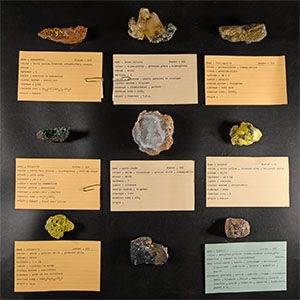
Natural History - Historic Mineral Specimen Collection
Sold for (Inc. bp): £39
Comprising: scolecite from Peru, collection number 437; granite from the A40 construction works, Middlesex, England, collection number 507; sulphur from Mexico, collection number 65; chalcopyrite, collection number 317; green calcite from Missouri, USA, collection number 241, with old James Walker label and invoice dated 1977; legrandite from Mexico, collection number 490, with an old Gregory, Bottley & Lloyd label; malachite from Tsumeb, South West Africa, collection number 448, with an old Gregory, Bottley & Lloyd label; bornite on chalcopyrite, collection number 210; agate geode half, collection number 385. 675 grams total, 37-74 mm
Acquired on the UK mineral and fossil market, since 1970. From the historic mineral collection of Richard Valentine Cain, London, UK, thence by descent. Eight specimens accompanied by an original historic index file card. -
.jpg)
Natural History - Large Fossil Ammonite
Jurassic Period, Toarcian Stage, circa 180 million years B.P.Sold for (Inc. bp): £20
Hildoceras sp. in an irregular matrix nodule. 1.34 kg total, 10.5-11.5 cm
From Whitby, UK. From a Lincolnshire, UK, collection. -
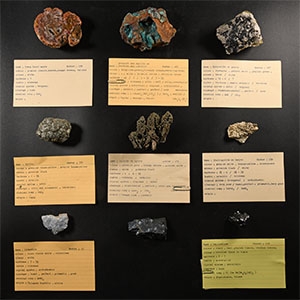
Natural History - Historic Mineral Specimen Collection
Sold for (Inc. bp): £39
Comprising: botryoidal psilomelane from Stanislawow, Poland, collection number 608, with an old Geologisch Centrum, Netherlands, label; rosasite and calcite on goethite and limonite from Mapimi, Durango, Mexico, collection number 61; sphalerite on quartz, collection number 187; pyrite from Italy, collection number 339; a cut and polished crazy laced agate nodule, collection number 299; chalcopyrite on baryte, collection number 238; celestine from Malagasy Republic, Africa, collection number 29; calcite on pyrite from Levant Mine, Cornwall, England, collection number 474; calcite from England, collection number 102. 1 kg total, 36-89 mm
Acquired on the UK mineral and fossil market, since 1970. From the historic mineral collection of Richard Valentine Cain, London, UK, thence by descent. Eight specimens accompanied by an original historic index file card.
