
Loading, please wait...
_900x900.jpg "Multi-Coloured Glass Bead Necklace Collection")
_200x200.jpg "Multi-Coloured Glass Bead Necklace Collection")
.jpg "Multi-Coloured Glass Bead Necklace Collection")
LOT 2135
Multi-Coloured Glass Bead Necklace Collection
20TH CENTURY A.D.
20 - 33 1/2 in. (117 grams total, 51-85 cm long).
Consisting of ten restrung necklaces of varying lengths, most composed of blue glass beads, including examples with polychrome decoration. [10]
ProvenanceUK gallery, early 2000s.
CONDITIONTimeLine Auctions follows a vetting process to ensure the authenticity and legality of all items, reinforcing our commitment to integrity and responsible trading. Each antiquity, antique, and coin lot undergoes thorough examination by a vetting committee of at least ten external specialists, professional trade association members, scientists, and archaeologists: Our Vetting Process
AUCTIONS:
TimeLine is a leading auction house specialising in antiquities, ancient art, collectables, natural history, coins, medals, and books. Our auctions offer museums, collectors, historians, and enthusiasts the opportunity to acquire unique and historically significant pieces.
-
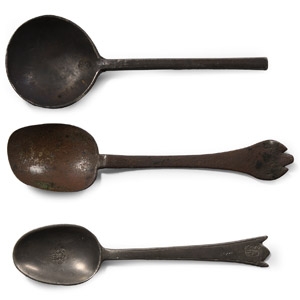
Jacobean and Later 'Published' Bronze and Pewter Spoon Collection
17th-early 18th century A.D.Sold for (Inc. bp): £111
Comprising: one with rectangular bowl flat handle with tulip finial; one with oval bowl and stamped motif to bowl and upper handle; one with shallow disc bowl, hexagonal-section handle, maker's mark inside the bowl. 173 grams total, 17-18.6 cm
From the collection of the famous author, writer and speaker, Gordon Bailey, Essex, UK; formed since 1968. -
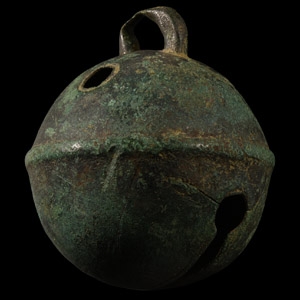
Large Post Medieval Bronze Crotal Bell
19th century A.D. or earlierSold for (Inc. bp): £46
Spherical crotal, rumbler or 'hame harness' bell with suspension loop and two tone holes to upper half with founder's initials 'Ro / W' for Robert Wells of Aldbourne Foundry, Wiltshire; with the original iron 'pea' inside. 203 grams, 71 mm
Acquired on the UK art market. From the private collection of Mr G.B., Hampshire, UK.
Robert Wells made bells in sizes 1 to 32 and this example is near the largest ever produced. These massive bells were usually fitted to a team bell frame, set across the harness collar; Robert Wells was active in the period 1760-1780. -
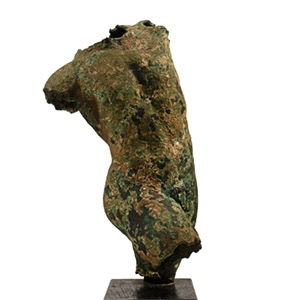
Bronze Torso of an Athlete
Late 19th-early 20th century A.D.Sold for (Inc. bp): £715
In Roman style, modelled nude in the contrapposto position with defined musculature; mounted on a custom-made display stand. 4.15 kg total, 40 cm high including stand
French private collection, likely from the early 20th century, as indicated by the wooden stand.
