
Loading, please wait...


LOT 2396
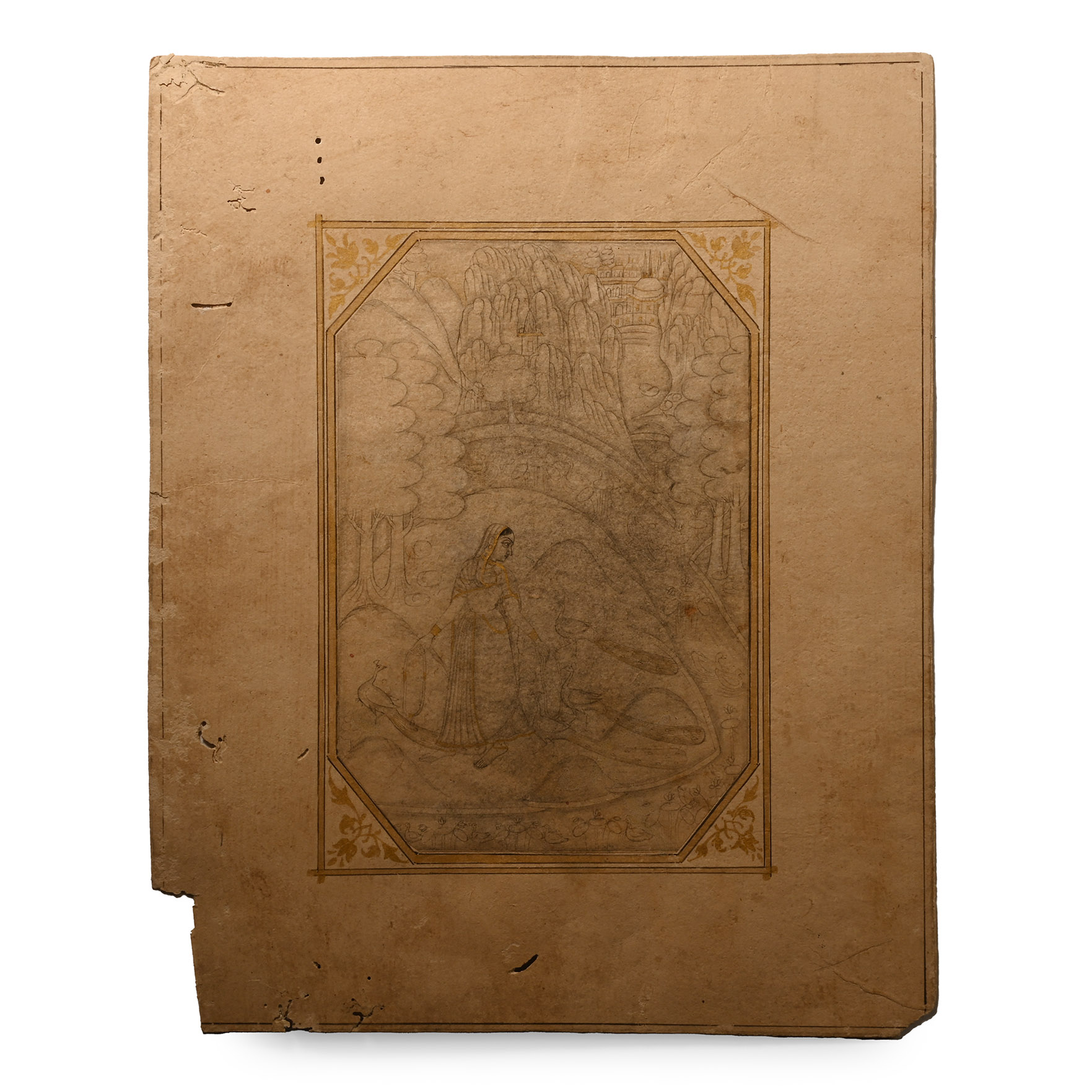
Mughal Drawing of a Princess with Peacocks
CIRCA 1780-1800 A.D.
10 1/4 x 8 1/4 in. (19 grams, 26.2 x 21 cm).
Rectangular card with inked border and reveal, liquid gold border with flower and tendril motif to each corner; detailed scene with a princess in the foreground advancing left but looking right towards three peacocks following her; in each of her hands a cord with a bell; waterway extending from centre to right edge and returning across lower edge, with waterlilies and other vegetation, swans (right) and ducks (top); to the rear, a group of trees, and another at right beyond the waterway; at the middle top, trees, rocky hills and a city in the distance; liquid gold to the princess's outer garments, black ink outline to her hair and face.
ProvenanceAcquired on the UK art market.
Scottish private collection.
TimeLine Auctions follows a vetting process to ensure the authenticity and legality of all items, reinforcing our commitment to integrity and responsible trading. Each antiquity, antique, and coin lot undergoes thorough examination by a vetting committee of at least ten external specialists, professional trade association members, scientists, and archaeologists: Our Vetting Process
AUCTIONS:
TimeLine is a leading auction house specialising in antiquities, ancient art, collectables, natural history, coins, medals, and books. Our auctions offer museums, collectors, historians, and enthusiasts the opportunity to acquire unique and historically significant pieces.
-
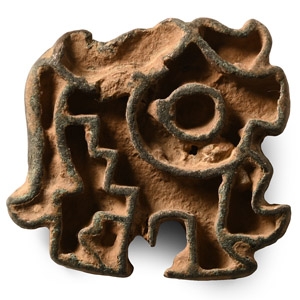
West Central Asian Stamp Seal with Quadruped
23rd-20th century B.C.Sold for (Inc. bp): £221
Zoomorphic stamp seal with loop handle to the reverse; accompanied by an old scholarly note, typed and signed by W.G. Lambert, late Professor of Assyriology, University of Birmingham, 1970-1993, which states: 'Stamp Seal of Bronze 38x38x12 mm. This bears the shape of the object depicted, with flat face and flat back, on which is mounted a handle of sheet metal with thickened edges. The design, which is compartmented, shows a standing quadruped with big snout and long tail hanging down the back. This comes from west central Asia and dates to c. 2300-2000 B.C. The upper part is bent back and is a little damaged, but generally this is in good condition and is a rare type. The metal is sound.' 26 grams, 41 mm
Ex Signo collection, the property of a West London businessman, formed in the late 1980s-early 1990s; collection number U-17, academically researched and catalogued by the late Professor Lambert in the early 1990s. -
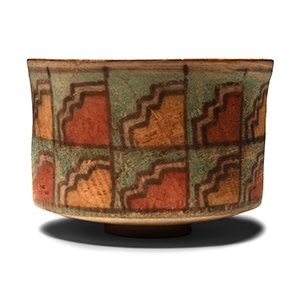
Indus Valley Painted Pottery Bowl
3rd millennium B.C.Sold for (Inc. bp): £1,430
Drum-shaped with gently carinated base and narrow foot, the outer body displaying polychrome painted panels with 'stairway' design. 77 grams, 86 mm
Acquired in 2003. Private collection, Europe. -
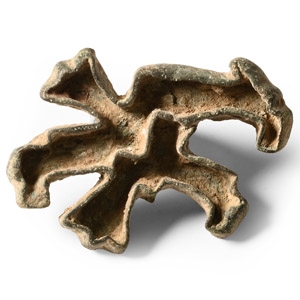
West Central Asian Stamp Seal with Eagle
23rd-20th century B.C.Sold for (Inc. bp): £247
Zoomorphic seal with V-shaped handle to the reverse; accompanied by an old scholarly note, typed and signed by W.G. Lambert, late Professor of Assyriology, University of Birmingham, 1970-1993, which states: 'Stam Seal of Bronze 45.5x38x19 mm. This has the shape of the items depicted, with flat face and flat back with handle of inverted V-shape mounted on it. The design is compartmented but not open-work and is divided into two compartments, one with three projections, the other with two. This comes from west central Asia and dates to c. 2300-2000 B.C. The ends of the projections have slight denting, but otherwise the object is in very good condition. Interpretation of the design is difficult, but each section appears to have one head of an eagle and one set of an eagle's tail feathers, as if two eagles are crossed, but there is still a difficulty with the third head. The design is extremely rare.' 20 grams, 45 mm
Ex Signo collection, the property of a West London businessman, formed in the late 1980s-early 1990s; collection number R-495, academically researched and catalogued by the late Professor Lambert in the early 1990s.
