
Loading, please wait...
_900x900.jpg "Monumental Roman Bronze Left Hand")
_200x200.jpg "Monumental Roman Bronze Left Hand")
_900x900.jpg "Monumental Roman Bronze Left Hand")
_200x200.jpg "Monumental Roman Bronze Left Hand")
_900x900.jpg "Monumental Roman Bronze Left Hand")
_200x200.jpg "Monumental Roman Bronze Left Hand")
.jpg "Monumental Roman Bronze Left Hand")
.jpg "Monumental Roman Bronze Left Hand")
.jpg "Monumental Roman Bronze Left Hand")
LOT 0148
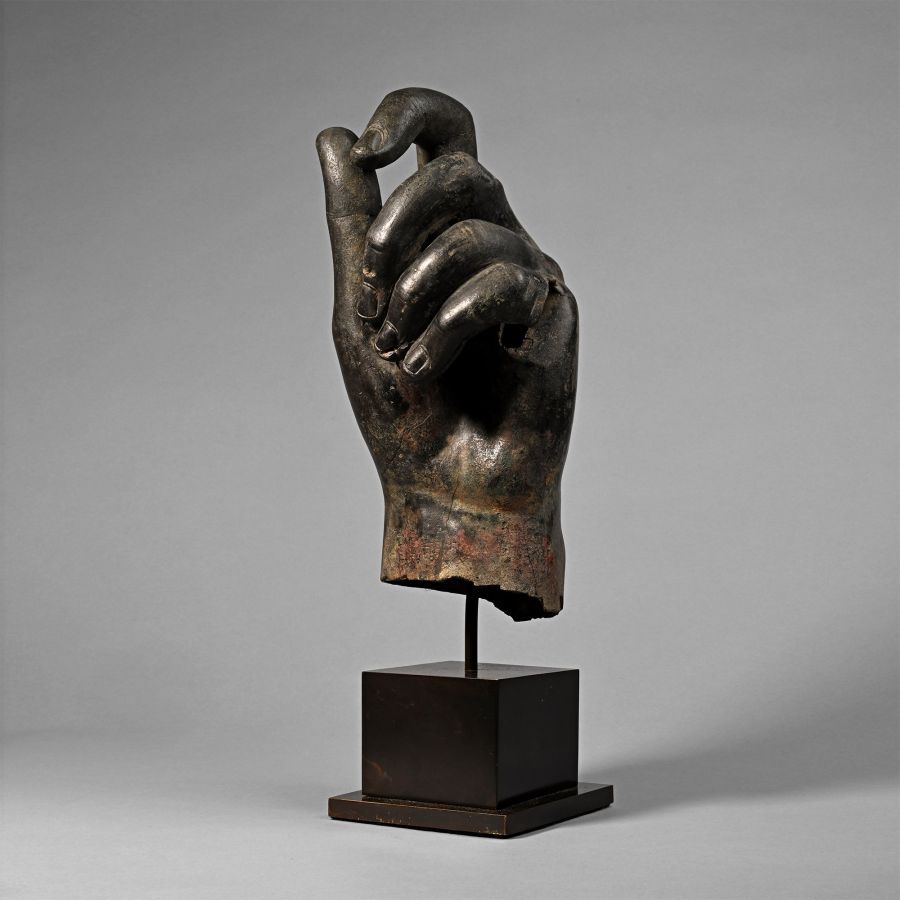
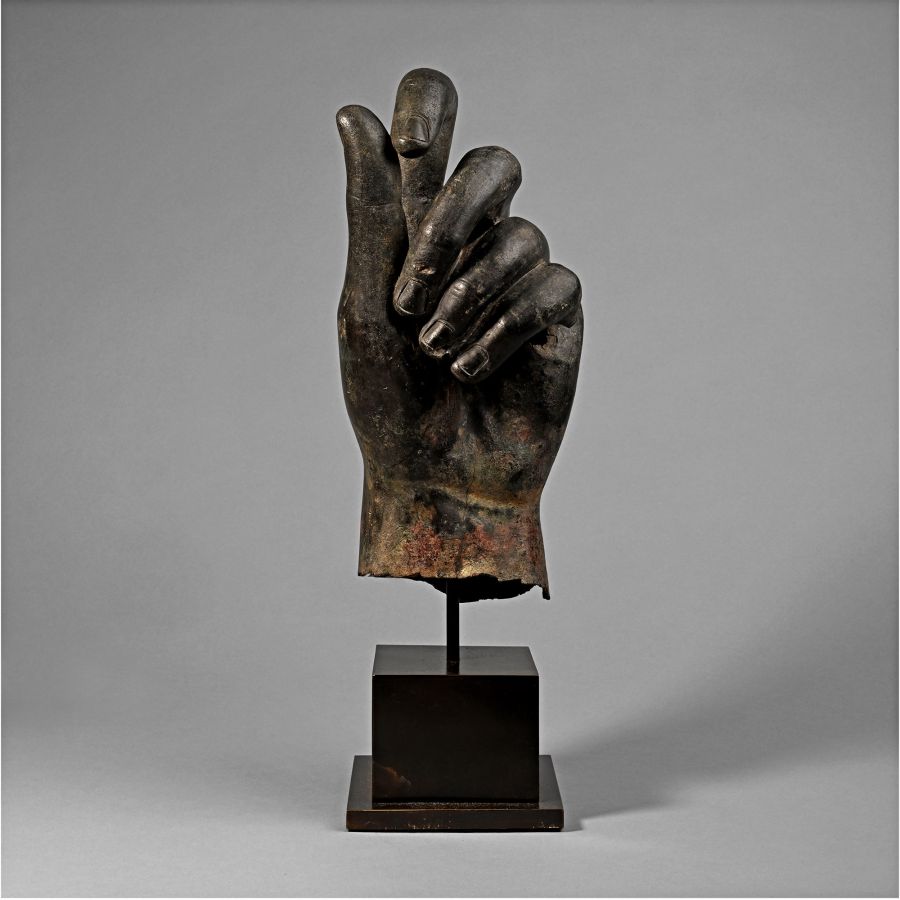
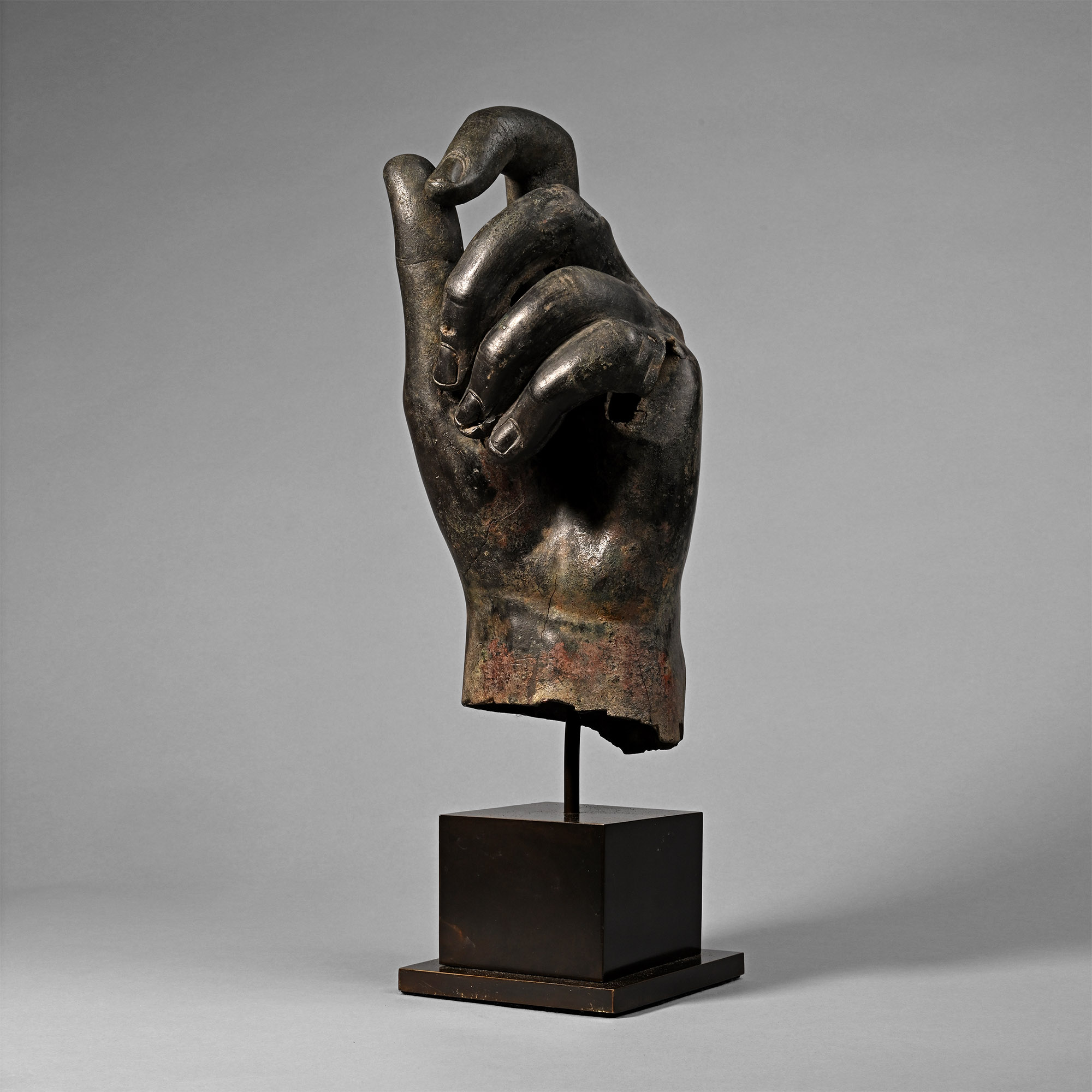
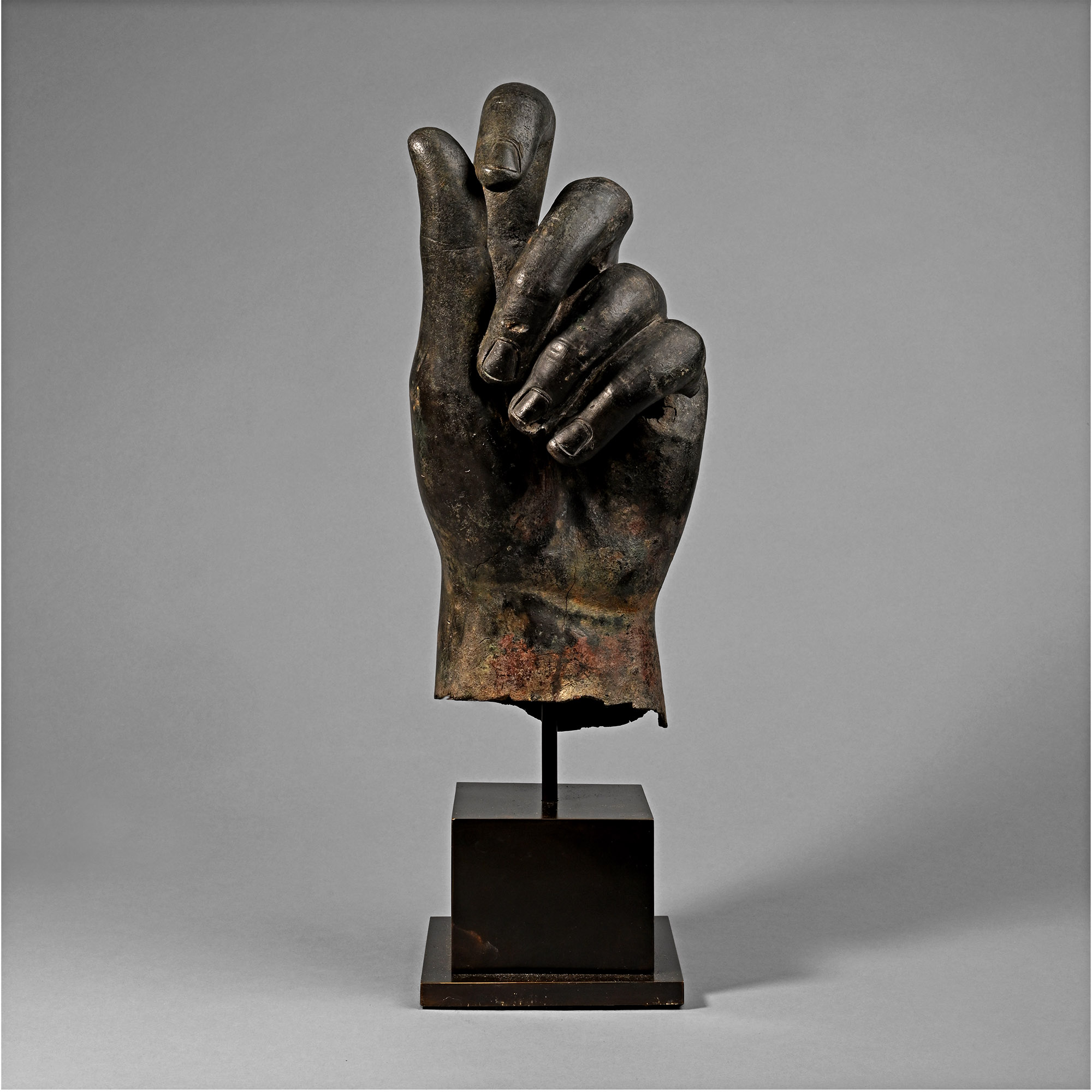
Monumental Roman Bronze Left Hand
CIRCA 2ND-3RD CENTURY A.D.
17 3/4 in. (4.75 kg total, 45 cm including stand).
A truly exceptional and imposing fragment, rendered with remarkable naturalism, the forefinger extended and gently bent, the thumb positioned for grip, and the remaining fingers elegantly curled inward, possibly from a life-sized statue of an emperor, magistrate or a general; presented on a custom-made display stand, the thumb and forefinger sympathetically restored.
ProvenanceEx Frits Phillips, Eindhoven, Netherlands, before 1980.
Private European collection, 1980s.
Private collection, London.
Accompanied by an academic report by Dr Raffaele D’Amato.
This lot has been checked against the Interpol Database of stolen works of art and is accompanied by a search certificate number no.12907-242493.
Cf. Russell, M., ‘Farewell two arms: a Roman bronze body part from Halnaker, West Sussex’ in Sussex Archaeological collections, 157, 2019, pp.125-132, for similar fragment; Formigli, E., 'La tecnica di costruzione delle statue di Riace' in Ministero dei Beni e delle attività culturali e del turismo, VI serie volume speciale, Roma, 1984, pp.107-142; Bol P. C., Antike Bronzetechnik, Monaco, 1985; Lahusen, G., Formigli, E., 'Ergebnisse der kunsthistorisch-technischen Analysen von zwei römischen Grossbronzen in den Museen des Vatikan', in BMonMusPont, VIII, 1988, pp.21-53; very similar to a bronze hand excavated in Netherlands in Voorburg in 1771, cf. Van Wijn, H., Historische en letterkundige avondstonden, 1800, II Vol. A4ff; for a possibly corresponding right hand see Christie's, New York Antiquities, Thursday 6 December 2007, New York, 2007, no.178.
FootnotesDuring the height of the Roman Empire, monumental bronze statues were not simply works of art; they were instruments of authority and prestige. By the 2nd and 3rd centuries A.D., Rome possessed the wealth and technical mastery to produce over life-sized figures in hollow bronze, a medium that required immense skill and resources. These statues were intended to impress and endure, often commemorating emperors, generals, and gods in a scale that placed them beyond the ordinary realm of mortals.
Such bronzes were used to dominate public spaces and convey imperial power. In forums, baths, and temples, the towering images of rulers reminded citizens of Rome’s strength and the divine favour said to rest upon its leaders. The famous equestrian statue of Marcus Aurelius in Rome is perhaps the best surviving example of this tradition; its imposing scale and lifelike rendering conveyed both the emperor’s authority and his humanity. Another renowned piece, the fragments of the colossal bronze statue of Constantine the Great, once stood in the heart of the capital and would have dwarfed viewers, embodying the emperor’s near-divine status. Even earlier examples, like the Bronze of Germanicus or the over life-sized bronzes of emperors found at sites such as Herculaneum, illustrate how these works were strategically placed to broadcast messages of victory and control.
Bronze was the perfect medium for such statements. Its ability to hold fine details gave these figures a vivid presence, while the sheer scale was designed to inspire awe. These statues were not simply commemorative; they were a visual language of power, cast in metal to endure beyond the individual and the age in which they were created.
TimeLine Auctions follows a vetting process to ensure the authenticity and legality of all items, reinforcing our commitment to integrity and responsible trading. Each antiquity, antique, and coin lot undergoes thorough examination by a vetting committee of at least ten external specialists, professional trade association members, scientists, and archaeologists: Our Vetting Process
AUCTIONS:
TimeLine is a leading auction house specialising in antiquities, ancient art, collectables, natural history, coins, medals, and books. Our auctions offer museums, collectors, historians, and enthusiasts the opportunity to acquire unique and historically significant pieces.
-
Roman Bronze Bust of Athena
1st century A.D. or laterSold for (Inc. bp): £293
Helmetted bust with segmented crest, braided collar with pendant; eyes with shallow sockets to accept glass inserts; mounting socket to reverse. 171 grams, 77 mm
London art market, 1999. Private collection, London, UK. -
.jpg)
Life-Size Roman Bronze Head of an Empress
Mid-3rd century A.D.Estimate: £40,000 - 60,000 (+bp*)
Opening Bid: £16,000
A member of the Imperial family, possibly an empress, depicted with an elaborate coiffure, the hair at the back of the head parted in the middle and the two strands folded over each other, then pulled to the front to form a looped horizontal layer parted in the middle of the smooth forehead and drawn back, individual curls represented as vertical lines along the forehead hairline up to the exposed ears, two locks hanging down the sides behind the ears, extending to the upper part of the neck; beautiful facial rendering with stoic expression, exquisite detailing to the eyebrows, eyelids and pupils; snub-nose, closed lips, thin and graceful neck; mounted on a custom-made display stand. 4.07 kg, 40.5 cm high including stand
Acquired on the German art market, early 1970s. German private family collection; by gift to the owner's son in 2015. Private collection, London. Accompanied by an academic report by Dr Raffele D'Amato, and Dr Marina Mattei, former curator of the Capitoline Museums for over 40 years. This lot has been checked against the Interpol Database of stolen works of art and is accompanied by a search certificate number no.12607-234556.
The mature age of the woman depicted in the portrait is revealed by the oval gaunt, deep-set eyes and the folds at the sides of the nose and mouth. The woman’s head shows the typical traits of the full and mature 3rd century A.D., executed in a Hellenistic style tradition. Our sculpture is well inserted in the imperial portrait type, bearing technical and aesthetical parallels to portraits in bronze. The hairstyle could be Scheitelzopf (or reverse plait), tightened by a hairnet, pinned to the top of the head. The same type of hairstyle, albeit with variations in the details (decorative curls and position of the hair loop), is found on a few other portraits of women that were dated to the Period of Gallienus by Marianne Bergmann. Some of the portraits in this typologically related group are likely to be private portraits. Hereby physiognomic features and especially imperial coin portraits need to be taken into account. In this context, it is important to compare the portrait with that of Trebonianus Gallus in the MET. Like the sculpture of Trebonianus Gallus, the head fits stylistically with Roman provincial bronzes from the Eastern Mediterranean or North Africa, possibly from workshops of Asia Minor or from the great metropolis of Alexandria, where bronze statuary was more common and Hellenistic influences remained strong. -
.jpg)
Late Roman Imperial Porphyry Fragment
4th-6th century A.D.Sold for (Inc. bp): £3,120
Formed as an irregular block with three possibly later polished sides, with the other three sides presenting a descending wall and two hollows carved in the upper and lower part; probably from an Imperial sarcophagus or monument; mounted on a custom-made stand. 10.55 kg, 31 cm including stand
Acquired from the private collection of a Somerset gentleman who was related to Sir Arthur Evans. From the private collection of a UK gentleman since before 2005.
For the Romans, porphyry was the Imperial marble par excellence, and from Constantine the Great until the end of the 5th century, but probably also later, it was used to create sarcophagi for the emperors and members of the Imperial families. This particular stone was connected with the Imperial family because of its red colour, recalling the violet and red shades of the purple (porphyra), the precious colour assigned only to emperors and their relatives. In Constantinople, a room of the Imperial palace was called Porphýra, located on one of the palace terraces overlooking the Sea of Marmara and the Bosphorus. It was perfectly square in shape with a pyramidal ceiling and was entirely covered in purple porphyry speckled with white dots: this was the room where the empresses gave birth to the heir of the Roman Empire, called Porphyrogénnētos, meaning ‘born in the purple room’. Porphyry was widely used for building churches in the Christian Empire, and Justinian exhausted the supplies from Egypt by building the Great Church of Hagia Sophia, where still today a great amount of this material can be seen. The impressive Imperial sarcophagi were kept in the Church of the Holy Apostles, as well as the great porphyry sarcophagus of Constantine the Great, of which only a small fragment survives today in the Archaeological Museum of Istanbul.
