
Loading, please wait...
_900x900.jpg "Monumental Egyptian Stone Head of a Pharaoh")
_200x200.jpg "Monumental Egyptian Stone Head of a Pharaoh")
.jpg "Monumental Egyptian Stone Head of a Pharaoh")
LOT 0014
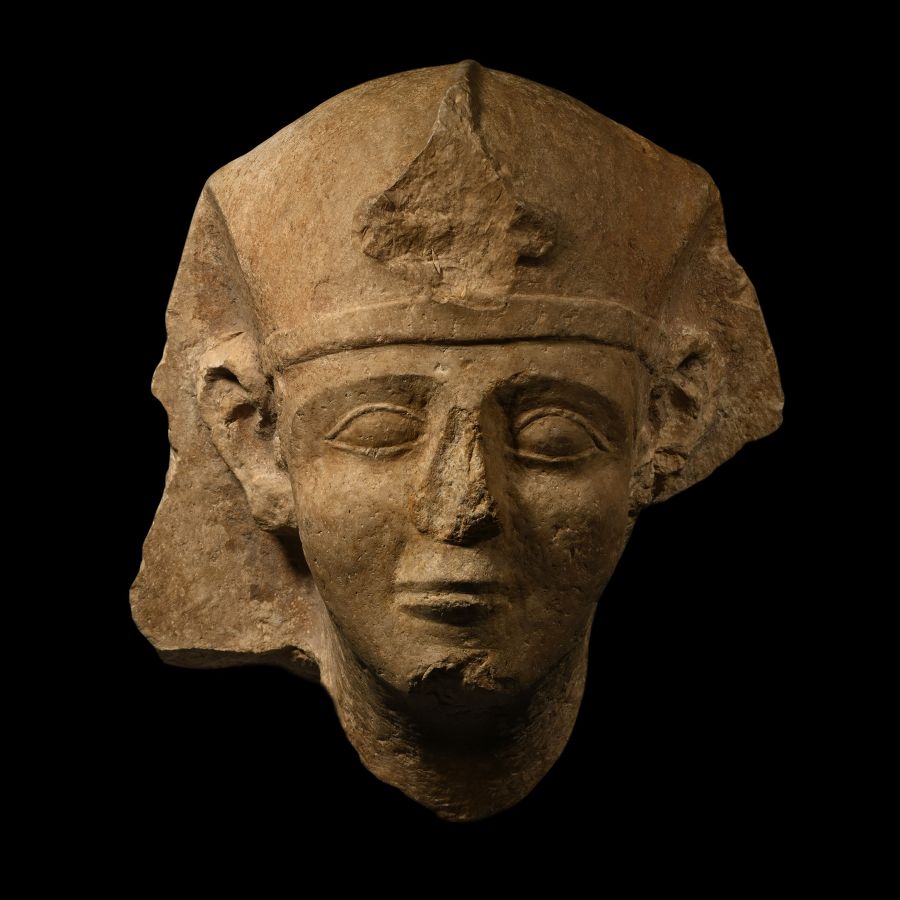
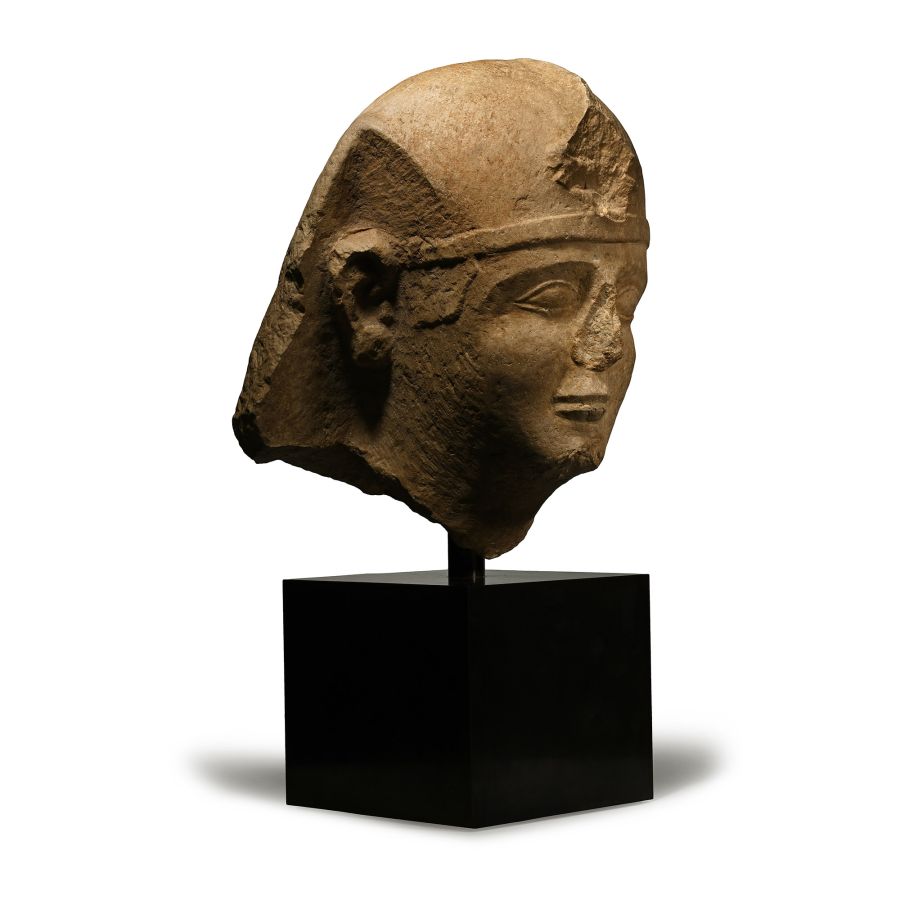
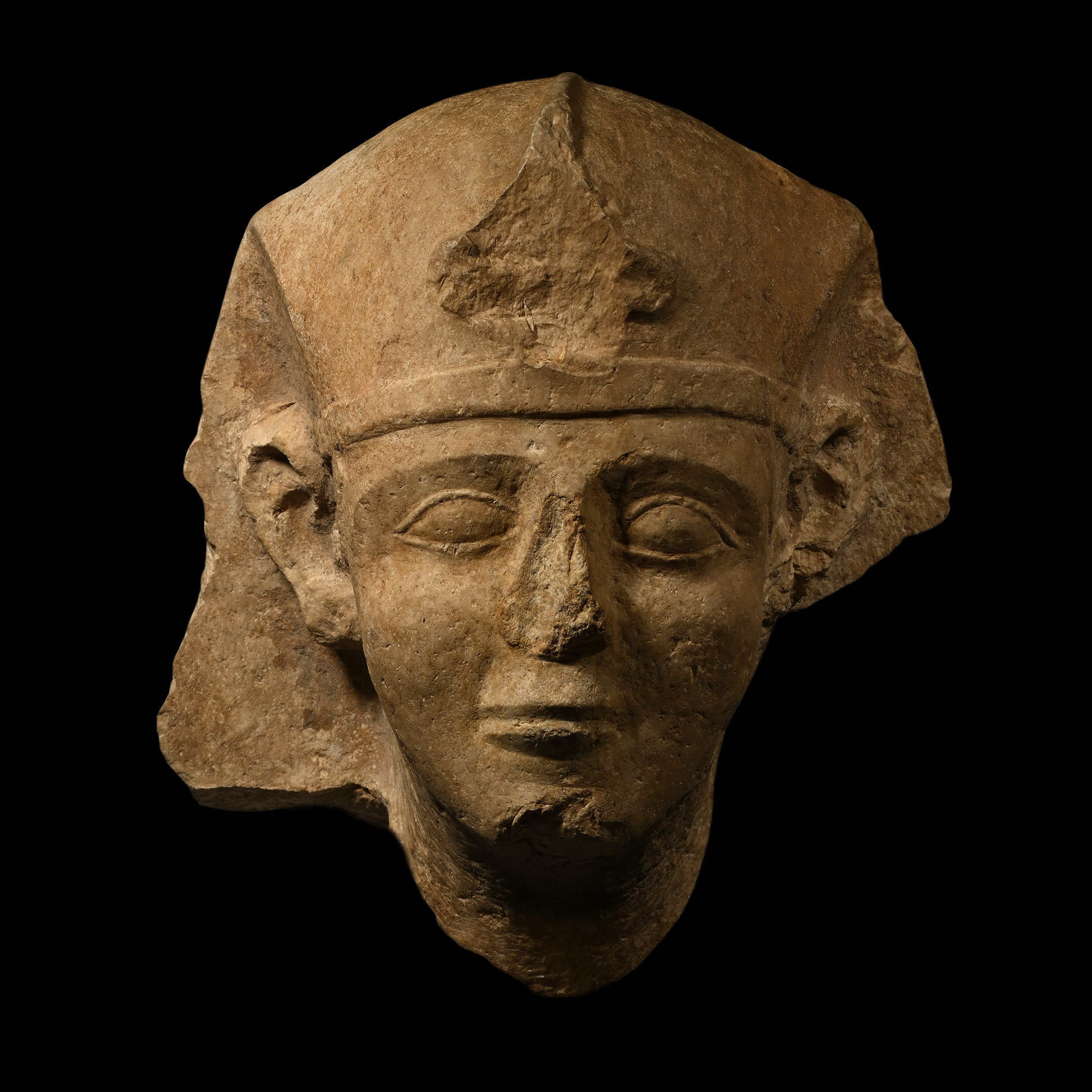
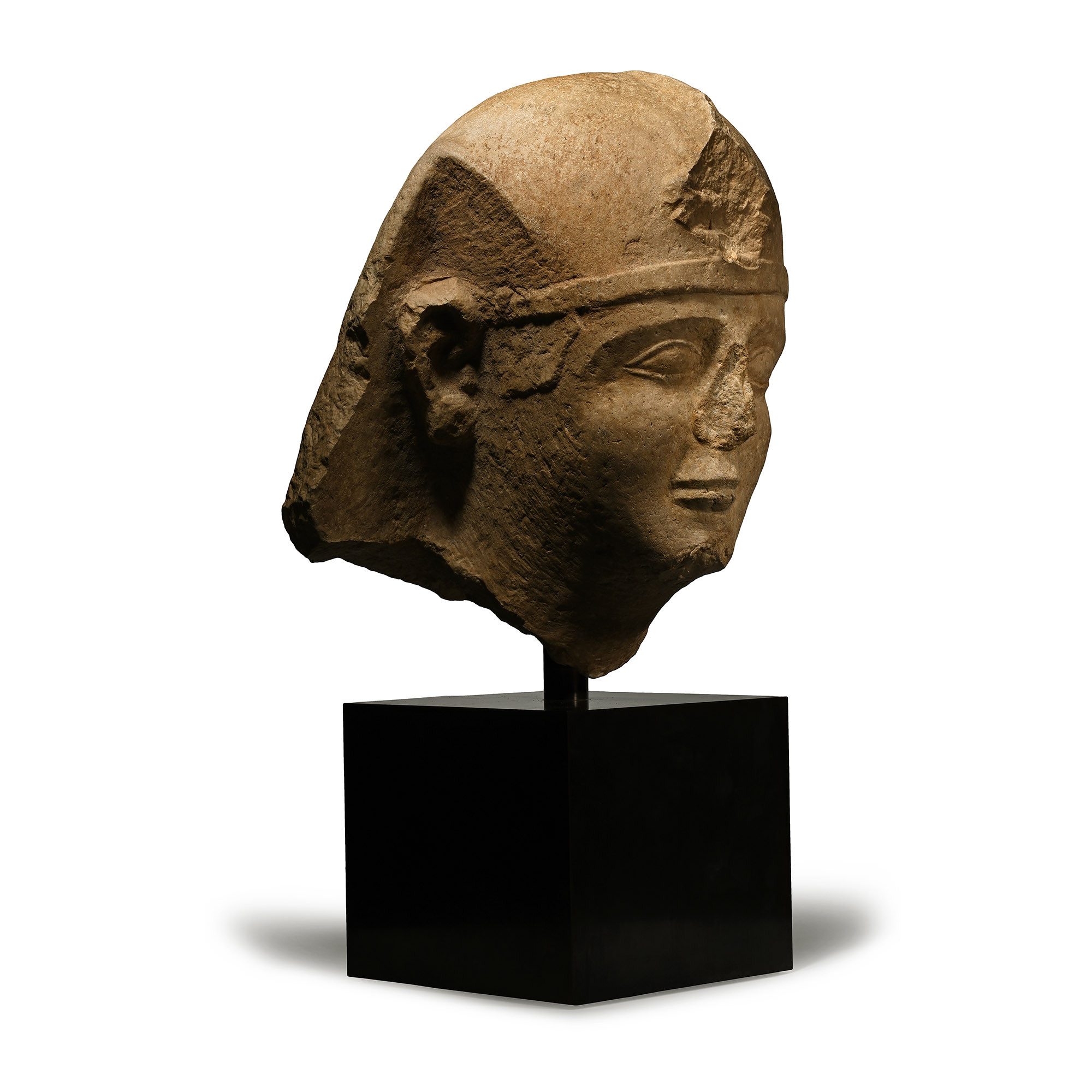
Monumental Egyptian Stone Head of a Pharaoh
PTOLEMAIC PERIOD, 332-30 B.C.
17 in. (45.15 kg, 43 cm).
An over-life-size head of a pharaoh, likely from a monumental sphinx, wearing the royal nemes headdress with a prominent headband and the remains of a rearing uraeus on the brow with a single coil of the body on either side of the cobra’s hood, its tail extending towards the back of the headdress; the large, almond-shaped eyes prominently outlined, and unlike on some portraits, the cosmetic lines do not extend beyond the outer corner; the fragmentary nose almost spanning the width of the small mouth modelled with straight and somewhat pursed lips; mounted on a custom-made display stand.
ProvenancePrivate collection, Germany, 1975.
European collection, 1980s-late 1990s.
By descent from the above to the present owner.
Accompanied by an academic report by Egyptologist Paul Whelan.
This lot has been checked against the Interpol Database of stolen works of art and is accompanied by search certificate number no.12201-218142.
Cf. Stanwick, P., Portraits of the Ptolemies: Greek Kings as Egyptian Pharaohs, Austin, 2002, pp. 67, 103 Cat. A27, for similar.
FootnotesThe presence of tool marks around the neck and sides of the head, contrasting the smooth surface of the face and front part of the headdress, suggests that the sculpture is an unfinished piece. The noticeably heavy brow line is a feature of the 30th Dynasty style, which influenced Ptolemaic royal portraiture (cf. Tomoum, N., The Sculptors' Models of the Late and Ptolemaic Periods, Cairo, 2006, pl.17, for a finished portrait assigned to the 30th Dynasty).
The distinctive features of the head are reminiscent of a granite sphinx head discovered at the Egyptian Delta site of Canopus, now housed in the Graeco-Roman Museum in Alexandria. Two additional heads, one also from the Canopus region, exhibit similar traits, hinting that this style may be indicative of the artistic output of this Delta region.
TimeLine Auctions follows a vetting process to ensure the authenticity and legality of all items, reinforcing our commitment to integrity and responsible trading. Each antiquity, antique, and coin lot undergoes thorough examination by a vetting committee of at least ten external specialists, professional trade association members, scientists, and archaeologists: Our Vetting Process
AUCTIONS:
TimeLine is a leading auction house specialising in antiquities, ancient art, collectables, natural history, coins, medals, and books. Our auctions offer museums, collectors, historians, and enthusiasts the opportunity to acquire unique and historically significant pieces.
LOT 0014
Monumental Egyptian Stone Head of a Pharaoh
Estimate £40,000 - 60,000€46,400 - 69,600 (for guidance only)$54,000 - 81,000 (for guidance only)
-
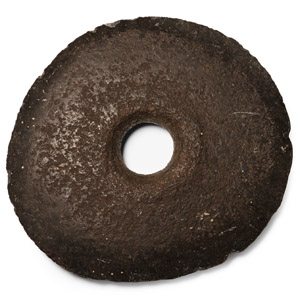
Egyptian Porphyry Disc-Mace
Neolithic Period, circa 2500-1500 B.C.Sold for (Inc. bp): £72
Circular in plan with worked cutting edge all round, socket with one chamfered face. 556 grams, 14 cm
Probably found Egypt, North Africa. Acquired on the British art market. From the collection of a South West London, UK, specialist Stone Age collector. -
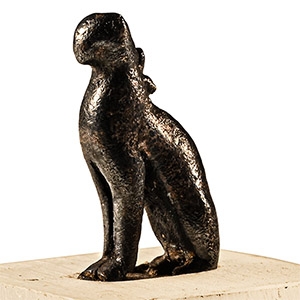
Egyptian Silver Bastet Cat Goddess
Late Period, 664-332 B.C.Estimate: £700 - 900 (‡+bp*)
Opening Bid: £350
Modelled seated on an oblong base; accompanied by a custom-made display base. 1.27 grams, 13 mm high (6.02 grams total, 33 mm including stand)
Ex Mrs Zimmermann Koutoulakis, December 1977. Ex R. Liechti (1934-2010) Geneva, Switzerland, collection between 1950-1990s.
Bastet was primarily a goddess of fertility, but she also represented festivities and intoxication, which formed part of the temple celebrations of her cult. -
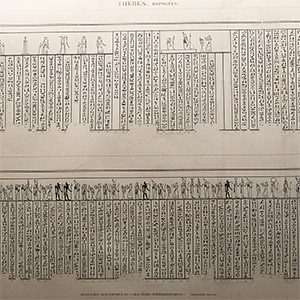
Large Egyptian Expedition Lithograph Print with Hieroglyphs
1820 A.D.Sold for (Inc. bp): £111
Willemin - Thèbes - Hypogées - Manuscrit sur papyrus en caractères hiéroglyphiques. Troisième partie - Proof etching on laid paper of plate 74 from La Description de l’Égypte: Antiquités, Volume II: Commission des sciences et arts d’Égypte with later backing sheet. 360 grams, 136 x 66 cm
From the collection of a North American priest. Acquired between 1981-1996. Property of a North American collector.
Produced between February 1802 and 1830 on the orders of Napoleon Bonaparte; published between 1809 and 1828. Just 1,000 copies were distributed to various institutions, printed on on laid paper with an 'Égypte ancienne et moderne' watermark. The book is subtitled Recueil des observations et des recherches qui ont été faites en Égypte pendant l’expédition de l’Armée française, publié par les ordres de Sa Majesté l’Empereur Napoléon le Grand (Gathering of observations and discoveries which were made in Egypt during the expedition of the French army, published on the orders of His Majesty the Emperor Napoleon the Great). It was the world's first encyclopedia devoted exclusively to the remains of ancient Egypt. The plates of this book are the first to present the archaeological sites of Thebes (Luxor). The papyrus manuscript was recovered from the underground chambers (hypogea). The original papyrus is now held in the Bibliothèque Nationale (1-19), Paris (Papyrus Cadet).
