
Loading, please wait...
_900x900.jpg "Monumental Early Etruscan Impasto Kyathos")
_200x200.jpg "Monumental Early Etruscan Impasto Kyathos")
_900x900.jpg "Monumental Early Etruscan Impasto Kyathos")
_200x200.jpg "Monumental Early Etruscan Impasto Kyathos")
_900x900.jpg "Monumental Early Etruscan Impasto Kyathos")
_200x200.jpg "Monumental Early Etruscan Impasto Kyathos")
.jpg "Monumental Early Etruscan Impasto Kyathos")
.jpg "Monumental Early Etruscan Impasto Kyathos")
.jpg "Monumental Early Etruscan Impasto Kyathos")
LOT 0055
Monumental Early Etruscan Impasto Kyathos
7TH CENTURY B.C.
9 7/8 in. (1.18 kg, 25 cm wide).
Fluted body tapering to a narrow foot, the shoulders decorated with tiered bosses, short neck with flared mouth; wide handle perforated with a triangle.
ProvenanceEstate of Mr Bruno Fellinger (1926-2016), Küsnacht, Switzerland.
with Galerie Rhéa, Zurich, Switzerland.
This lot has been checked against the Interpol Database of stolen works of art and is accompanied by a search certificate number no.12648-236390.
Cf. Hall Dohan, E., Italic Tomb-Groups in the University Museum, University of Pennsylvania, 1942, p.83, no.7, pl.44, Vulci Tomb 51, for a smaller parallel; see also Metropolitan Museum of Art, accession number 26.60.44, for a very similar piece.
FootnotesBuccheroid impasto is the name attributed by modern archaeologists to wheel thrown pottery. The clay in these specimens is less refined, and the firing techniques less precise than in the later bucchero ware.
CONDITIONTimeLine Auctions follows a vetting process to ensure the authenticity and legality of all items, reinforcing our commitment to integrity and responsible trading. Each antiquity, antique, and coin lot undergoes thorough examination by a vetting committee of at least ten external specialists, professional trade association members, scientists, and archaeologists: Our Vetting Process
AUCTIONS:
TimeLine is a leading auction house specialising in antiquities, ancient art, collectables, natural history, coins, medals, and books. Our auctions offer museums, collectors, historians, and enthusiasts the opportunity to acquire unique and historically significant pieces.
LOT 0055
Monumental Early Etruscan Impasto Kyathos
Estimate £3,500 - 4,500€4,060 - 5,220 (for guidance only)$4,730 - 6,080 (for guidance only)
-
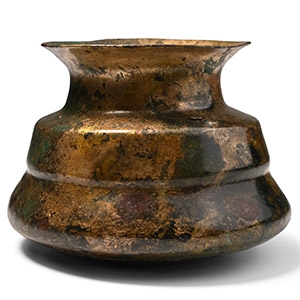
Greek Bronze Jar
Late 1st millennium B.C.Sold for (Inc. bp): £468
Bell-shaped in profile with stepped sidewall, carinated shoulder and flared rim; domed and tiered underside with basal disc. 263 grams, 11.6 cm wide
Ex property of a London, UK, gentleman, Mayfair gallery, 1990s. -
.jpg)
Large Etruscan Terracotta Caeretan Cylinder-Stamped Brazier
7th-6th century B.C.Sold for (Inc. bp): £3,120
Comprising a wide and shallow body with everted rim; the internal wall and the upper face of the rim decorated with a procession of nude men in knielauf position, some holding a lituus in their left hand with their right hand raised up towards the sky, the other figures with both of their hands raised up, the figures alternating with figures of lions and antelopes; rosette to the centre. 9.4 kg, 44.5 cm wide
Acquired on the European art market in the early 2000s. with Galerie Rhéa, Zurich, Switzerland. Accompanied by an academic report by Dr Raffaele D’Amato. This lot has been checked against the Interpol Database of stolen works of art and is accompanied by search certificate number no.12776-237862.
As can be discerned from the identifying marks under the vessels, Caeretan craftsmen used the potting wheel to produce the braziers, a technique introduced in Etruria in the 8th century B.C. They were usually decorated with one or more stamped friezes rolled onto the clay with a large cylindrical matrix before firing. The subjects of these friezes were adapted by the Etruscans from Near Eastern and Greek prototypes. Today, these braziers are found in chamber graves, but they were used in the daily life of Etruscans in domestic and sacred contexts, and employed as portable hearths. A famous example came from the Tomba Maroi III in the Banditaccia Necropolis at Cerveteri, now in the Museo of Villa Giulia, Rome (Pieraccini, 2003, fig.10). It was found perched on a stone seat, and within the burned brazier were burned remains, several eggs and three drinking cups. -
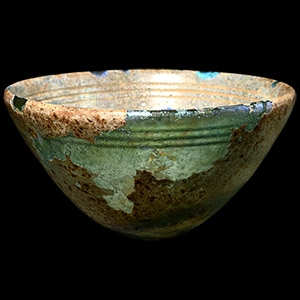
Hellenistic Iridescent Pale Aqua Glass Bowl
Mid 2nd-early 1st century B.C.Estimate: £2,000 - 3,000 (+bp*)
Opening Bid: £1,000
Conical in profile, aqua glass with three incised bands below the rim on the inner face. 374 grams, 15.7 cm wide
Dr Jutaro Kawabe, Nagoya, Japan, his collection formed in the 1960s-1970s. with Hoshigaoka Gallery until the late 1990s. Private collection, London, UK. This lot has been checked against the Interpol Database of stolen works of art and is accompanied by search certificate number no.12949-245243.
On ancient glass, iridescence is the soft play of colour that develops as the surface ages and becomes silica-rich. Minute layers form over time and break light into shifting blues, greens and golds. It is not a modern finish but something time has drawn out of the material itself, so the pattern and palette are unique to each piece. Collectors prize good, stable iridescence because it lifts the form: ribs read more crisply, profiles glow, and simple vessels take on depth and movement. Museums now tend to preserve these surfaces rather than polish them away, recognising both their beauty and what they tell us about an object’s long life (though it is not, by itself, a dating test). For display, iridescent glass performs brilliantly under gentle, directional light, where the colours “turn” as the vessel is moved. Well-preserved, even iridescence of this quality is not common and adds materially to the presence—and desirability—of the piece.
