
Loading, please wait...
LOT 1033
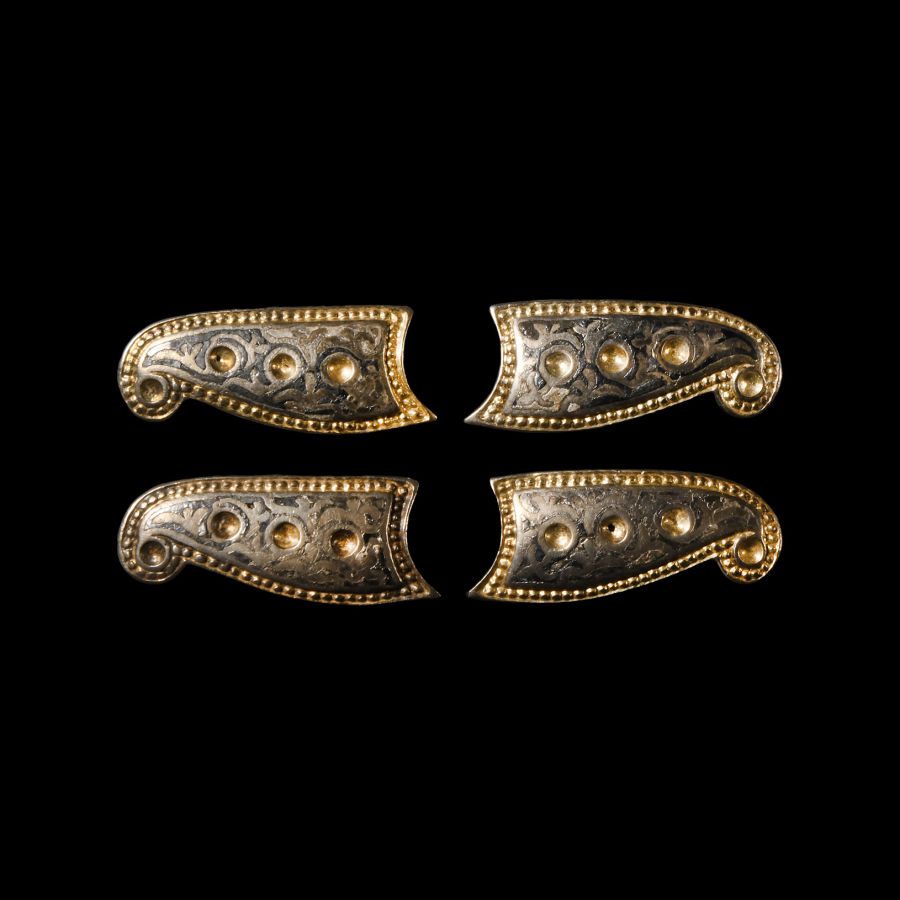
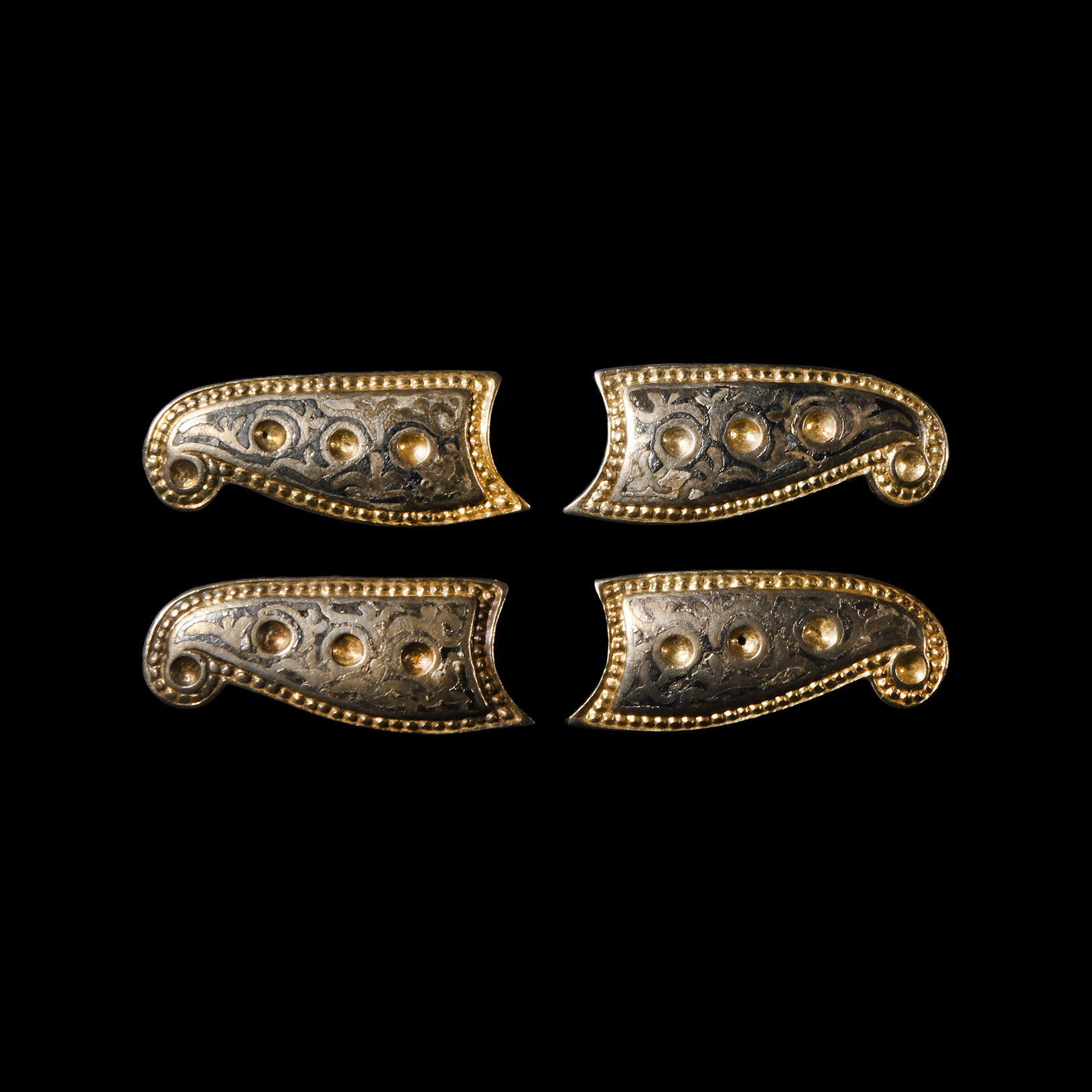
Mongol Silver Belt Mount Group
13TH CENTURY A.D.
1 5/8 in. (25.7 grams total, 40-41 mm).
Each with a broader scooped edge tapering to a volute flourish, pellets adorning the perimeter, three medial circular dimples, fourth dimple to the scrolled end, against a field of foliate scrolls and niello fill; each with a set of mounting lugs to the reverse. [4]
ProvenanceAcquired in the 1980s-1990s.
Ex an important central London gallery, London W1.
Cf. Ohkonko, N.A., 'A Mongolian Burial Group near Novopavlovka settlement in Stavropol Krai' in Batyr, Traditional Military Culture of the Peoples of Eurasia, no.1, 2010, pp.88-96, fig.7, no.3.
FootnotesSimilar plaques have been found in the burial graves of Mongol commanders and their wives, probably once part of a waist belt from which the sabre and other weapons were hanging. They were found together with arms, unique elements of the costume of fabric and leather, and splendid jewellery of gold and silver.
CONDITIONTimeLine Auctions follows a vetting process to ensure the authenticity and legality of all items, reinforcing our commitment to integrity and responsible trading. Each antiquity, antique, and coin lot undergoes thorough examination by a vetting committee of at least ten external specialists, professional trade association members, scientists, and archaeologists: Our Vetting Process
AUCTIONS:
TimeLine is a leading auction house specialising in antiquities, ancient art, collectables, natural history, coins, medals, and books. Our auctions offer museums, collectors, historians, and enthusiasts the opportunity to acquire unique and historically significant pieces.
LOT 1033
Mongol Silver Belt Mount Group
Estimate £200 - 300€230 - 350 (for guidance only)$270 - 410 (for guidance only)
-
Viking Age Iron Sword with Five-Lobed Pommel
Circa 10th-11th century A.D.Sold for (Inc. bp): £4,940
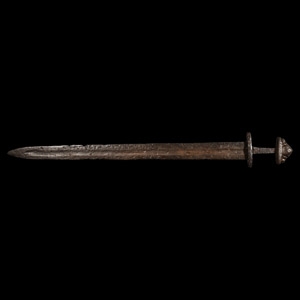
Composed of a double-edged tapering blade of Petersen Type T variant, with a slightly rounded point, shallow fullers; boat-shaped cross guard with traces of vertical silver strips, narrow tang; boat-shaped upper guard supporting a five-lobed pommel with traces of silver inlay. 1.05 kg, 89.5 cm
The general blade structure is still homogenous, few delamination traces on the sides, some flaking along the pattern-welds, small corrosion damages along the edge; in general fine condition, an excellent weapon.
Acquired 1971-1972. From the collection of the vendor's father. Property of a London, UK, collector. Accompanied by an academic report by Dr Raffaele D’Amato. This lot has been checked against the Interpol Database of stolen works of art and is accompanied by search certificate number no.11755-202775. -
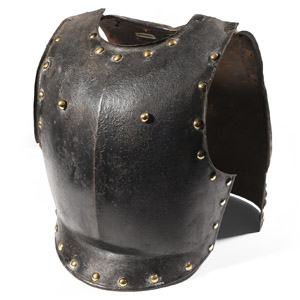
Post Medieval Spanish 'Conquistador' Cuirass Set
17th century A.D.Sold for (Inc. bp): £3,510
The breastplate with pronounced vertical rib and two rivets to front, roll at neck and splay at base with rivets to full perimeter, with inked accession numbers '21238A' (crossed through) and 'SDM - EW1' above '1931 - 30 - 6, a' and inked handwritten paper label reading 'Old Spanish Armour (Conquistador) / Found with remains of Spanish Galleon on / the estate of Leakin family (Georgia) coast. / about 1870. Refer to Trinity College Hertford Ct. / for information in Leakin family. / Given originally to Mrs Mark Howden (Hartford Ct.) / [ ] when I was 7 years old. / Luke W Lee 1944' in eight lines and also with chalked 'Old Spanish Armour / from Georgia 1944' inscription in two lines; the backplate generally matching but with vertical groove at centre and no splay at base, with inked accession numbers '31238B' (crossed through) and 'SDM - EW1' above '1951 - 30 - 6, b'. 3.3 kg, 42.5 cm high
From a Southern Californian museum, with accession numbers. Ex American collector. Acquired from TimeLine Auctions, UK, 2018, lot 181. The Kusmirek Collection, UK. This lot has been checked against the Interpol Database of stolen works of art and is accompanied by search certificate no.204020.
Trinity College, Hartford was founded in 1823; further research in their archives could provide more information on this cuirass set and the site of the 'Spanish galleon' shipwreck discovered in about 1870. -
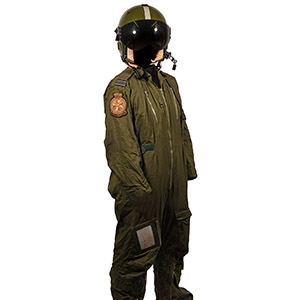
Mk3C Fighter Flying Helmet and Suit
1980s A.D.Sold for (Inc. bp): £572
Including MK 9 flying suit coveralls (for height 162-172cm, weight greater than 72.64 kg, size 4) with insignia to 825 Squadron (Fleet Air Arm) on shoulder and sewn cleaning and user instruction labels to the interior, shoulders with Flt Lieutenant Officer rank slides; MK3C flying helmet with clear and smoked visors, pig skin and blue velvet lining with electrical headset and adjustable microphone with radio lead and plug; Air Ministry label to interior reading 'Serial number 26396 Large Mk 3C' and AM 'crow's foot'. 2.9 kg, 29 cm
Acquired from J C Militaria, UK. The Kusmirek Collection, UK. Accompanied by a copy of JCM listing details and brief squadron research.
825 Squadron was originally formed in 1934 and served during WWII; it was reformed on the outbreak of the Falklands War in 1982 and equipped with ten Sea King helicopters; the squadron was disbanded in September 1982.
