
Loading, please wait...
_900x900.jpg "Mongol Ceramic Fire Bomb or Hand Grenade")
_200x200.jpg "Mongol Ceramic Fire Bomb or Hand Grenade")
.jpg "Mongol Ceramic Fire Bomb or Hand Grenade")
LOT 1419
Mongol Ceramic Fire Bomb or Hand Grenade
12TH-13TH CENTURY A.D.
5 5/8 in. (474 grams, 14.3 cm).
Piriform body with domed filler-hole, the surface divided by four long grooves united at the bottom, and pattern like scales; intended to be filled with explosive liquid and wick, used as a hand grenade. [No Reserve]
ProvenanceAcquired 1980-2015.
Ex Abelita family collection.
Cf. Arendt, W. I., Granaten des 13-14. Jahrhunderts, die an der Wolga gefunden sind, Zeitschrift fur Historische Waffen-und Kostumkunde, 11 (1926-8), p.42; cf. Arendt, W., Die Spharisch-konischen Gefasse aus Gebranntem Ton, ibid; cf. Ayalon, D., Gunpowder and Firearms in the Mamluk Kingdom, London, 1956, p.16; the shape finds correspondence with a specimen from British Museum, inventory no. 1882,0720.1 from Bulandshahr, India, in Hildburgh, W.L., ‘Aeolopiles as fire blowers’ in Archaeologia, 94, 1951, pp..27-55, pl.XVI.c.
FootnotesThis piece was a sort of ceramic fire grenade, similar to the ones used by the Eastern Romans but of Turco-Mongol type. Apart from the use of manual flame-throwers, special corps of soldiers employed terracotta grenades, in the form of small jars, abundantly evidenced in archaeological excavations, even in Burma.
CONDITIONTimeLine Auctions follows a vetting process to ensure the authenticity and legality of all items, reinforcing our commitment to integrity and responsible trading. Each antiquity, antique, and coin lot undergoes thorough examination by a vetting committee of at least ten external specialists, professional trade association members, scientists, and archaeologists: Our Vetting Process
AUCTIONS:
TimeLine is a leading auction house specialising in antiquities, ancient art, collectables, natural history, coins, medals, and books. Our auctions offer museums, collectors, historians, and enthusiasts the opportunity to acquire unique and historically significant pieces.
-
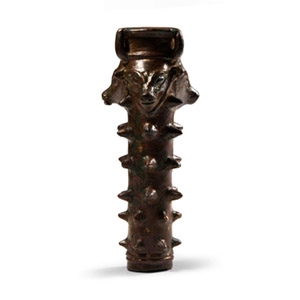
Elamite Spiked Bronze Macehead with Bulls
Late 2nd-early 1st millennium B.C.Estimate: £1,800 - 2,400 (+bp*)
Opening Bid: £1,000
With three adjoining bull heads in high relief to the top, with three ears and three horns serving all the three heads; the horns curving towards the rim of the the closed top; the shaft adorned with vertical rows of pointed spikes; hollow socket tube with ring collar at the base. 349 grams, 14.5 cm
with a London, UK gallery, 1971-early 2000s. Accompanied by an academic report by Dr Raffaele D'Amato. This lot has been checked against the Interpol Database of stolen works of art and is accompanied by search certificate number no.11997-22061. -
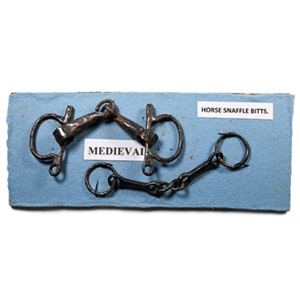
Medieval Iron Horse Snaffle Bit Collection
Circa 14th-16th century A.D.Sold for (Inc. bp): £72
Two snaffle bits with curb strap ring to each end, mounted on a fabric-covered display board with titling panel. 467 grams total, 17.5-20 cm
From the collection of the famous author, writer and speaker, Gordon Bailey, Essex, UK; formed since 1968. -
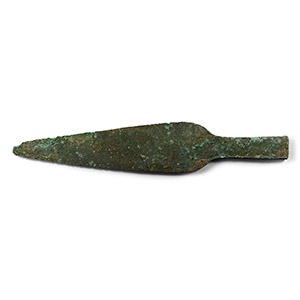
Western Asiatic Integral Hilted Bronze Short Sword
Late 3rd-2nd millennium B.C.Estimate: £300 - 400 (+bp*)
Opening Bid: £150
With a broad, lentoid-section flat blade, rounded tip, sloping sides, well marked shoulders with wide but short tang. 713 grams, 43.5 cm
Acquired 1980-2015. Ex Abelita family collection.
The sword finds similarity with the one from the Royal Cemetery of Ur. This is the most primitive form of dagger, consisting of a simple, pointed blade having slightly convex outline shoulders sloping to a short tang which has no rivets, and was probably hafted to wood with bitumen. Examples of the type come from Kish, Ur, dated to the 'Jemdet Nasr Period,' while the Ur date from the Early Dynastic to Sargonic Periods.
