
Loading, please wait...
LOT 1359
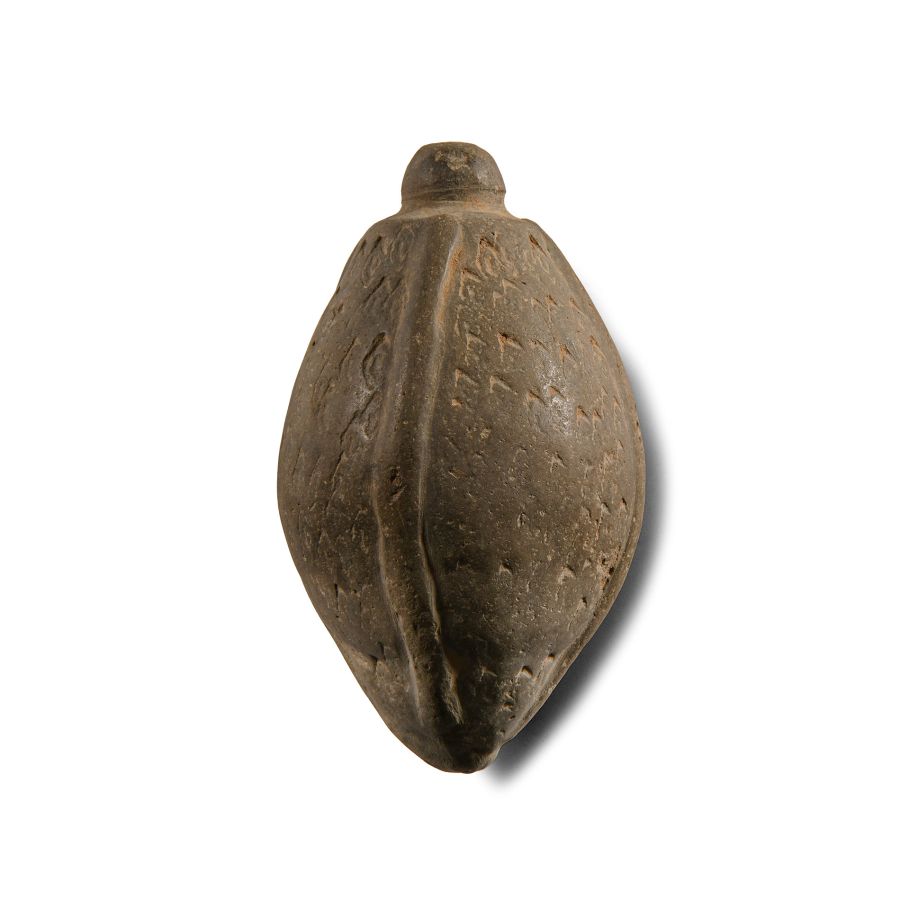
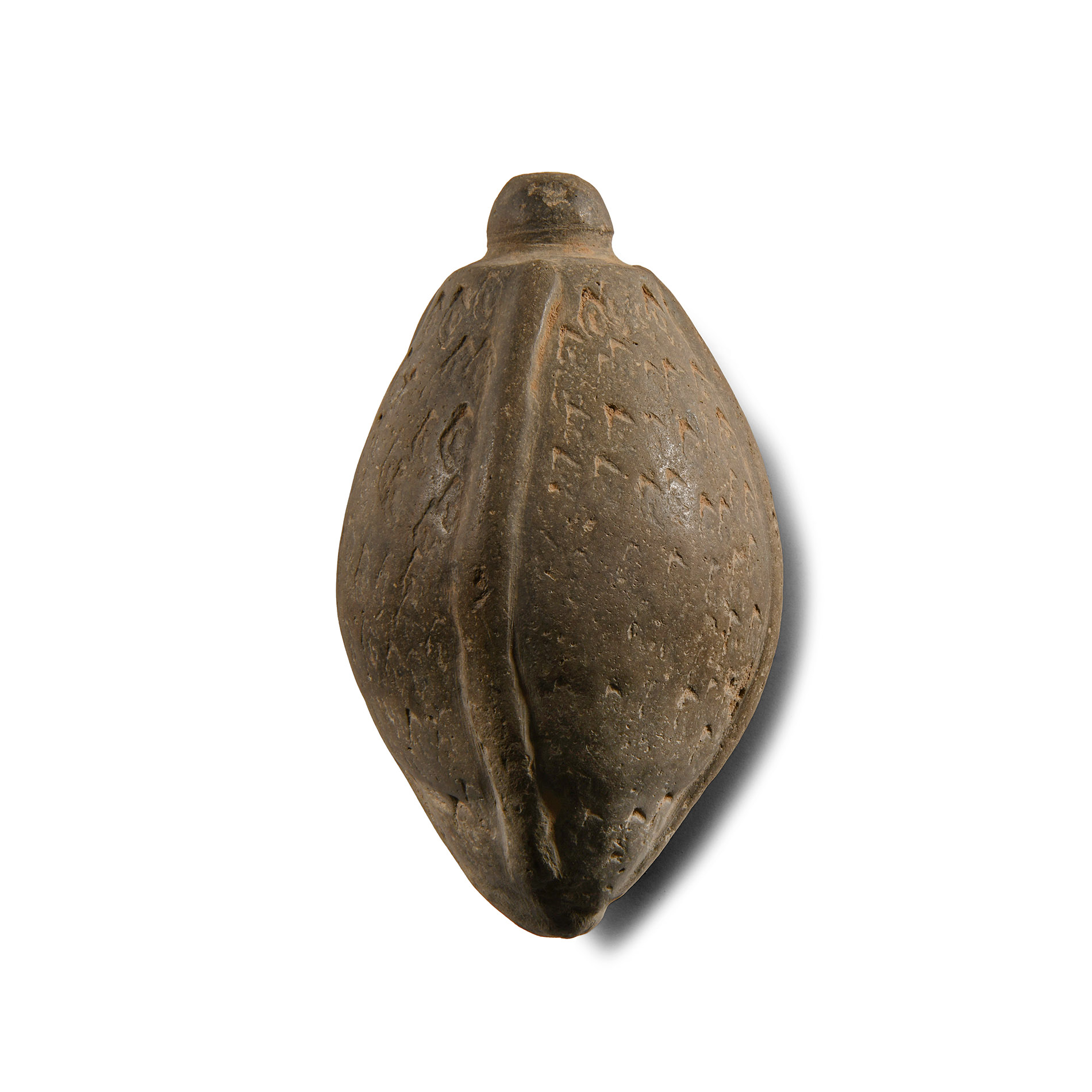
Mongol Ceramic Fire Bomb or Hand Grenade
12TH-13TH CENTURY A.D.
5 5/8 in. (474 grams, 14.3 cm).
Piriform body with domed filler-hole, the surface divided by four long grooves united at the bottom, and pattern like scales; intended to be filled with explosive liquid and wick, used as a hand grenade. [No Reserve]
ProvenanceAcquired 1980-2015.
Ex Abelita family collection.
Accompanied by an academic paper by military specialist Dr Raffaele D'Amato, dated 15 July 2019 and titled 'Eastern Roman Empire - Greek Fire Bomb or Hand Grenade (μεσαίον kακάβιον) 9th-11th century AD'.
Cf. Arendt, W. I., Granaten des 13-14. Jahrhunderts, die an der Wolga gefunden sind, Zeitschrift fur Historische Waffen-und Kostumkunde, 11 (1926-8), p.42; cf. Arendt, W., Die Spharisch-konischen Gefasse aus Gebranntem Ton, ibid; cf. Ayalon, D., Gunpowder and Firearms in the Mamluk Kingdom, London, 1956, p.16; the shape finds correspondence with a specimen from British Museum, inventory no. 1882,0720.1 from Bulandshahr, India, in Hildburgh, W.L., ‘Aeolopiles as fire blowers’ in Archaeologia, 94, 1951, pp..27-55, pl.XVI.c.
FootnotesThis piece was a sort of ceramic fire grenade, similar to the ones used by the Eastern Romans but of Turco-Mongol type. Apart from the use of manual flame-throwers, special corps of soldiers employed terracotta grenades, in the form of small jars, abundantly evidenced in archaeological excavations, even in Burma.
CONDITIONTimeLine Auctions follows a vetting process to ensure the authenticity and legality of all items, reinforcing our commitment to integrity and responsible trading. Each antiquity, antique, and coin lot undergoes thorough examination by a vetting committee of at least ten external specialists, professional trade association members, scientists, and archaeologists: Our Vetting Process
AUCTIONS:
TimeLine is a leading auction house specialising in antiquities, ancient art, collectables, natural history, coins, medals, and books. Our auctions offer museums, collectors, historians, and enthusiasts the opportunity to acquire unique and historically significant pieces.
-
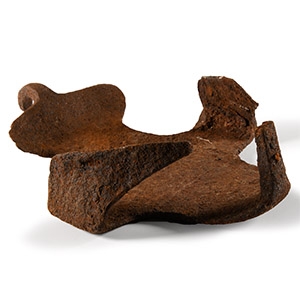
Roman Iron 'Hipposandalus' Military Horseshoe
1st-4th century A.D.Sold for (Inc. bp): £494
Iron shoe with lateral curved plates and vertical bar to the front, rear panel with hooked spur for attachment. 350 grams, 16.5 cm
From a collection acquired on the UK art market from various auction houses and collections mostly before 2000. From an important Cambridgeshire estate; thence by descent.
Hipposandals (soleae ferreae) were used on horses with injured hooves, a sort of equine orthopaedic shoe used by the mulomedicus, i.e. a Roman military veterinarian. Another important function was that to protect the hooves of the horse from injuries and damages from hard objects. The hipposandal of type 1 was formed from a sub-oval plate which tapered towards the front and rear with projections at the front, back and on either side. The heel was upturned at about 45 degrees and flared outwards. It would have terminated with a downward facing hook, now missing. The base of the sole was flat. -
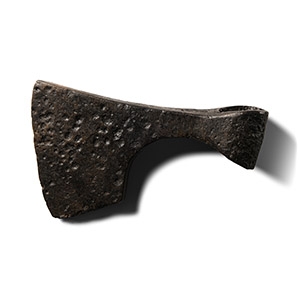
Viking Age Iron Bearded Axehead
Circa 9th-11th century A.D.Sold for (Inc. bp): £208
With triangular-section narrow blade widening to a broad bevelled edge and square chin, flared socket. 221 grams, 11.1 cm
From the collection of a Californian, USA, gentleman, dating back to the late 1960s.
The more commonly used weapons of the Finno-Ugrian people were axes, commonly found in all Finnic areas, as well as spears. Iron axeheads of this typology show a sub-trapezoidal asymmetrical blade, often perforated through the centre. -
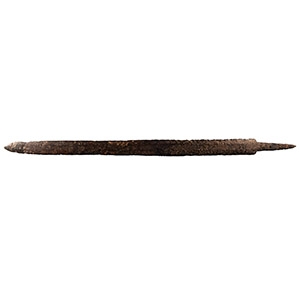
Byzantine Iron Spathion Sword
9th-11th century A.D.Sold for (Inc. bp): £845
An Eastern Roman spathion with long, double-edged parallel blade, a tapering, medium length tang, retaining possible remains of the fabrica mark in the middle, near the rivet hole for the handle. 698 grams, 81cm
Acquired 1970-1980. From the collection of a Surrey gentleman.
