
Loading, please wait...
LOT 1252
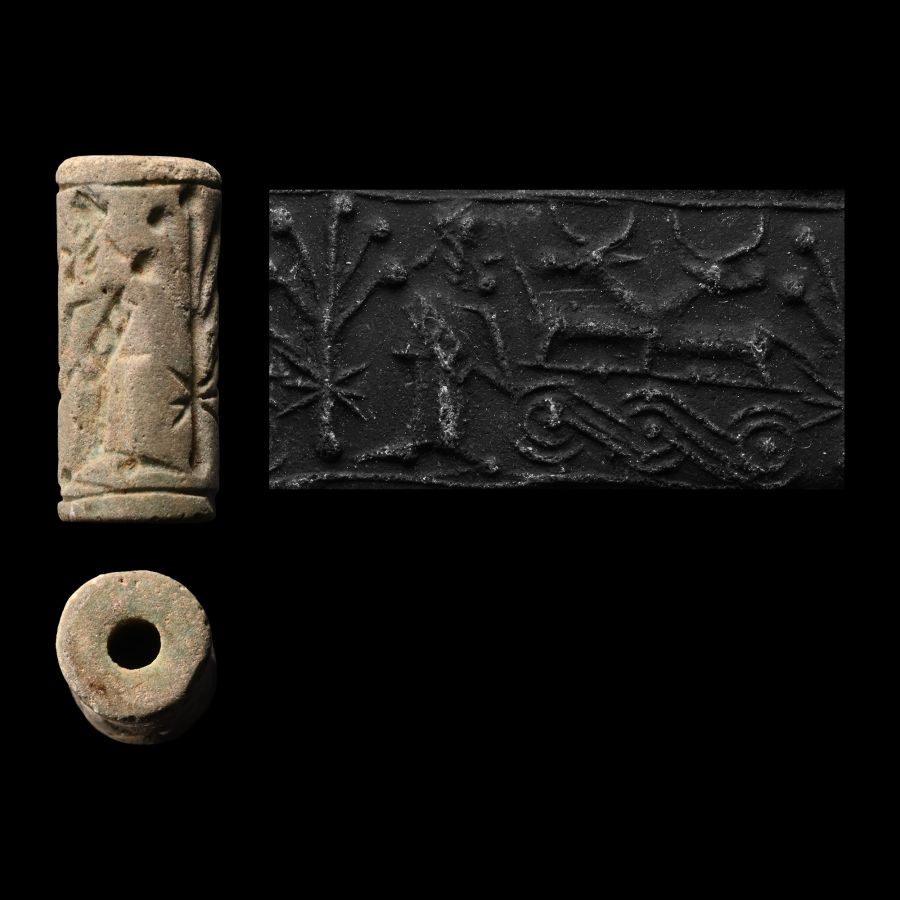
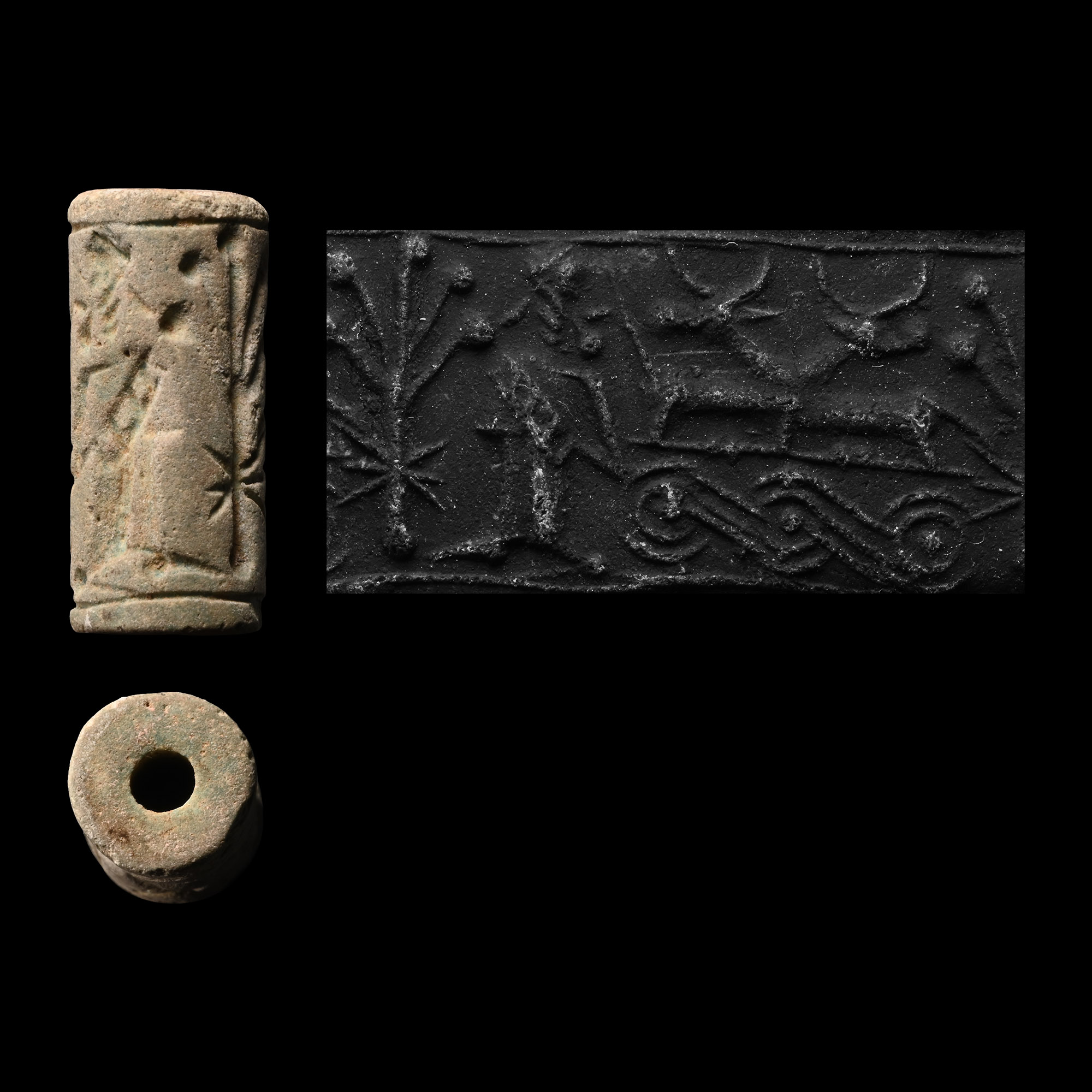
Mitanni Faience Cylinder Seal with Storm God
CIRCA 1500-1200 B.C.
1 in. (3.82 grams, 26 mm).
Accompanied by a copy of an old scholarly note, typed and signed by W.G. Lambert, late Professor of Assyriology, University of Birmingham, 1970-1993, which states: 'Cylinder Seal of Faience with Green Glaze, 26.5 x 12 mm. The main scene consists of a standing man, dressed in a robe that reaches his ankles, with a decorated band passing over one shoulder. His arms are held at the waist. He faces on his left a stylized sacred tree consisting of a main stem and five brances [sic] ending in buds at the top. The remaining area is filled with two registers. The lower one consists of of a guilloche consisting of three spirals. The upper register shows two, facing, recumbent horned animals, both with heads turned back, but one with raised tail, the other with tail downwards. The whole area of design is contained within a line above and another beneath. This seal is Mitanni, c. 1500-1200 B.C., and from anywhere within the area from Syria to Western Kurdistan. It reflects the Hurrian civilization of this area, and the tree is the symbol of the storm god, Hurrian Teshub, Babylonian Adad, Hebrew Hadad or Baal. The standing figure is probably meant as a worshiper. The horned animals are well known on such seals, but while they may well be symbolic, they are not understood. The guilloche is a common item of decoration for the period. Faience is a manufactured substance, comparable to the modern porcelain. In the ground it often deteriorates over the centuries and has a powdery surface. this one, however, is in fine condition and the only mark of its age is that the glaze covering its surface has lost its colour. In this fine condition such seals are rare.'; supplied with a museum-quality impression.
ProvenanceFrom the private collection of a North American lady, formed 1970s-early 1990s, with collection reference no.P32.
Accompanied by a copy of a scholarly note, typed and signed by Professor Wilfrid George Lambert dated September 1990.
This lot has been cleared against the Art Loss Register database, and is accompanied by an illustrated lot declaration signed by the Head of the Antiquities Department, Dr Raffaele D'Amato.
TimeLine Auctions follows a vetting process to ensure the authenticity and legality of all items, reinforcing our commitment to integrity and responsible trading. Each antiquity, antique, and coin lot undergoes thorough examination by a vetting committee of at least ten external specialists, professional trade association members, scientists, and archaeologists: Our Vetting Process
AUCTIONS:
TimeLine is a leading auction house specialising in antiquities, ancient art, collectables, natural history, coins, medals, and books. Our auctions offer museums, collectors, historians, and enthusiasts the opportunity to acquire unique and historically significant pieces.
-
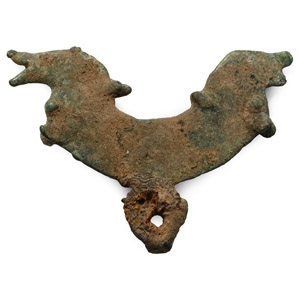
Luristan Bronze Animal-Headed Pendant
2nd-1st millennium B.C.Sold for (Inc. bp): £26
Formed as an addorsed pair of porcine heads with pricked ears, pierced lug above. 7.5 grams, 46 mm
Acquired in the 1990s. Ex Abelita family collection. This lot has been cleared against the Art Loss Register database, and is accompanied by an illustrated lot declaration signed by the Head of the Antiquities Department, Dr Raffaele D'Amato. -
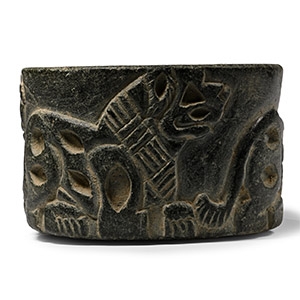
Bactrian Chlorite Vessel with Lions
3rd millennium B.C.Sold for (Inc. bp): £1,820
With frieze of crouching lions in profile, each with sockets to the flanks to accept coloured inserts (absent); chipped rim repaired. 273 grams, 85 mm
with Surena Gallery, 1999. Private collection, Europe. Accompanied by a copy of an Art Loss Register certificate dated 20th April 2004. This lot has been checked against the Interpol Database of stolen works of art and is accompanied by a search certificate number no.12405-226712. This lot has been cleared against the Art Loss Register database, and is accompanied by an illustrated lot declaration signed by the Head of the Antiquities Department, Dr Raffaele D'Amato. -
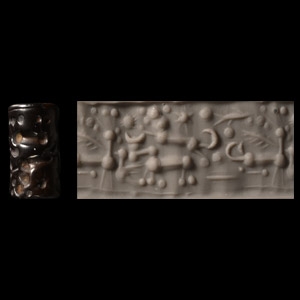
Mitanni Hematite Cylinder Seal
Circa 1400-1200 B.C.Sold for (Inc. bp): £390
Cylinder with cord and bead handles; accompanied by a copy of an old scholarly note, typed and signed by W.G. Lambert, late Professor of Assyriology, University of Birmingham, 1970-1993, which states: 'Cylinder seal of hematitite [sic], 13 x 7 mm., worn but the design clear. Space filled with: lion, sphynx, bird, fish, quadruped with bird's head, star, sun, and sundry dots and shapes. Mitanni Elaborate Style, from the area between Kurdistan and the East Mediterranean, c. 1400-1200 B.C.'; supplied with a museum-quality impression. 2.63 grams, 12 mm
UK private collection, acquired 1980-1983. Accompanied by a copy of a scholarly note, typed and signed by Professor Wilfrid George Lambert in November 1988. This lot has been cleared against the Art Loss Register database, and is accompanied by an illustrated lot declaration signed by the Head of the Antiquities Department, Dr Raffaele D'Amato.
