
Loading, please wait...
_900x900.jpg "Mitanni Brown Hematite Cylinder Seal with Winged Birds")
_200x200.jpg "Mitanni Brown Hematite Cylinder Seal with Winged Birds")
.jpg "Mitanni Brown Hematite Cylinder Seal with Winged Birds")
LOT 0221
Mitanni Brown Hematite Cylinder Seal with Winged Birds
CIRCA 1500-1250 B.C.
1 in. (14.4 grams, 23 mm).
Cylinder with cord and bead handles; accompanied by a copy of an old scholarly note, typed by W.G. Lambert, late Professor of Assyriology, University of Birmingham, 1970-1993, which states: 'Description of Cylinder Seal of brown Hematitite (sic), 29 x 15.5 mm. Standing composite figure with human legs and body, but a bird's wings and head, is placed between a large recumbent horned quadruped with long neck and a smaller horned quadruped with short neck; other items; scorpion, hand, fish, star. The whole of the design in enclosed within upper and lower rules. This is a good example of the Mitanni "Elaborate Style", from anywhere between north-western Iran and the eastern Mediterranean. As is normal for such Mitanni seals, the cutting was done entirely with three semi-mechanical tools: the drill, the tubular drill and the cutting wheel. The date will be c. 1500-1250 B.C. The ancient name of the composite figure is not so far known. Save for a gash on the standing figure, the condition is fine.'; supplied with a museum-quality impression. [No Reserve]
ProvenanceUK private collection, acquired 1980-1983.
Accompanied by a copy of a scholarly note typed by Professor Wilfrid George Lambert in October 1987.
This lot has been cleared against the Art Loss Register database, and is accompanied by an illustrated lot declaration signed by the Head of the Antiquities Department, Dr Raffaele D'Amato.
TimeLine Auctions follows a vetting process to ensure the authenticity and legality of all items, reinforcing our commitment to integrity and responsible trading. Each antiquity, antique, and coin lot undergoes thorough examination by a vetting committee of at least ten external specialists, professional trade association members, scientists, and archaeologists: Our Vetting Process
AUCTIONS:
TimeLine is a leading auction house specialising in antiquities, ancient art, collectables, natural history, coins, medals, and books. Our auctions offer museums, collectors, historians, and enthusiasts the opportunity to acquire unique and historically significant pieces.
-
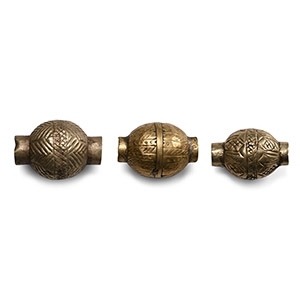
Western Asiatic Large Metal Bead Group
19th-early 20th century A.D.Sold for (Inc. bp): £13
Comprising three large beads with collars and incised/punched decoration. 59 grams total, 53-61 mm
Ex collection of a late London, UK, collector, 1970s. This lot has been cleared against the Art Loss Register database, and is accompanied by an illustrated lot declaration signed by the Head of the Antiquities Department, Dr Raffaele D'Amato. -
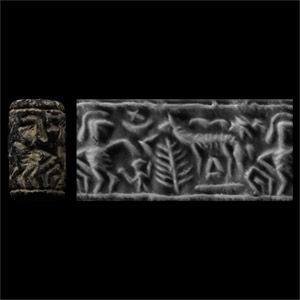
Levantine Black Stone Cylinder Seal with Standing Human Figure
Circa 1200-900 B.C.Sold for (Inc. bp): £234
Cylinder with cord and bead handles; accompanied by a copy of an old scholarly note, typed and signed by W.G. Lambert, late Professor of Assyriology, University of Birmingham, 1970-1993, which states: 'Description of Cylinder Seal of Soft Black Stone, 19 x 11 mm. Standing human with big shock of hair, resting one hand on the head of a child; quadruped standing on base-line with 'delta' between legs; pecking bird, tree, bull's horns (?), combined star and crescent, fly, and one or two unidentified items. The whole design is put between rules. Levantine, c. 1200-900 B.C. An unusual design. Condition: good.'; supplied with a museum-quality impression. 5.06 grams, 18 cm
UK private collection, acquired 1980-1983. Accompanied by a copy of a scholarly note, typed and signed by Professor Wilfrid George Lambert in October 1987. This lot has been cleared against the Art Loss Register database, and is accompanied by an illustrated lot declaration signed by the Head of the Antiquities Department, Dr Raffaele D'Amato. -
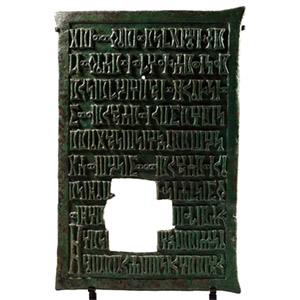
South Arabian King Rabbishamsum Nimran Bronze Dedicatory Plaque
Circa 150 A.D.Estimate: £12,000 - 17,000 (+bp*)
Opening Bid: £6,000
Rectangular in profile with spur to each upper angle; high-relief reserved epigraphic text in ten lines with void at lower centre; dedicated to the god Dhu-Samāwī by Ẓabiyum Yarḥab, under the Reign of King Rabbīshamsum Nimrān; mounted on a custom-made stand. 2.03 kg total, 28 x 18.6 cm (34.5 cm high including stand)
Ex Robin Marshal-Carter, Adelaide, South Australia, 1970. Private collection, London, UK. Accompanied by a full transliteration and translation into modern English. This lot has been checked against the Interpol Database of stolen works of art and is accompanied by a search certificate number no.12697-235195. This lot has been cleared against the Art Loss Register database, and is accompanied by an illustrated lot declaration signed by the Head of the Antiquities Department, Dr Raffaele D'Amato.
From the temple of Yaghrū consecrated to the god dhu-Samāwī, in the wādī 'l-Shudayf in northern Yemen.
