
Loading, please wait...
LOT 0032
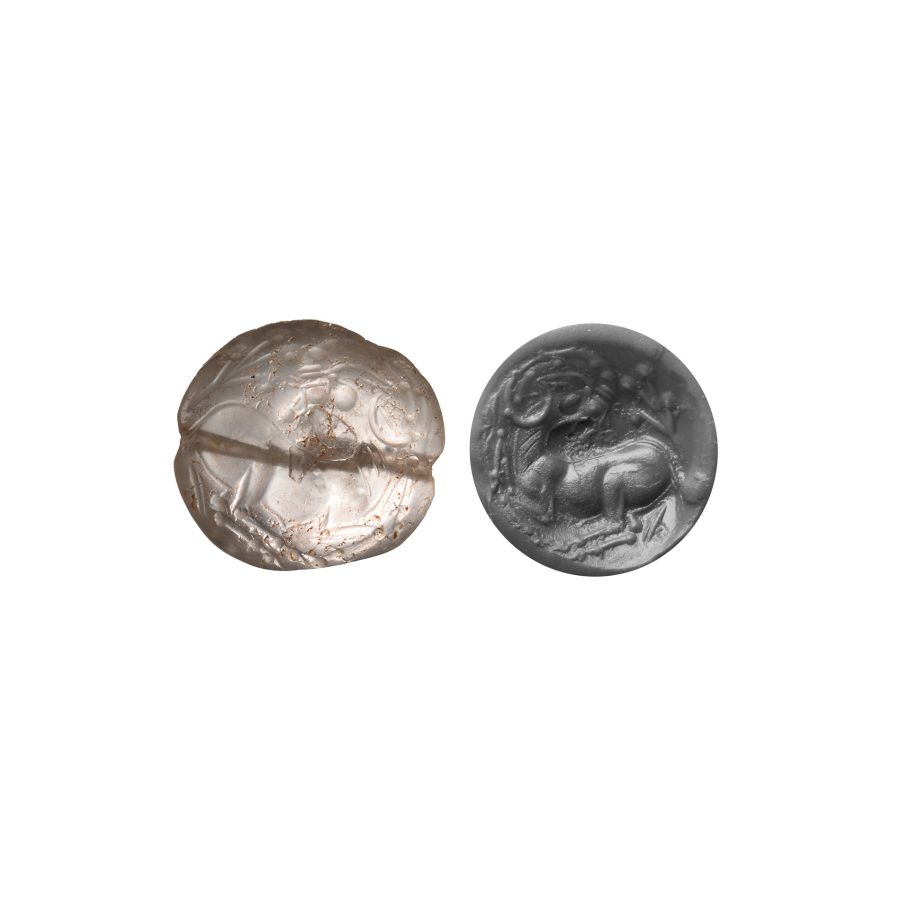
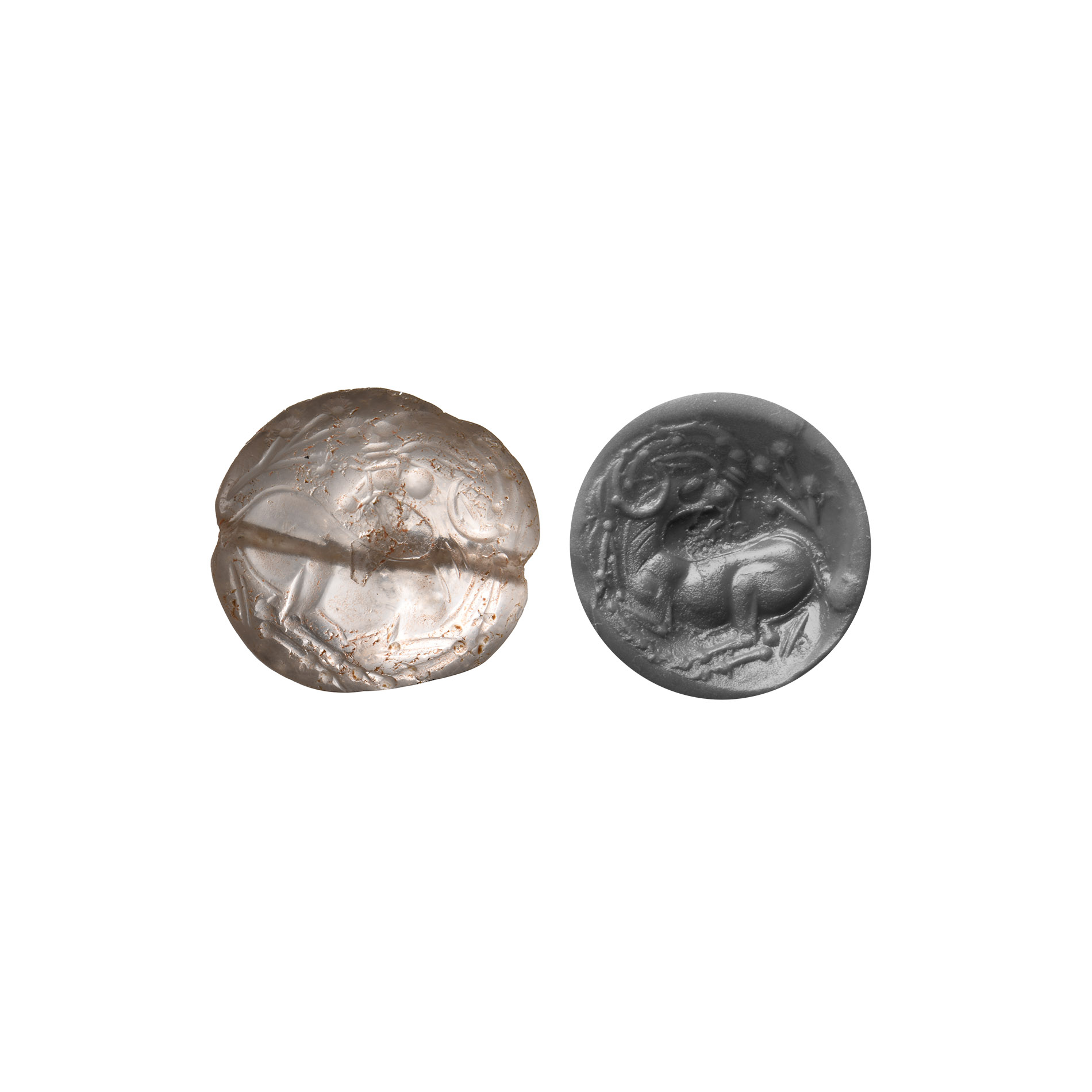
Minoan Lentoid Rock Crystal Seal
CIRCA 1450-1375 B.C.
3/4 in. (3.63 grams, 18 mm).
Displaying an incuse bull or other horned quadruped looking backwards; drilled for suspension.
ProvenanceAcquired in 1970.
with Coins and Antiquities, formerly known as D.J. Crowther Ltd, Mayfair, London, UK.
Private collection of a London antiquarian.
Cf. a comparable image in Boardman, J., Greek Gems and finger rings, early bronze age to Late Classical, London, 1973 (2001), no.106, p.47.
FootnotesThe style of the lentoid seal has similarities with an agate lentoid seal from Fourni, Archanes, dated to the last period of the Cretan Palace in Knossos, before the island was occupied by the Achaeans. On the Cretan lentoid seals, single animals or a group of animals are plentiful. One of the most common motifs is that of a reclining or standing animal. Single animals are sometimes depicted with contorted bodies.
CONDITIONTimeLine Auctions follows a vetting process to ensure the authenticity and legality of all items, reinforcing our commitment to integrity and responsible trading. Each antiquity, antique, and coin lot undergoes thorough examination by a vetting committee of at least ten external specialists, professional trade association members, scientists, and archaeologists: Our Vetting Process
AUCTIONS:
TimeLine is a leading auction house specialising in antiquities, ancient art, collectables, natural history, coins, medals, and books. Our auctions offer museums, collectors, historians, and enthusiasts the opportunity to acquire unique and historically significant pieces.
-
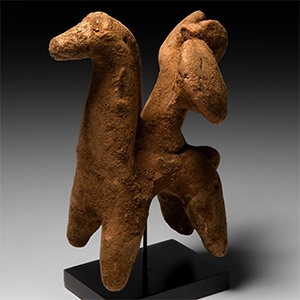
Archaic Greek Terracotta Figure of Mounted Warrior with Shield
7th-5th century B.C.Sold for (Inc. bp): £364
Modelled in the round, the stylised horse standing on stub legs, with a long neck and detailing to its eyes; the warrior holding a shield in his left hand, right hand and arm raised to eye level, wearing a crested helmet; restored and mounted on a custom-made display stand. 339 grams total, 14.5 cm high including stand
Acquired before 1990. From an old German collection. -
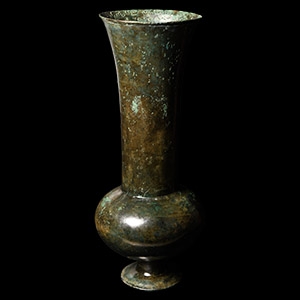
Early Parthian Bronze Vase
Circa 3rd century B.C.Sold for (Inc. bp): £442
Featuring a squat piriform body, flared cylindrical neck and short waisted stem with everted foot. 227 grams, 21 cm high
UK collection, early 1990s and before. Acquired on the UK art market since the early 2000s. From a private collection, Lancashire, UK. -
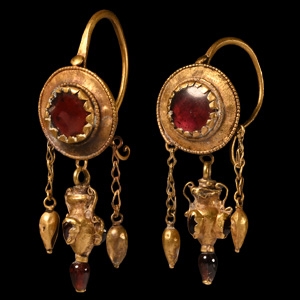
Greek Gold Earrings with Amphora Drops
Circa 2nd century B.C.Sold for (Inc. bp): £1,950
Each composed of a tiered discoid head with polished garnet inlays in claw settings, filigree to the outer perimeter, tapering hook to reverse and three dangles below, the central one formed as an amphora with scrolled handles, three polished garnet cabochons to the equator and a garnet bead to base; flanked by two lotus or bud-shaped charms on short lengths of chain. 14.28 grams total, 52-57 mm
Acquired 1970-2010. From the collection of a late Japanese gentleman.
