
Loading, please wait...
_900x900.jpg "Minoan Bronze Statuette of a Lady")
_200x200.jpg "Minoan Bronze Statuette of a Lady")
.jpg "Minoan Bronze Statuette of a Lady")
LOT 0036
Minoan Bronze Statuette of a Lady
MIDDLE PERIOD, CIRCA 1700-1450 B.C.
6 1/2 in. (499 grams total, 16.5 cm high including stand).
With a small, stylised face with detailed eyes, nose and mouth; right hand raised to hold a child; wearing a flounced skirt with double belt; mounted on a custom-made display stand. [No Reserve]
ProvenanceBritish private collection, acquired by 2000.
From a collection acquired on the UK art market from various auction houses and collections mostly before 2000.
From an important Cambridgeshire estate; thence by descent.
See Comstock, M., Vermeule C., Greek, Etruscan & Roman Bronzes in the Museum of Fine Arts Boston, New York, 1971, p.4, no.1, for similar.
FootnotesIn the Dictean Cave in Greece, many votive statuettes of this type were found. The flounced skirt is characteristic of Minoan women's dress, and it was lavishly decorated in folds of different colours. It could be worn with or without a narrow corselet, but in both cases exposing the breast. The exposed breast was connected to the cult of the mother goddess, and fertility, an element here reinforced by the presence of the suckling child.
CONDITIONTimeLine Auctions follows a vetting process to ensure the authenticity and legality of all items, reinforcing our commitment to integrity and responsible trading. Each antiquity, antique, and coin lot undergoes thorough examination by a vetting committee of at least ten external specialists, professional trade association members, scientists, and archaeologists: Our Vetting Process
AUCTIONS:
TimeLine is a leading auction house specialising in antiquities, ancient art, collectables, natural history, coins, medals, and books. Our auctions offer museums, collectors, historians, and enthusiasts the opportunity to acquire unique and historically significant pieces.
-
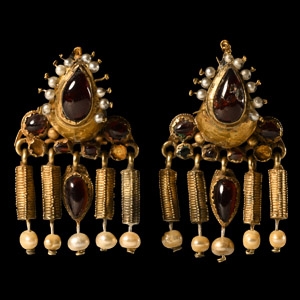
Hellenistic Gold Earring Pair
1st century B.C.-1st century A.D.Sold for (Inc. bp): £5,980
Each with a hollow-form crescentic body with a large teardrop-shaped garnet set within a cell with radiating pearl studs; a pendant panel below with garnet cabochons, five pendant drops with pearl finials and a central teardrop-shaped garnet; accompanied by a custom-made display stand. 22.40 grams total, 47-49 mm (107 grams total, 92 mm high including stand)
From a private collection. Acquired from Mr D.S., 7 February 2008. Private UK collection. This lot has been checked against the Interpol Database of stolen works of art and is accompanied by search certificate no.12119-214174.
The material culture of the Hellenistic east followed the eastern Mediterranean polychromy. Many beautiful jewels were produced in Alexandria or in the Syrian cities and the majority of their precious decorations was imitated by jewellers of more remote provinces, like those of the Greek Pontic cities. -
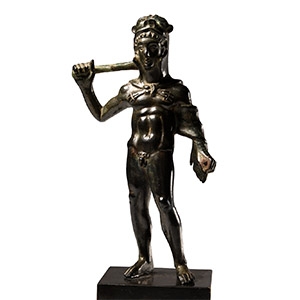
Etruscan Bronze Statuette of Herakles
4th-3rd century B.C.Estimate: £20,000 - 30,000 (‡+bp*)
Opening Bid: £10,000
Modelled in the round with a muscular nude body, his club resting on his shoulder and the hair dressed in rows of tight, close-set curls underneath the Nemean lionskin hood with cloak billowing over his left arm, the paws tied across his chest; mounted on a custom-made display stand. 290 grams total, 14.5 cm high (19.5 cm high including stand)
Fine condition, excellent uniform patina.
with Sotheby's, New York, 21 November 1985, no.60. Ex private New York collection. Accompanied by an academic report by Dr Raffaele D'Amato. This lot has been checked against the Interpol Database of stolen works of art and is accompanied by search certificate number no.11794-206497.
The statuette assumes the position of the 'attacking Hercules', which characterises numerous Etruscan statues of the hero of the classical era, however, with a less aggressive stance. The type was probably an Etruscan creation of the 5th century B.C., based on Greek models, which lasted until the end of the Hellenistic period, when Etruria was by then incorporated into the Roman world. This statuette, despite certain anatomical stylisation and an impersonal characterisation of the face, is the result of a good artistic and technical quality. The comparison of the artwork with the group identified as ‘Trieste’ from Colonna shows that this specimen is more recent and should be dated to the end of the Hellenistic Age. These small statuettes were probably offered ex-voto by the Romano-Etruscan aristocracy of the period. -
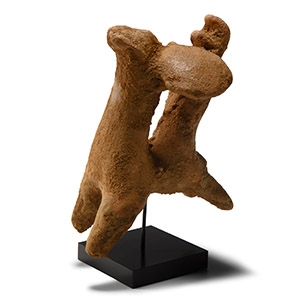
Archaic Greek Terracotta Figure of Mounted Warrior with Shield
7th-5th century B.C.Sold for (Inc. bp): £208
The figure comprising a stylised horse with elongated neck, mounted by a bearded rider figure holding a shield, restored; mounted on a custom-made display stand. 277 grams total, 13 cm including stand
Acquired before 1990. From an old German collection.
