
Loading, please wait...
_900x900.jpg "Migration Period Iron Sword with Bronze Pommel")
_200x200.jpg "Migration Period Iron Sword with Bronze Pommel")
_900x900.jpg "Migration Period Iron Sword with Bronze Pommel")
_200x200.jpg "Migration Period Iron Sword with Bronze Pommel")
.jpg "Migration Period Iron Sword with Bronze Pommel")
.jpg "Migration Period Iron Sword with Bronze Pommel")
LOT 1365
Migration Period Iron Sword with Bronze Pommel
5TH-6TH CENTURY A.D.
35 7/8 in. (707 grams, 91 cm).
A spatha with a double-edged parallel-sided blade, battle nicks to both cutting edges; long tang with a fastening rivet in situ; small trapezoidal bronze pommel.
ProvenanceFrom the private collection of a London gentleman, from his grandfather's collection formed before the early 1970s.
Accompanied by an academic report by Dr Raffaele D’Amato.
This lot has been checked against the Interpol Database of stolen works of art and is accompanied by a search certificate number no.12040-216429.
Exhibited at the Harwich Museum, Harwich, Essex, UK, 19th June-9th September 2024; accompanied by a copy of a photograph of the artefacts on display.
LiteratureCf. Menghin, W., Das Schwert im Frühen Mittelalter, Stuttgart, 1983, nos.60, 66, 67; Lebedinski, I., Armes et guerriers Barbares au temps des grandes invasions IVème au Vième siècle après J.C., Paris, 2001, pp.126-127; Strassmeir, A., Das Frankische Heer der Merowingerzeit, Berlin, 2019, pp.34-37.
FootnotesThe spatha, often with an elegantly decorated hilt with golden elements, was characterised by a relatively light handle so that the centre of gravity of the weapon was moved towards the tip. The evolution of the 'barbarian' long sword in the west, during the invasions, began around the 5th century.
CONDITIONTimeLine Auctions follows a vetting process to ensure the authenticity and legality of all items, reinforcing our commitment to integrity and responsible trading. Each antiquity, antique, and coin lot undergoes thorough examination by a vetting committee of at least ten external specialists, professional trade association members, scientists, and archaeologists: Our Vetting Process
AUCTIONS:
TimeLine is a leading auction house specialising in antiquities, ancient art, collectables, natural history, coins, medals, and books. Our auctions offer museums, collectors, historians, and enthusiasts the opportunity to acquire unique and historically significant pieces.
-
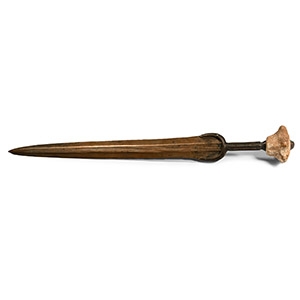
Luristan Bronze Sword with Decorated Stone Pommel
13th-7th century B.C.Estimate: £800 - 1,000 (+bp*)
Opening Bid: £500
With solid cast hilt with penannular guard and a horizontally ribbed grip; a massive star-shaped pommel and a multi-fullered blade tapering to a sharp tip; handle restored. 1.03 kg, 63.5 cm
Acquired 1980-2015. Ex Abelita family collection.
According to Moorey, such category of swords were distributed in the Northern Iran area, as proved by the Amarlu finds. Based on the example from the Ashmolean Museum, he dated them to the end of the 2nd millennium B.C., more precisely to a period between 1400-1200 B.C. The type was in use until the 7th century B.C. -
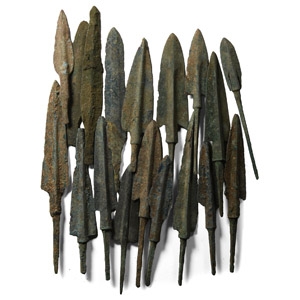
Luristan Bronze Arrowhead Collection
Circa 14th-10th century B.C.Sold for (Inc. bp): £312
Including triangular, leaf-shaped, barbed and other types. 450 grams total, 9.5-15.5 cm
Ex London, UK, collection, 1990s. -
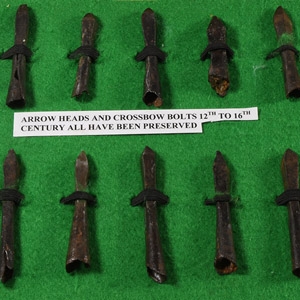
Cased Medieval to Tudor 'Published' Iron Crossbow Bolt Collection
12th-16h century A.D.Sold for (Inc. bp): £195
Comprising: 14 crossbow bolts with pyramidal point, square-section shaft, and a tubular socket. 1.24 kg total, 32.5 x 22.5 x 5 cm
From the collection of the famous author, writer and speaker, Gordon Bailey, Essex, UK; formed since 1968.
The crossbow, a bow fixed at its centre to a wooden stock, was a formidable weapon reintroduced in Western Europe in 11th century A.D.; it was used by the Genoese crossbowmen, mainly in French service, during the 100 Years War; its heavy bolt could easily penetrate a shield or armour breast plate at close range.
