
Loading, please wait...
_900x900.jpg "Migration Period Iron Sword with Bronze Pommel")
_200x200.jpg "Migration Period Iron Sword with Bronze Pommel")
_900x900.jpg "Migration Period Iron Sword with Bronze Pommel")
_200x200.jpg "Migration Period Iron Sword with Bronze Pommel")
.jpg "Migration Period Iron Sword with Bronze Pommel")
.jpg "Migration Period Iron Sword with Bronze Pommel")
LOT 0280
Migration Period Iron Sword with Bronze Pommel
5TH-6TH CENTURY A.D.
35 7/8 in. (707 grams, 91 cm).
A spatha with a double-edged parallel-sided blade, battle nicks to both cutting edges; long tang with a fastening rivet in situ; small trapezoidal bronze pommel.
ProvenanceFrom the private collection of a London gentleman, from his grandfather's collection formed before the early 1970s.
Accompanied by an academic report by Dr Raffaele D’Amato.
This lot has been checked against the Interpol Database of stolen works of art and is accompanied by a search certificate number no.12040-216429.
Cf. Menghin, W., Das Schwert im Frühen Mittelalter, Stuttgart, 1983, nos.60, 66, 67; Lebedinski, I., Armes et guerriers Barbares au temps des grandes invasions IVème au Vième siècle après J.C., Paris, 2001, pp.126-127; Strassmeir, A., Das Frankische Heer der Merowingerzeit, Berlin, 2019, pp.34-37.
FootnotesThe spatha, often with an elegantly decorated hilt with golden elements, was characterised by a relatively light handle so that the centre of gravity of the weapon was moved towards the tip. The evolution of the 'barbarian' long sword in the west, during the invasions, began around the 5th century.
CONDITIONTimeLine Auctions follows a vetting process to ensure the authenticity and legality of all items, reinforcing our commitment to integrity and responsible trading. Each antiquity, antique, and coin lot undergoes thorough examination by a vetting committee of at least ten external specialists, professional trade association members, scientists, and archaeologists: Our Vetting Process
AUCTIONS:
TimeLine is a leading auction house specialising in antiquities, ancient art, collectables, natural history, coins, medals, and books. Our auctions offer museums, collectors, historians, and enthusiasts the opportunity to acquire unique and historically significant pieces.
LOT 0280
Migration Period Iron Sword with Bronze Pommel
Estimate £2,000 - 3,000€2,320 - 3,480 (for guidance only)$2,700 - 4,050 (for guidance only)
-
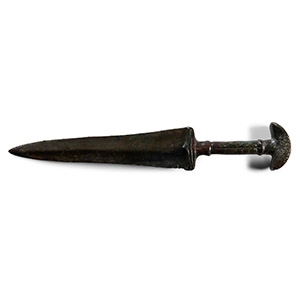
Luristan Bronze Short Dagger
1st millennium B.C.Sold for (Inc. bp): £715
With broad lobed pommel, balustered grip and narrow guard; lentoid-section triangular blade; extremely rare and unusual. 83 grams, 19.5 cm
From a Mayfair, London gallery, 1990s. -
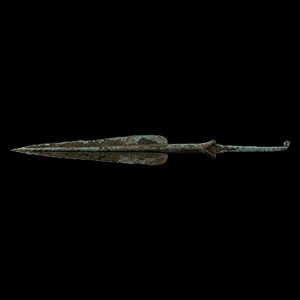
Marlik Type Bronze Tanged Spearhead
12th-11th century B.C.Estimate: £100 - 140 (+bp*)
Opening Bid: £50
With heavily ridged and tapering blade, short collared shaft and a square-section tapering tang bent at the tip. 159 grams, 31.5 cm
Acquired 1980-2015. Ex Abelita family collection.
The weapon belongs to type I of the Khorasani classification. Similar weapons have been excavated in Marlilk by Professor Negahban and dated by Stutzinger to the late 13th-early 12th century B.C. -
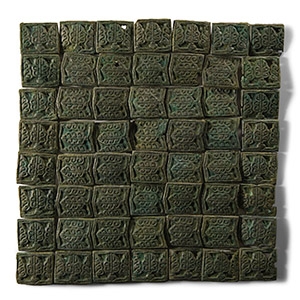
Viking Age Bronze Horse Harness Mount Set
9th-11th century A.D.Sold for (Inc. bp): £156
Group of rectangular mounts each with fixing studs to the reverse, decorated with a dense foliage and leaf motif. 205 grams total, 24-26 mm
From the private collection of a London gentleman, from his grandfather's collection formed before the early 1970s.
