
Loading, please wait...
_900x900.jpg "Migration Period Iron Spatha Sword with Garnet Inlaid Hilt")
_200x200.jpg "Migration Period Iron Spatha Sword with Garnet Inlaid Hilt")
_900x900.jpg "Migration Period Iron Spatha Sword with Garnet Inlaid Hilt")
_200x200.jpg "Migration Period Iron Spatha Sword with Garnet Inlaid Hilt")
.jpg "Migration Period Iron Spatha Sword with Garnet Inlaid Hilt")
.jpg "Migration Period Iron Spatha Sword with Garnet Inlaid Hilt")
LOT 1406
Migration Period Iron Spatha Sword with Garnet Inlaid Hilt
5TH-7TH CENTURY A.D.
3/4 - 31 1/2 in. (753 grams total, 1.9-80 cm).
Comprising a double-edged parallel-sided blade showing battle nicks on both cutting edges, medium length tapering tang; lentoid-shaped lower-guard with inset garnets to one side; accompanied by an amber sword bead with a bronze stud with garnet inlay. [4]
ProvenanceFrom the private collection of a London gentleman, from his grandfather's collection formed before the early 1970s.
Accompanied by an academic report by Dr Raffaele D’Amato.
This lot has been checked against the Interpol Database of stolen works of art and is accompanied by a search certificate no. 12063-217911.
Cf. Menghin, W., Das Schwert im Frühen Mittelalter, Stuttgart, 1983; Zasetskaïa, I.P., Kul’tura Kotchovnikov iujnorusskikh stepeï v gunnskuïu epokhu (Culture of the nomads of the southern Russian steppes in the Hun era), Saint Petersburg, 1994; Lebedinski, I., Armes et guerriers Barbares au temps des grandes invasions IVème au Vième siècle après J.C., Paris, 2001, pp.117ff., swords from Loutchistoïé, Novohryhorivka, Bátaszék, Jakuszowice, Szirmabesényo, Ártánd, Horgos; Miks, C., Studien zur Römischen Schwertbewaffnung in der Kaiserzeit, I-II Banden, Rahden, 2007; Kazanski, M.M., Barbarians at the borders of the Eastern Roman Empire (in Russian), Simferopol, 2024, figs.12, p.20, 23, p.31, pl.36, for similar cross-guards.
FootnotesThis type of swords (cf. Lebedinsky 2001, p.117) usually had stones hanging from the pommel or hilt, like the one preserved here. This typology was widespread in central Europe by the Huns and there are also specimens attested in Gaul in the 5th century.
CONDITIONTimeLine Auctions follows a vetting process to ensure the authenticity and legality of all items, reinforcing our commitment to integrity and responsible trading. Each antiquity, antique, and coin lot undergoes thorough examination by a vetting committee of at least ten external specialists, professional trade association members, scientists, and archaeologists: Our Vetting Process
AUCTIONS:
TimeLine is a leading auction house specialising in antiquities, ancient art, collectables, natural history, coins, medals, and books. Our auctions offer museums, collectors, historians, and enthusiasts the opportunity to acquire unique and historically significant pieces.
LOT 1406
Migration Period Iron Spatha Sword with Garnet Inlaid Hilt
Sold for (Inc. bp): £4,160
-
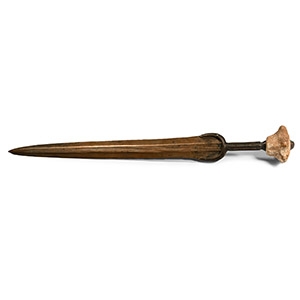
Luristan Bronze Sword with Decorated Stone Pommel
13th-7th century B.C.Estimate: £800 - 1,000 (+bp*)
Opening Bid: £500
With solid cast hilt with penannular guard and a horizontally ribbed grip; a massive star-shaped pommel and a multi-fullered blade tapering to a sharp tip; handle restored. 1.03 kg, 63.5 cm
Acquired 1980-2015. Ex Abelita family collection.
According to Moorey, such category of swords were distributed in the Northern Iran area, as proved by the Amarlu finds. Based on the example from the Ashmolean Museum, he dated them to the end of the 2nd millennium B.C., more precisely to a period between 1400-1200 B.C. The type was in use until the 7th century B.C. -
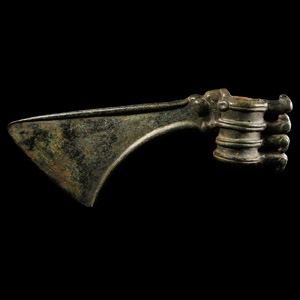
Luristan Bronze Spike-Butted Axehead
11th-8th century B.C.Estimate: £3,000 - 4,000 (‡+bp*)
Opening Bid: £1,500
Blade with folded upper and lower edge, cylindrical socket with projecting ribs formed as the necks and heads of birds, blace 'projecting' from the mouth of a roaring lion at the neck. 478 grams, 22.5 cm
Ex Parisian private collection. with Cuvreau Expertises Enchères S.A., sale 60, 21 June 2009, lot 105. This lot has been checked against the Interpol Database of stolen works of art and is accompanied by search certificate number no.11876-206787. -
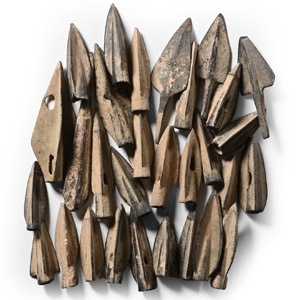
Greek Bronze Arrowhead Collection
Circa 5th-3rd century B.C.Sold for (Inc. bp): £221
Including triangular-section sockettedtype, triangular barbed type, tanged leaf-shaped type and others. 104 grams total, 23-58 mm
Ex London, UK, collection, 1990s.
