
Loading, please wait...
_900x900.jpg "Migration Period Iron Spatha Sword with Garnet Inlaid Hilt")
_200x200.jpg "Migration Period Iron Spatha Sword with Garnet Inlaid Hilt")
_900x900.jpg "Migration Period Iron Spatha Sword with Garnet Inlaid Hilt")
_200x200.jpg "Migration Period Iron Spatha Sword with Garnet Inlaid Hilt")
.jpg "Migration Period Iron Spatha Sword with Garnet Inlaid Hilt")
.jpg "Migration Period Iron Spatha Sword with Garnet Inlaid Hilt")
LOT 0278
Migration Period Iron Spatha Sword with Garnet Inlaid Hilt
5TH-7TH CENTURY A.D.
3/4 - 31 1/2 in. (753 grams total, 1.9-80 cm).
Comprising a double-edged parallel-sided blade showing battle nicks on both cutting edges, medium length tapering tang; lentoid-shaped lower-guard with inset garnets to one side; accompanied by an amber sword bead with a bronze stud with garnet inlay. [4]
ProvenanceFrom the private collection of a London gentleman, from his grandfather's collection formed before the early 1970s.
Accompanied by an academic report by Dr Raffaele D’Amato.
This lot has been checked against the Interpol Database of stolen works of art and is accompanied by a search certificate no. 12063-217911.
Cf. Menghin, W., Das Schwert im Frühen Mittelalter, Stuttgart, 1983; Zasetskaïa, I.P., Kul’tura Kotchovnikov iujnorusskikh stepeï v gunnskuïu epokhu (Culture of the nomads of the southern Russian steppes in the Hun era), Saint Petersburg, 1994; Lebedinski, I., Armes et guerriers Barbares au temps des grandes invasions IVème au Vième siècle après J.C., Paris, 2001, pp.117ff., swords from Loutchistoïé, Novohryhorivka, Bátaszék, Jakuszowice, Szirmabesényo, Ártánd, Horgos; Miks, C., Studien zur Römischen Schwertbewaffnung in der Kaiserzeit, I-II Banden, Rahden, 2007; Kazanski, M.M., Barbarians at the borders of the Eastern Roman Empire (in Russian), Simferopol, 2024, figs.12, p.20, 23, p.31, pl.36, for similar cross-guards.
FootnotesThis type of swords (cf. Lebedinsky 2001, p.117) usually had stones hanging from the pommel or hilt, like the one preserved here. This typology was widespread in central Europe by the Huns and there are also specimens attested in Gaul in the 5th century.
CONDITIONTimeLine Auctions follows a vetting process to ensure the authenticity and legality of all items, reinforcing our commitment to integrity and responsible trading. Each antiquity, antique, and coin lot undergoes thorough examination by a vetting committee of at least ten external specialists, professional trade association members, scientists, and archaeologists: Our Vetting Process
AUCTIONS:
TimeLine is a leading auction house specialising in antiquities, ancient art, collectables, natural history, coins, medals, and books. Our auctions offer museums, collectors, historians, and enthusiasts the opportunity to acquire unique and historically significant pieces.
LOT 0278
Migration Period Iron Spatha Sword with Garnet Inlaid Hilt
Estimate £5,000 - 7,000€5,800 - 8,120 (for guidance only)$6,750 - 9,450 (for guidance only)
-
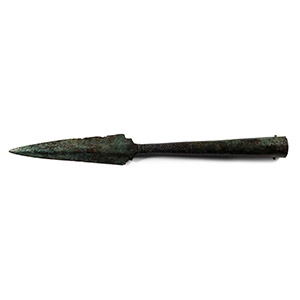
Elamite Socketted Spearhead
1st millennium B.C.Estimate: £300 - 400 (+bp*)
Opening Bid: £167
With tapering split socket, stepped shoulders and two-edged triangular head; pronounced midrib, bands of low-relief chevron and braid detailing, attachment pin. 180 grams, 28 cm
From a Mayfair, London, gallery, 1990s. -
.jpg)
Medieval 'Thames' Iron Dagger with Wood Handle
Circa 15th century A.D.Sold for (Inc. bp): £260
Sturdy single-edged triangular whittle-tang blade with thick back; with reproduction wooden handle. 137 grams, 34 cm
Found Billingsgate spoil from the Thames foreshore, London, UK, circa 1984. Property of an Essex collector. -
.jpg)
Migration Period Iron Sword with Rock Crystal, Gold and Garnet Sword Bead
5th-6th century A.D.Estimate: £2,000 - 3,000 (+bp*)
Opening Bid: £600
Comprising a double-edged blade with pointed tip, battle nicks to both cutting edges; short bronze guard and a long tang; accompanied by a facetted rock crystal hilt pendant with a granulated gold mount above, set with a garnet cabochon; Eastern Roman or Alano-Gothic. 750 grams, 4-91.5 cm
From the private collection of a London gentleman, from his grandfather's collection formed before the early 1970s. Accompanied by an academic report by Dr Raffaele D’Amato. This lot has been checked against the Interpol Database of stolen works of art and is accompanied by a search certificate number no.12041-216428.
A characteristic type of the Migration period, originally used by nomadic people such as the Alans and Sarmatians. An important element of these swords was the presence (in tombs) of amber or rock crystal fittings, which some authors have identified being part of the pommel (Zasetskaya), and others as pendants hanging from the hilt of the sword. Interestingly the sword of grave 9 from the Necropolis of Novohryhorivka is decorated with a similar pendant, made of amber and fitted with a silver mount decorated with a filigree border.
