
Loading, please wait...
LOT 1168
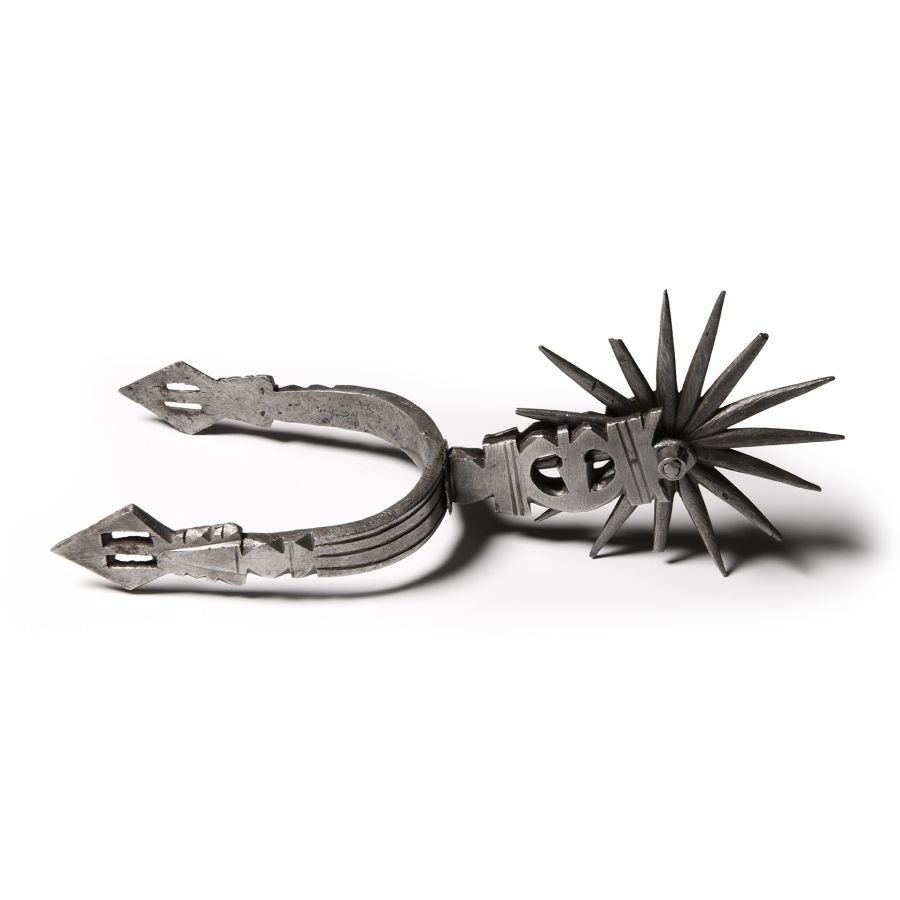
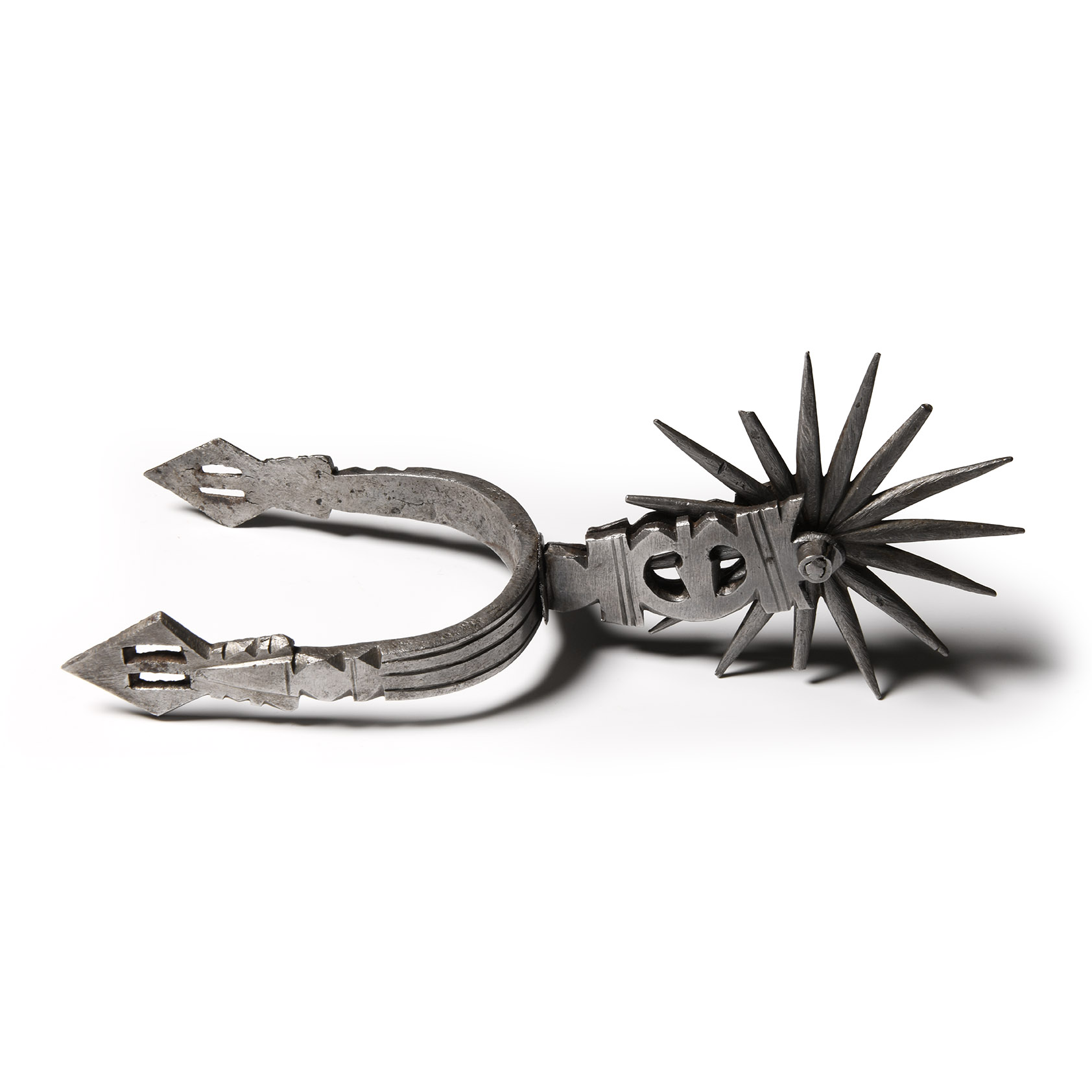
Mexican Iron Rowel Spur
18TH-19TH CENTURY A.D.
8 5/8 in. (252 grams, 22 cm).
Heelband with geometric motifs, channelling and lozengiform terminals, pierced work neck and large free-running rowel.
ProvenanceAcquired from Rusty Old Arms, UK, 2014.
The Kusmirek Collection, UK.
Accompanied by copies of the ROA invoice and listing.
TimeLine Auctions follows a vetting process to ensure the authenticity and legality of all items, reinforcing our commitment to integrity and responsible trading. Each antiquity, antique, and coin lot undergoes thorough examination by a vetting committee of at least ten external specialists, professional trade association members, scientists, and archaeologists: Our Vetting Process
AUCTIONS:
TimeLine is a leading auction house specialising in antiquities, ancient art, collectables, natural history, coins, medals, and books. Our auctions offer museums, collectors, historians, and enthusiasts the opportunity to acquire unique and historically significant pieces.
LOT 1168
Mexican Iron Rowel Spur
Estimate £150 - 200€170 - 230 (for guidance only)$200 - 270 (for guidance only)
-
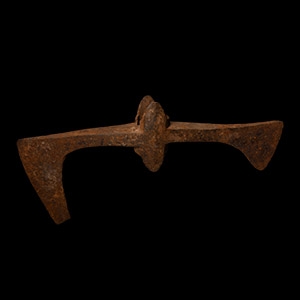
Eastern Roman Iron Double Axehead
11th-14th century A.D.Sold for (Inc. bp): £221
Composed of a central circular socket with flanges, one head with extended lower blade, the other with a wedge-shaped head. 1.8 kg, 36 cm
Acquired 1990s-early 2000s. East Anglian private collection.
This kind of 'Tzikourion' is found in all the Eastern Roman territories from 11th to 14th century A.D., and in many South East European territories. The overall design and the massive T-shaped hafting socket are very similar to those of an 11th century war axe from Cozanesti, Moldova, and from various14th century A.D. specimens from Bulgaria. -
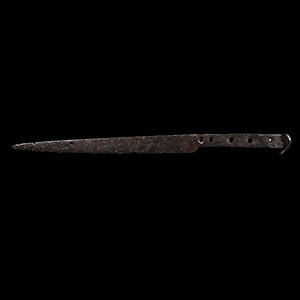
Medieval Iron Single-Edged Dagger
15th-16th century A.D.Estimate: £120 - 170 (+bp*)
Opening Bid: £50
The blade with a tapering, triangular cross-section and tang with rivet holes; wedge-shaped domed pommel. 131 grams, 31.5 cm
Acquired 1960s-1990s. From the late Alison Barker collection, a retired London barrister.
This is a weapon rather than a domestic knife, and is depicted as a sidearm for soldiers and knights alike in various iconography. This type of dagger was in use from the 14th to mid 16th century, and this example finds similarities with Hauswehrs used in the Eastern Europe during the 15th-16th century A.D. -
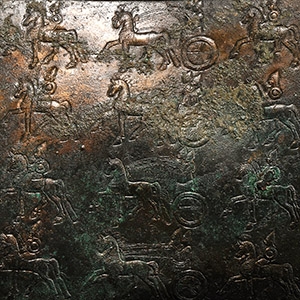
Neo-Assyrian 'Axel Guttmann' Bronze Belt Section Group
9th-7th century B.C.Sold for (Inc. bp): £2,340
Comprising two belt sections, each perforated around the edges for attachment: one with a repoussé display of alternating lions leaping towards warriors on horseback, leaping horned bulls and archers standing in horse-drawn war chariot; one fragment with articulate loop; the other folding over on itself, with repoussé display of helmetted warriors on horseback, alternating with warriors driving horse-drawn chariots; Urartian or Assyrian. 845 grams total, 30.5-35 cm
Ex Axel Guttmann collection, with reference no.AG R 244. Accompanied by an academic report by Dr Raffaele D’Amato. This lot has been checked against the Interpol Database of stolen works of art and is accompanied by search certificate number no.11760-203204.
