
Loading, please wait...
LOT 1194
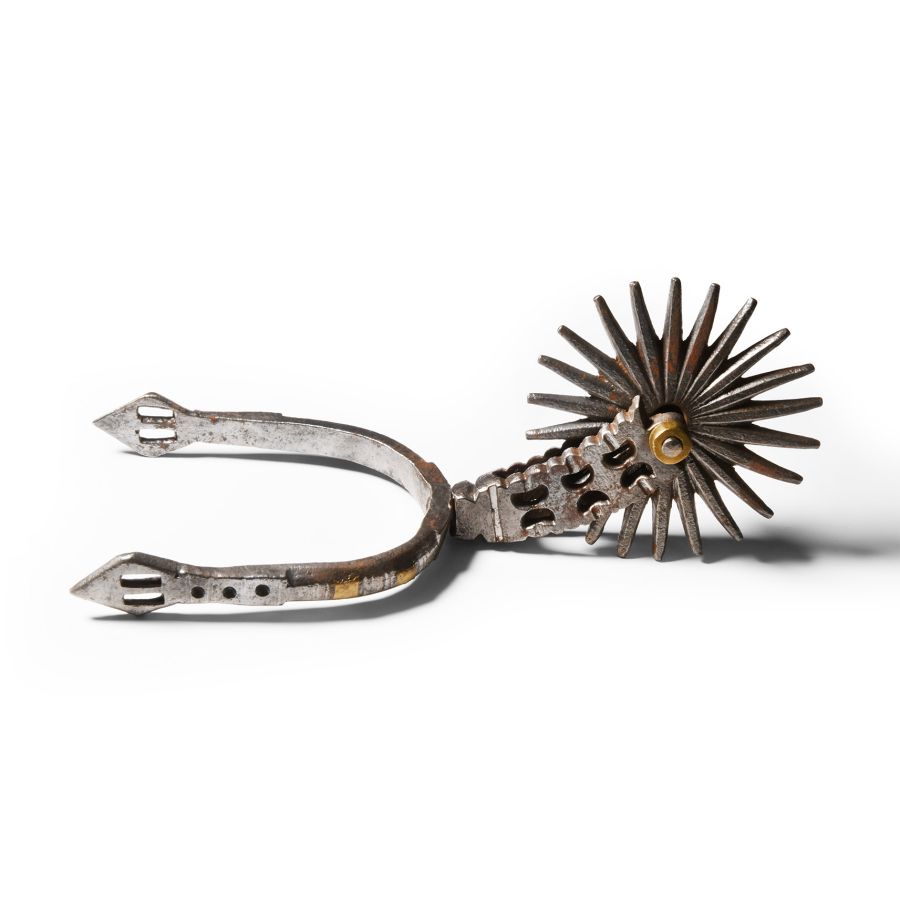
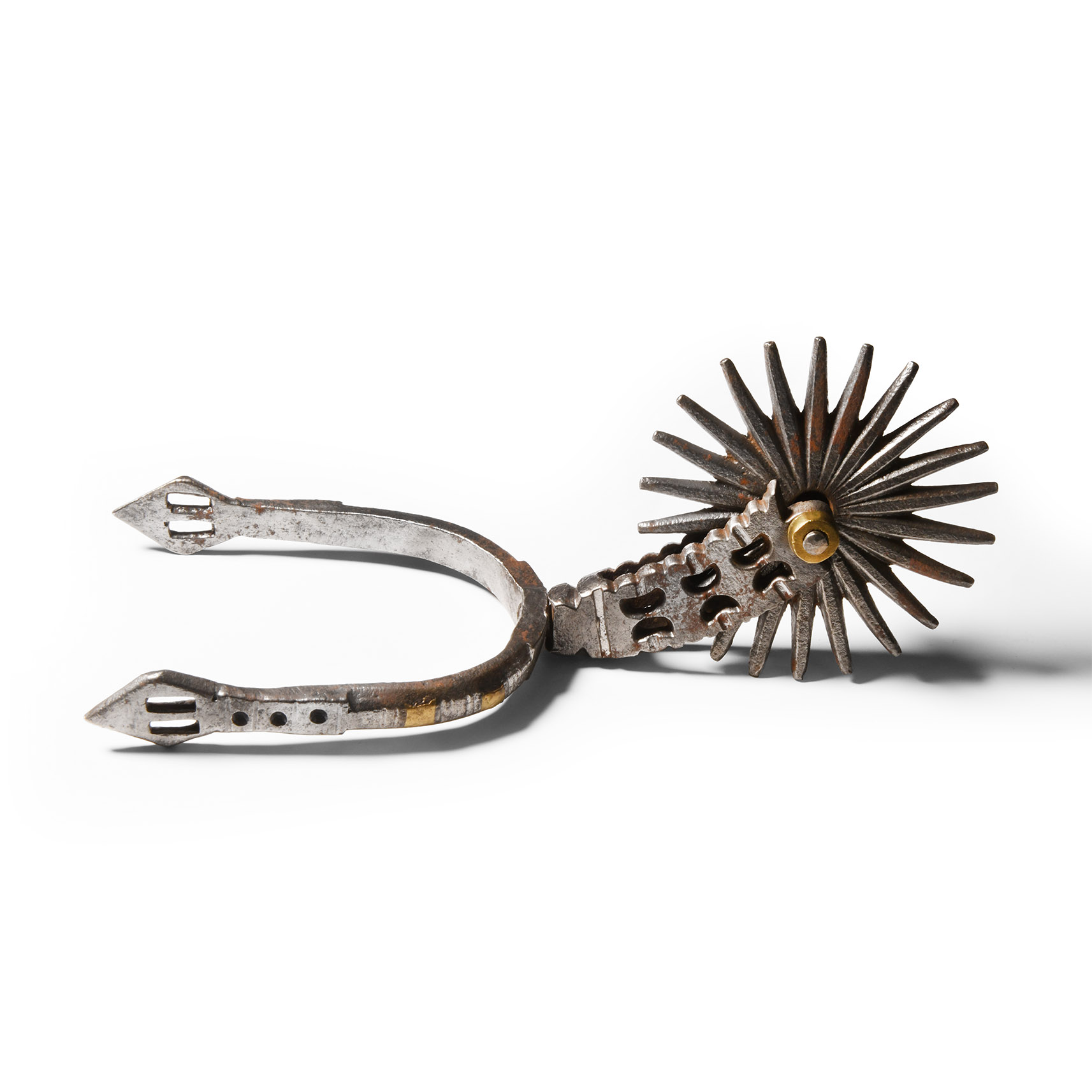
Mexican Iron and Brass Rowel Spur
19TH CENTURY A.D.
8 5/8 in. (349 grams, 22 cm).
With pierced crescent motifs to the shank, free-running star-shaped rowel and geometric engraving to heelband with lozengiform terminals. [No Reserve]
ProvenanceAcquired from Czerny's Auctions, Italy, 2016, lot 390.
The Kusmirek Collection, UK.
Accompanied by copy of Czerny's invoice and lot details.
TimeLine Auctions follows a vetting process to ensure the authenticity and legality of all items, reinforcing our commitment to integrity and responsible trading. Each antiquity, antique, and coin lot undergoes thorough examination by a vetting committee of at least ten external specialists, professional trade association members, scientists, and archaeologists: Our Vetting Process
AUCTIONS:
TimeLine is a leading auction house specialising in antiquities, ancient art, collectables, natural history, coins, medals, and books. Our auctions offer museums, collectors, historians, and enthusiasts the opportunity to acquire unique and historically significant pieces.
-
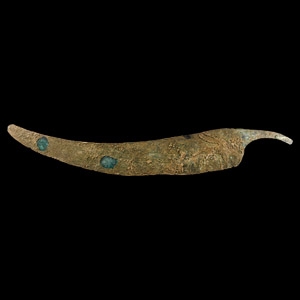
Western Asiatic Bronze Dagger
2nd-1st millennium B.C.Estimate: £100 - 140 (+bp*)
Opening Bid: £50
Single-edged, curved with scooped shoulder and flat tang. 78 grams, 31 cm
Ex German collection, Cologne, 1980-1990s.
In the middle of the 2nd millennium B.C., combat knives were widely used in Palestine and Syria. Some of them reproduced in local forms and constructions of the beginning of the 2nd millennium B.C., others had a concave blade with a humpbacked back or S-shaped blades which, apparently, should be associated with influences from Asia Minor influence. -
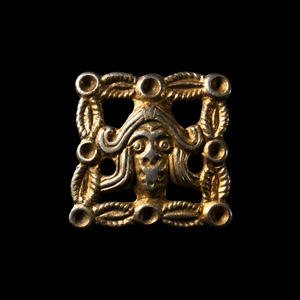
Khazar Silver-Gilt Sword Belt Mount with Warrior
9th-10th century A.D.Sold for (Inc. bp): £374
Square in plan with a slightly convex openwork panel composed of alternating circular cells and leaf-like ovals, central male head with long hair and stylised facial features, possibly wearing a helmet; attachment loop to each corner on the reverse. 8.27 grams, 22 mm
Fine condition.
Acquired in the 1980s-1990s. Ex an important central London gallery, London W1. -
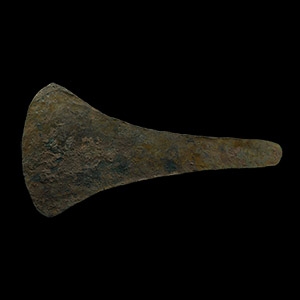
Western Asiatic Bronze Flat Axe
Circa 2nd millennium B.C.Sold for (Inc. bp): £78
Featuring wedge-shaped cheeks, a convex cutting edge and rounded terminal. 106 grams, 18.6 cm
UK private collection formed before 2000. Ex North London, UK, gallery.
The flat axe belongs to Type 1, sub-type a.4 of the Çetin-Bilgi classification of flat axes. They have concave-sided blade, rectangular in section, a splayed cutting edge and a narrow butt. The first examples of axe-type weapons appear in the last phase of the Late Chalcolithic Age in the Middle East and Anatolia.
