
Loading, please wait...
LOT 1302
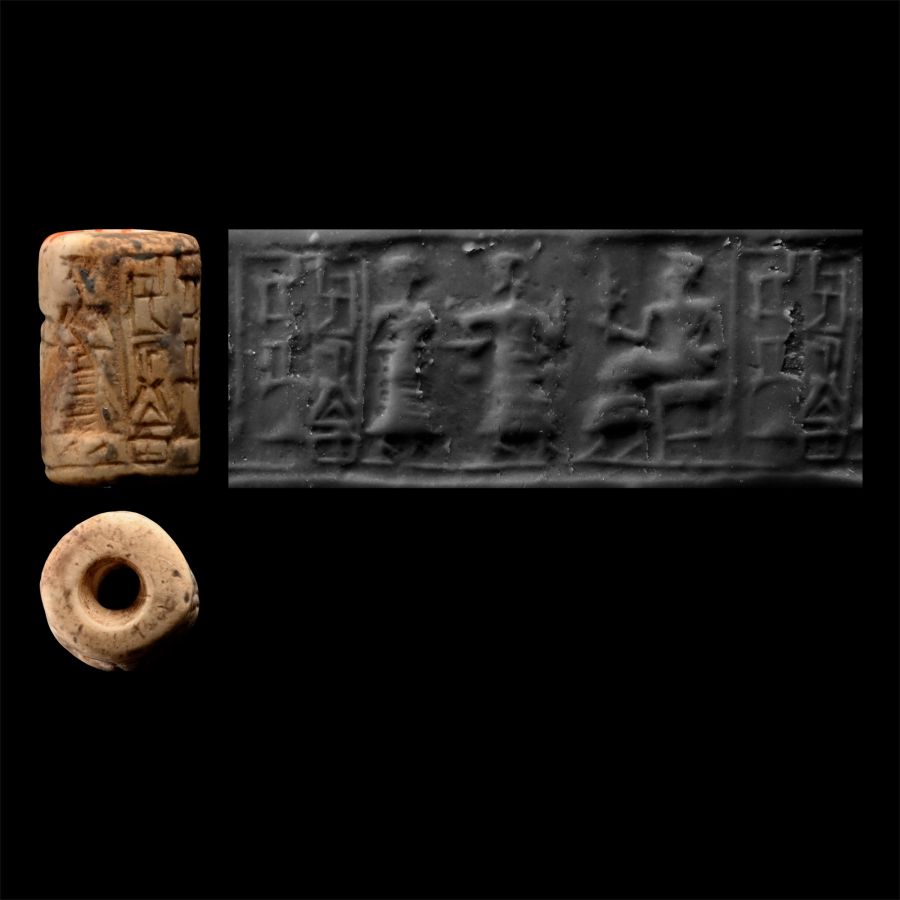
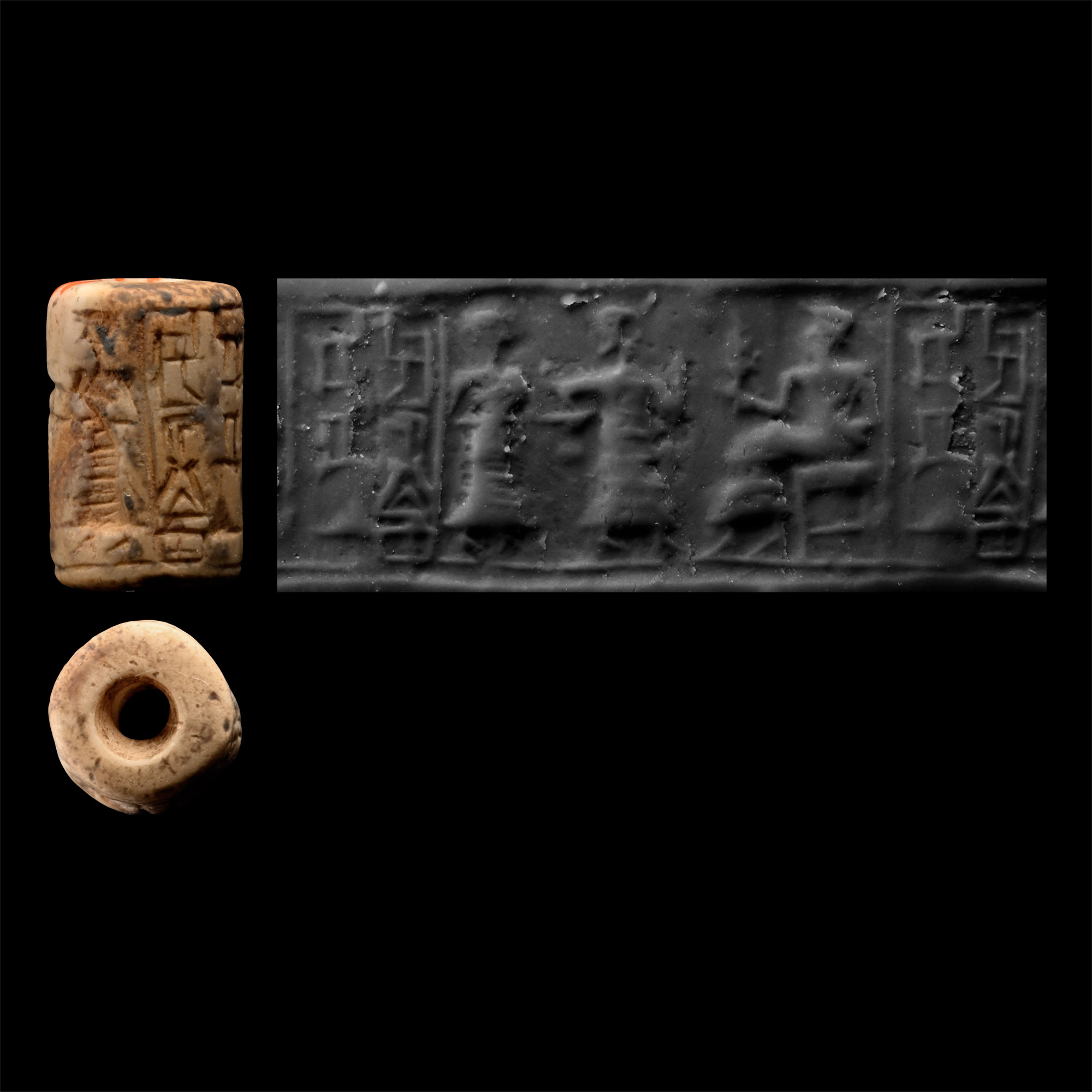
Mesopotamian Stone Cylinder Seal for Tatku-Mamma
CIRCA 2000-1900 B.C.
5/8 in. (3.66 grams, 15 mm).
Cylinder with cord and bead handles; accompanied by a copy of an old scholarly note, typed and signed by W.G. Lambert, late Professor of Assyriology, University of Birmingham, 1970-1993, which states: 'Description of Cylinder Seal of White/Cream Stone, 15 x 9.5 mm. Seated figure in flounced dress faces a standing figure in flounced dress with right hand raised in greeting and left hand gripping wrist of similarly dressed figure behind. There is a base-line, but no upper rule. Inscription (owner's name) : tá-at-ku-ma-ma = Tatku-Mamma. This is a north- or west-Mesopotamian rendering of the Ur III presentation scene. In the Ur III examples the seated deity meets a human being introduced by a minor deity, but in this case all three figures are similarly dressed. The seated deity holds up a piece of plant for identification, perhaps marking him as the Syrian storm god Addu. The date must be c. 2000-1900 B.C. Condition: good.'; supplied with a museum-quality impression. [No Reserve]
ProvenanceUK private collection, acquired 1980-1983.
Accompanied by a copy of a scholarly note, typed and signed by Professor Wilfrid George Lambert in October 1987.
This lot has been cleared against the Art Loss Register database, and is accompanied by an illustrated lot declaration signed by the Head of the Antiquities Department, Dr Raffaele D'Amato.
TimeLine Auctions follows a vetting process to ensure the authenticity and legality of all items, reinforcing our commitment to integrity and responsible trading. Each antiquity, antique, and coin lot undergoes thorough examination by a vetting committee of at least ten external specialists, professional trade association members, scientists, and archaeologists: Our Vetting Process
AUCTIONS:
TimeLine is a leading auction house specialising in antiquities, ancient art, collectables, natural history, coins, medals, and books. Our auctions offer museums, collectors, historians, and enthusiasts the opportunity to acquire unique and historically significant pieces.
-
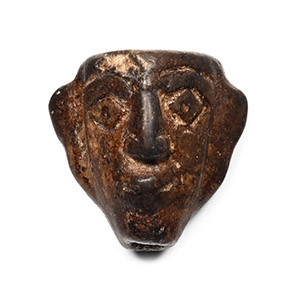
Sumerian Black Stone Face Amulet
Uruk/Jemdet Nasr Period, circa 3500-2900 B.C. or laterEstimate: £250 - 350 (+bp*)
Opening Bid: £125
Carved in the half-round with large eyes and ears; drilled depression above the head and beneath the chin. 4.6 grams, 19 mm
From the 'S' collection, acquired 1970-1990s. Accompanied by a description from Peter Gert Van der Veen, senior lecturer of Levantine Archaeology, Johannes Gutenberg-Universität, Mainz. This lot has been cleared against the Art Loss Register database, and is accompanied by an illustrated lot declaration signed by the Head of the Antiquities Department, Dr Raffaele D'Amato. -
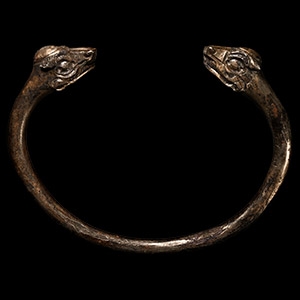
Achaemenid Silver Bracelet with Beast-Heads
2nd century B.C.-1st century A.D.Estimate: £500 - 700 (+bp*)
Opening Bid: £250
Comprising a round-section penannular body and finely-modelled opposed beast-head terminals. 54.2 grams, 78 mm
Ex Simmons gallery, London, UK, 1990s. This lot has been cleared against the Art Loss Register database, and is accompanied by an illustrated lot declaration signed by the Head of the Antiquities Department, Dr Raffaele D'Amato. -
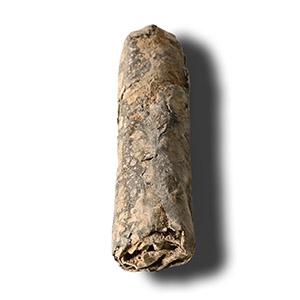
Western Asiatic Aramaic Lead Scroll with Magical Text
2nd-8th century A.D.Sold for (Inc. bp): £293
A rectangular lead sheet rolled into a tight scroll with the text to the inner face. 31 grams, 58 mm
Collected from 1970-1999. From the collection of the late Mr S.M., London, UK. This lot has been cleared against the Art Loss Register database, and is accompanied by an illustrated lot declaration signed by the Head of the Antiquities Department, Dr Raffaele D'Amato.
The item was possibly meant to be what the Romans called a defixio or 'curse tablet', on which the magical malediction was recorded and then shut away (by being tightly rolled up) so that the victim could not find it or change it.
