
Loading, please wait...
_900x900.jpg "Mesopotamian Stone Cylinder Seal for Shamash-ili, son of Nirgal-gamil")
_200x200.jpg "Mesopotamian Stone Cylinder Seal for Shamash-ili, son of Nirgal-gamil")
.jpg "Mesopotamian Stone Cylinder Seal for Shamash-ili, son of Nirgal-gamil")
LOT 0206
Mesopotamian Stone Cylinder Seal for Shamash-ili, son of Nirgal-gamil
CIRCA 2ND-1ST MILLENNIUM B.C.
1 in. (9.16 grams, 28 mm).
Engraved with a frieze composed of human figures and columns of text: 'Shamash-ili, son of Nirgal-gamil (?), servant of (the god) Sakkud'; drilled vertically for suspension.
ProvenanceFrom an important London, UK, collection, 1970-1990.
Examined by Professor Wilfrid George Lambert FBA (1926-2011), historian, archaeologist, and specialist in Assyriology and Near Eastern archaeology, in the late 1980s and early 1990s.
TimeLine Auctions follows a vetting process to ensure the authenticity and legality of all items, reinforcing our commitment to integrity and responsible trading. Each antiquity, antique, and coin lot undergoes thorough examination by a vetting committee of at least ten external specialists, professional trade association members, scientists, and archaeologists: Our Vetting Process
AUCTIONS:
TimeLine is a leading auction house specialising in antiquities, ancient art, collectables, natural history, coins, medals, and books. Our auctions offer museums, collectors, historians, and enthusiasts the opportunity to acquire unique and historically significant pieces.
LOT 0206
Mesopotamian Stone Cylinder Seal for Shamash-ili, son of Nirgal-gamil
Sold for (Inc. bp): £546
-
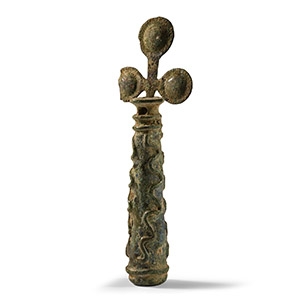
Luristan Bronze Kohl Pot with Snakes and Applicator
13th-7th century B.C.Sold for (Inc. bp): £85
Tapering tubular pot with trumpet-shaped mouth, raised collars to neck and base, undulating snake motifs; applicator with handle formed as three radiating lobes. 46 grams, 11.1 cm
From a collection of a gentleman, acquired on the London art market in the 1990s. -
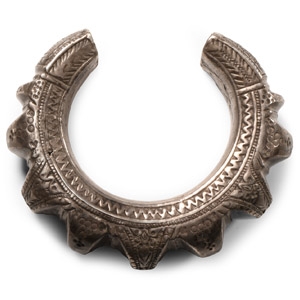
Silver Decorated Bracelet
19th-20th century A.D.Sold for (Inc. bp): £72
Hollow-formed with rattle inside, D-shaped in section with running zigzag to each lateral face, raised transverse crests with punched annulet, rosette and other ornament. 61 grams, 91 mm
UK private collection before 2000. Acquired on the UK art market. Property of a London gentleman. -
.jpg)
Azerbaijan Horse Rhyton
1st millennium B.C.Estimate: £1,000 - 1,400 (+bp*)
Opening Bid: £500
Funicular body with a flaring neck and zoomorphic finial, with circular spout in its chest; chipped. 1.35 kg, 28 cm
Ex London, UK, gallery, 1971-early 2000s. Property of a London gentleman.
