Loading, please wait...
Details
LOT 1238
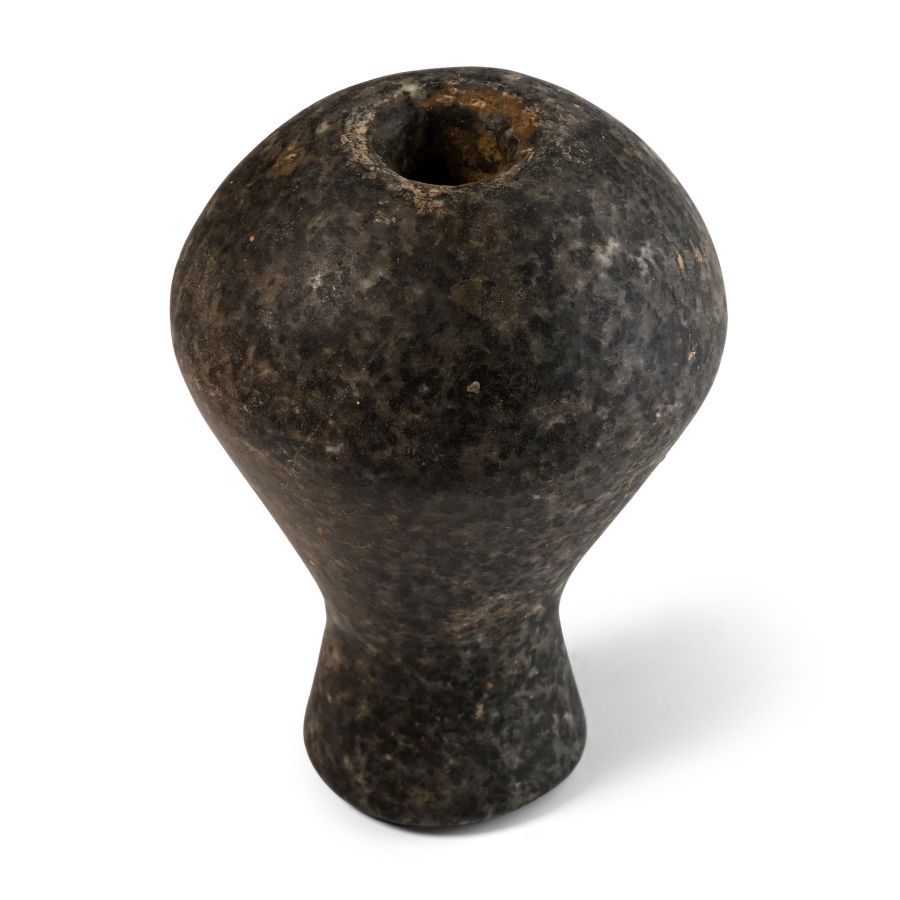
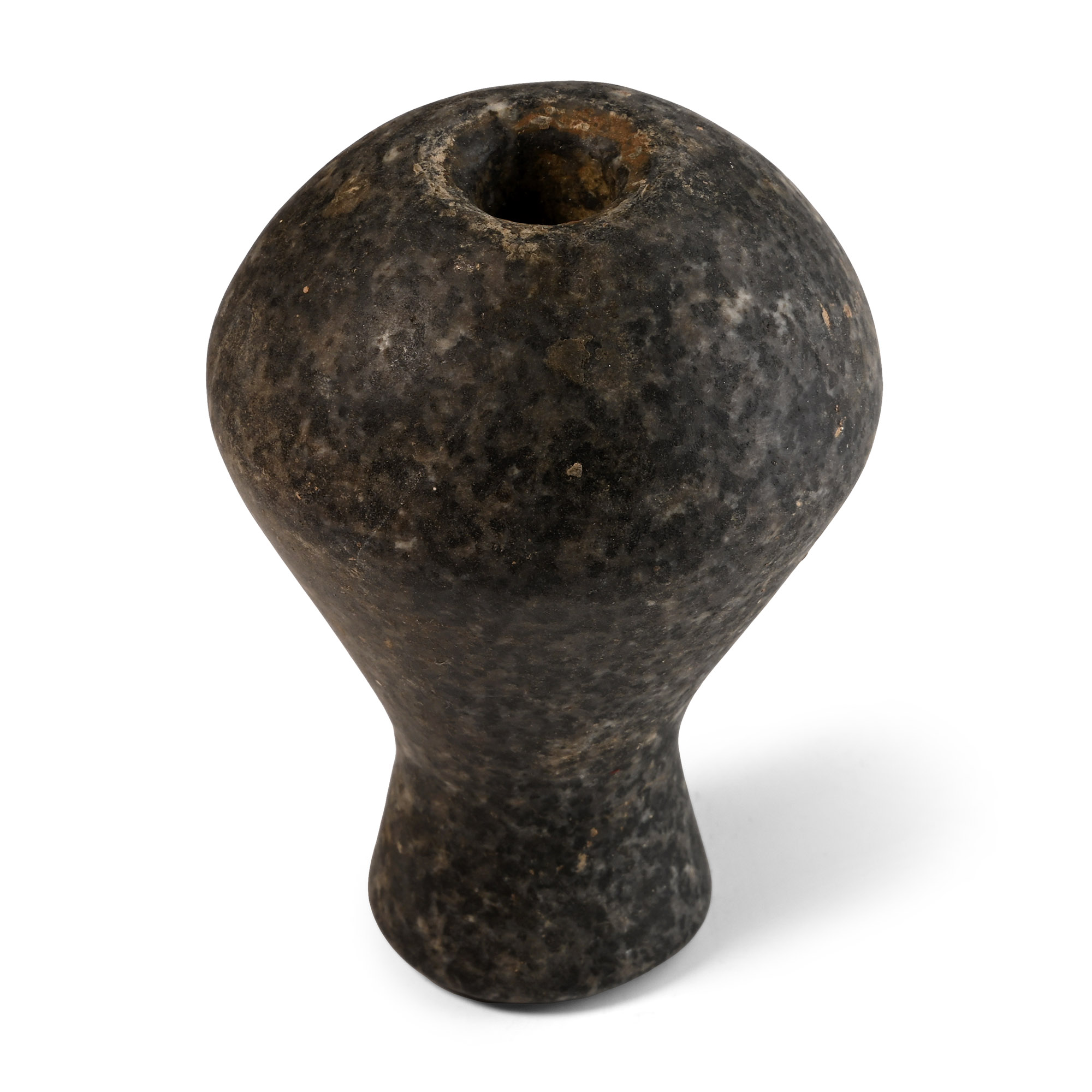
Mesopotamian Black and Grey Mottled Stone Macehead
3RD-2ND MILLENNIUM B.C.
3 3/4 in. (481 grams, 96 mm).
Piriform in profile with flared tubular socket and flat rim, carination to the bulb.
Provenance
Ex 1990s collection and with a central London gallery.
Literature
See Gorelik, M., Weapons of Ancient East, IV millennium BC-IV century BC, Saint Petersburg, 2003, pl.XXX, no.47, mace of a deity, detail of the image on the “Stela of Kites” Eanatuma, Ngirsu, mid-3rd millennium B.C.
CONDITIONVETTING:
TimeLine Auctions follows a vetting process to ensure the authenticity and legality of all items, reinforcing our commitment to integrity and responsible trading. Each antiquity, antique, and coin lot undergoes thorough examination by a vetting committee of at least ten external specialists, professional trade association members, scientists, and archaeologists: Our Vetting Process
AUCTIONS:
TimeLine is a leading auction house specialising in antiquities, ancient art, collectables, natural history, coins, medals, and books. Our auctions offer museums, collectors, historians, and enthusiasts the opportunity to acquire unique and historically significant pieces.
RELATED LOTS
-
Bactrian Black Chlorite 'Hand Bag' Ceremonial Weight
3rd millennium B.C.Sold for (Inc. bp): £9,750
D-shaped in profile with void below the curved edge, obverse with reserved serpent and lion opposed, the lion's claw grasping the serpent; reverse with spread eagle flanked by rearing serpents; all bodies with sockets to accept coloured inserts; mounted on a custom-made stand. 2.95 kg total,18.5 cm (22.5 cm including stand)
with Gallery Rosen Ancient Art, Tel Aviv, 1960s. Ex London, UK, gallery, 1971-early 2000s. London, UK, collection. This lot has been checked against the Interpol Database of stolen works of art and is accompanied by a search certificate no.12774-237878.
The object could have been carried or swung in ceremonies or processions. On one side is a bird of prey, with its claws surrounded by the writhing bodies of two serpents, whose heads flank the bird's head. This symmetrical scheme probably renders a version of the enmity of eagle and serpent, which must have been an important theme of ancient Iranian art; the motif was later diffused throughout the world. -
South Arabian Alabaster Head of a Woman
3rd-1st century B.C.Sold for (Inc. bp): £585
Modelled with an angular nose with straight ridge, small mouth with raised lips, rounded cheeks and chin, shallow eyes with grooved outlines, shallow ears, short neck, the back and the top of the head left roughly tooled; mounted on a custom-made display stand. 3.3 kg total, 24.3 cm high including stand
UK collection, 1990s. Acquired on the UK art market, before 2000. Private collection, Mr M.V., a London-based businessman.
This finely carved calcite-alabaster head was probably unfinished, as can be seen from the absence of the holes for the inlay of the eyes and the unfinished ears. In the Arabian funerary sculptures of the period, the tops of the heads are usually cut off flat just above the hair line and left roughly tooled. The cut was due to the necessity of fitting them into niches of 'house shrines'. Large stelae with niches containing such heads were found in the Timna Cemetery. -
Jemdet Nasr White Marble Cylinder Seal with Temple
3000-2800 B.C.Sold for (Inc. bp): £1,430
Showing a decorated temple with animals, accompanied by a museum quality impression and a copy of an old scholarly note, typed and signed by W.G. Lambert, late Professor of Assyriology, University of Birmingham, 1970-1993, which states: Cylinder Seal of White Marble, 41 x 35 mm. The engraving shows a decorated temple facade and beside it four horned animals, a standard on a pole and a motif of four dots. This is a Jemdet Nasr seal, c. 3000-2800 B.C., from southern Mesopotamia, and is in very good state of preservation. It illustrates the Sumerian city state of the time. the temple was the largest building, and it owned flocks and herds, being a big economic organization as well as a religious institution. For the climate and terrain sheep and goats were the normal domestic animals, and ordinary people might own these. The larger domestic animals, which included cattle and other horned animals such as gazelles which eventually proved unsuccessful as domestic animals, were owned only by the temple. Seals of this size and quality are rare.' 98.8 grams, 41 mm
with Armand Trampitsch, Glyptique Archéologie, Paris, Hôtel Drouot, Sale No.2, 13-14 May 1992, no.216. Accompanied by a copy of a scholarly note, typed and signed by Professor Wilfrid George Lambert in 1992.
Seals were the working signatures of the ancient Near East. Pressed or rolled into wet clay, they secured jars, bags, doors and tablets, and left a distinct impression that identified the owner, authorised a transaction, and showed whether a container had been opened. Stamp seals (pressed once to leave a single emblem) appear from the 7th–4th millennia BC and continue throughout later periods; cylinder seals (rolled to create a repeating frieze) develop in Mesopotamia in the late 4th millennium BC and are used into the 1st millennium BC. Beyond administration, seals were miniature artworks and amulets. Their images—gods and worshippers, royal hunts, banquets, heroes and mythic beasts—broadcast rank, piety and profession, and were believed to protect the owner. Materials range from soft stones to hard chalcedonies, haematite and lapis, worked with drills and abrasives to achieve crisp intaglio cutting. Many were worn on cords or rings and followed their owners through life, sometimes into the grave. Seals matter because they underpin the earliest systems of record-keeping and trade. Impressions on tablets and bullae are primary documents for ancient law, economy and religion; the seals themselves preserve that imagery in the round. For collectors, well-cut examples with sharp impressions, good polish and honest ancient wear are especially desirable, and pieces with early collection histories are keenly sought.