
Loading, please wait...
LOT 0209
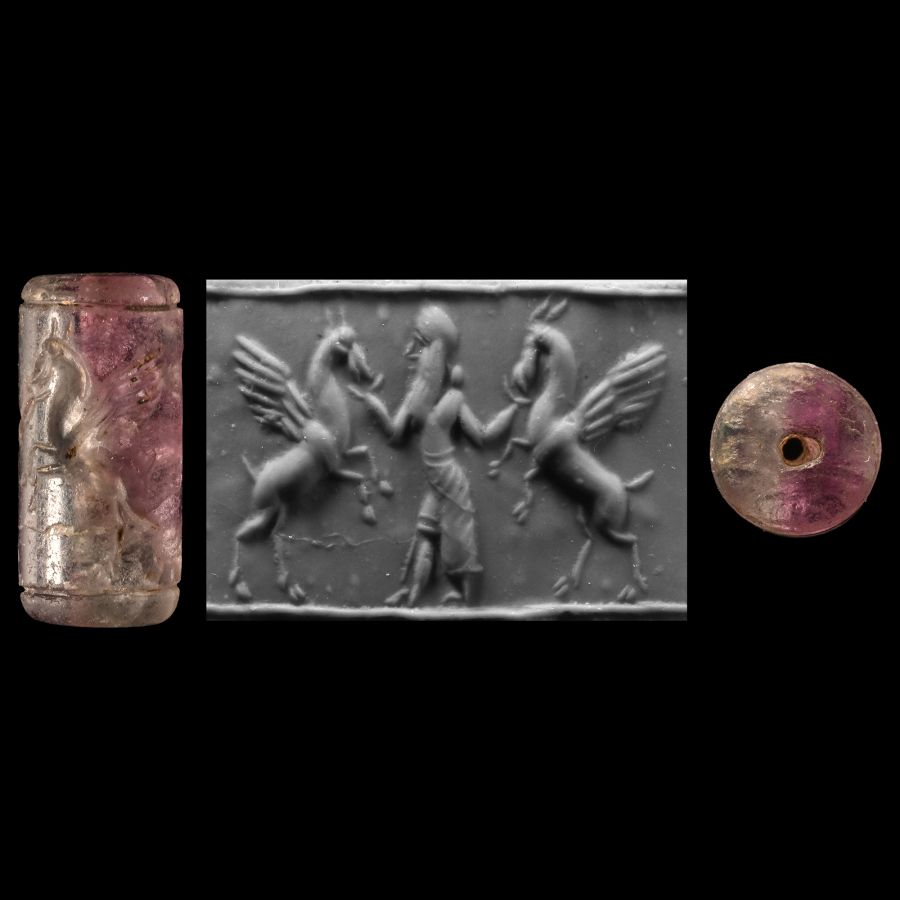
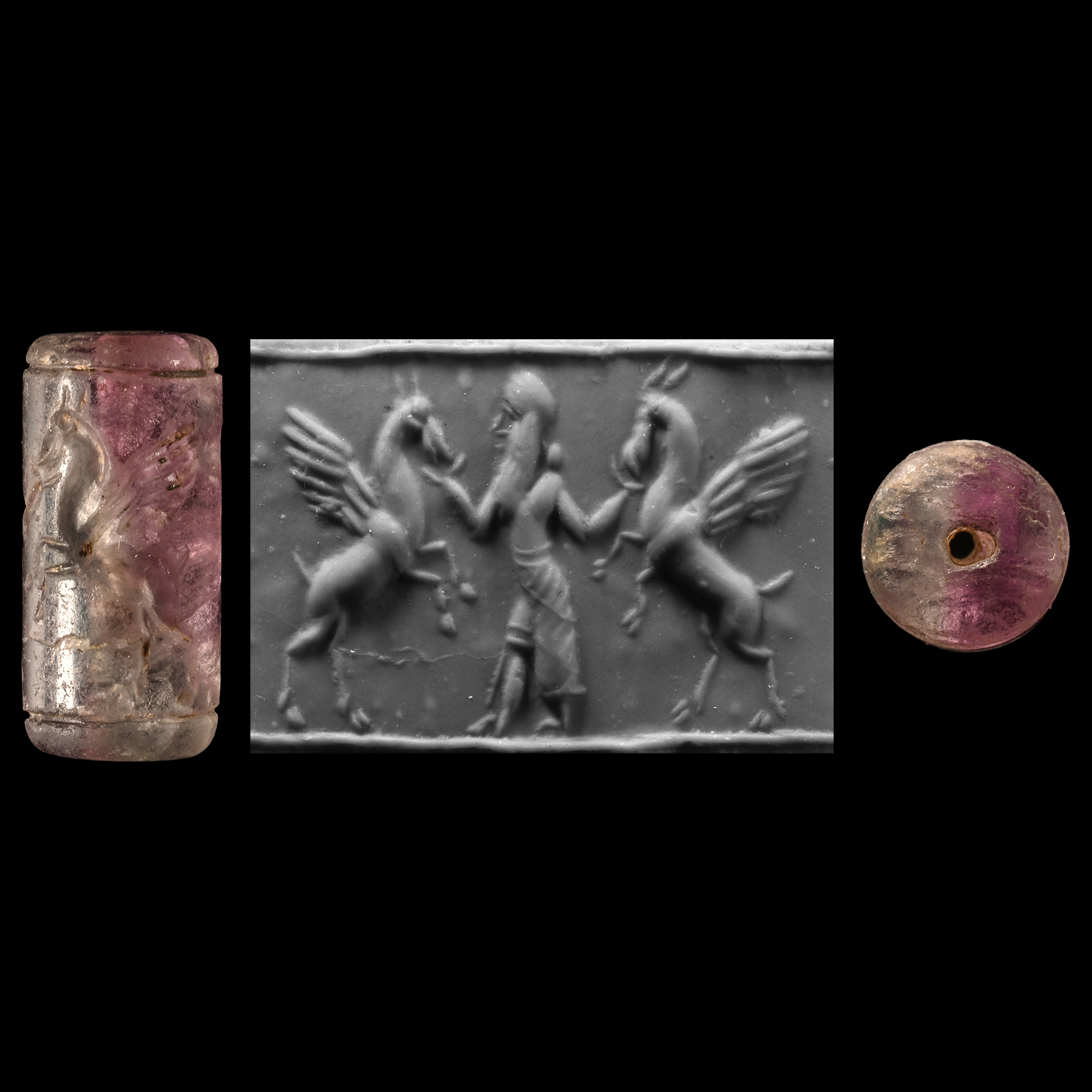
Mesopotamian Amethyst Cylinder Seal with Bearded God
CIRCA 900-600 B.C.
1 in. (6.57 grams, 23 mm).
With bearded male between winged horses; accompanied by an old scholarly note, written and signed by W.G. Lambert, late Professor of Assyriology, University of Birmingham, 1970-1993, which states: 'Cylinder Seal of Amethist [sic] 24 x 11mm. Standing god between two winged horses. North Mesopotamia or West Iran. c.900-600 B.C. Condition good.' [No Reserve]
ProvenanceEx Oasis Ancient Art, London, W1, before 1990.
Academically researched and catalogued by the late Professor Lambert in the 1990s.
From a collection acquired from various auction houses in the UK.
From the estate of Mr R.W., a private Wiltshire, UK, collector; thence by descent.
Accompanied by an original handwritten and signed scholarly note by the late W.G. Lambert, Professor of Assyriology at the University of Birmingham, 1970-1993.
TimeLine Auctions follows a vetting process to ensure the authenticity and legality of all items, reinforcing our commitment to integrity and responsible trading. Each antiquity, antique, and coin lot undergoes thorough examination by a vetting committee of at least ten external specialists, professional trade association members, scientists, and archaeologists: Our Vetting Process
AUCTIONS:
TimeLine is a leading auction house specialising in antiquities, ancient art, collectables, natural history, coins, medals, and books. Our auctions offer museums, collectors, historians, and enthusiasts the opportunity to acquire unique and historically significant pieces.
-
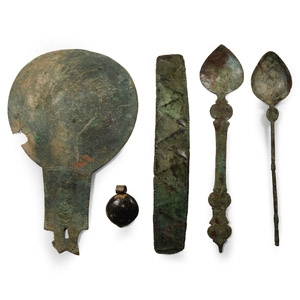
Western Asiatic Bronze Artefact Group
1st millennium A.D. and laterSold for (Inc. bp): £33
Including liturgical spoons and other items. 247 grams total, 4.6-22.8 cm
UK private collection before 2000. On the UK art market. Property of a London gentleman. -
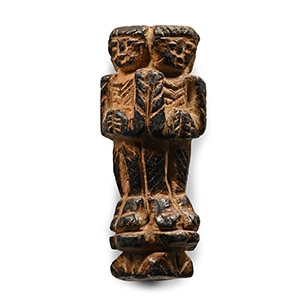
Mesopotamian Hardstone Amulet
1st millennium B.C.Sold for (Inc. bp): £156
Carved with four outward-facing figures on a plinth, with their hands clasped at the chest. 11.2 grams, 36 mm
Acquired in the 1960s-1970s. From the private collection of N.S. and A.L., Bavaria, Germany. Acquired from Gorny and Mosch, Munich, 12 December 2015, no.855 (Part). Property of a French collector. -
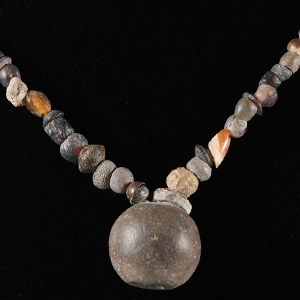
Western Asiatic Mixed Bead Necklace
1st millennium B.C. and laterSold for (Inc. bp): £26
Restrung designer necklace of graduated tubular and other beads, in glass, carnelian and other materials. 46.4 grams, 39 cm
Acquired on the London, UK, art market in the 1990s. Ex London, UK, gallery.
