
Loading, please wait...
LOT 0231
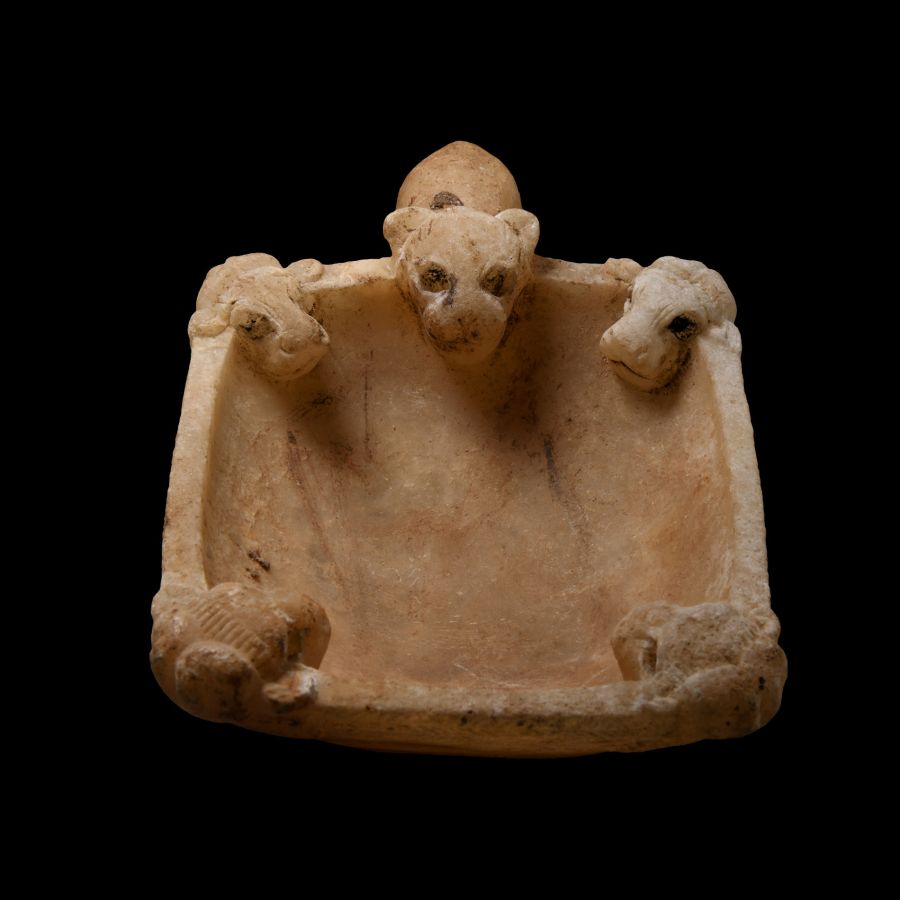
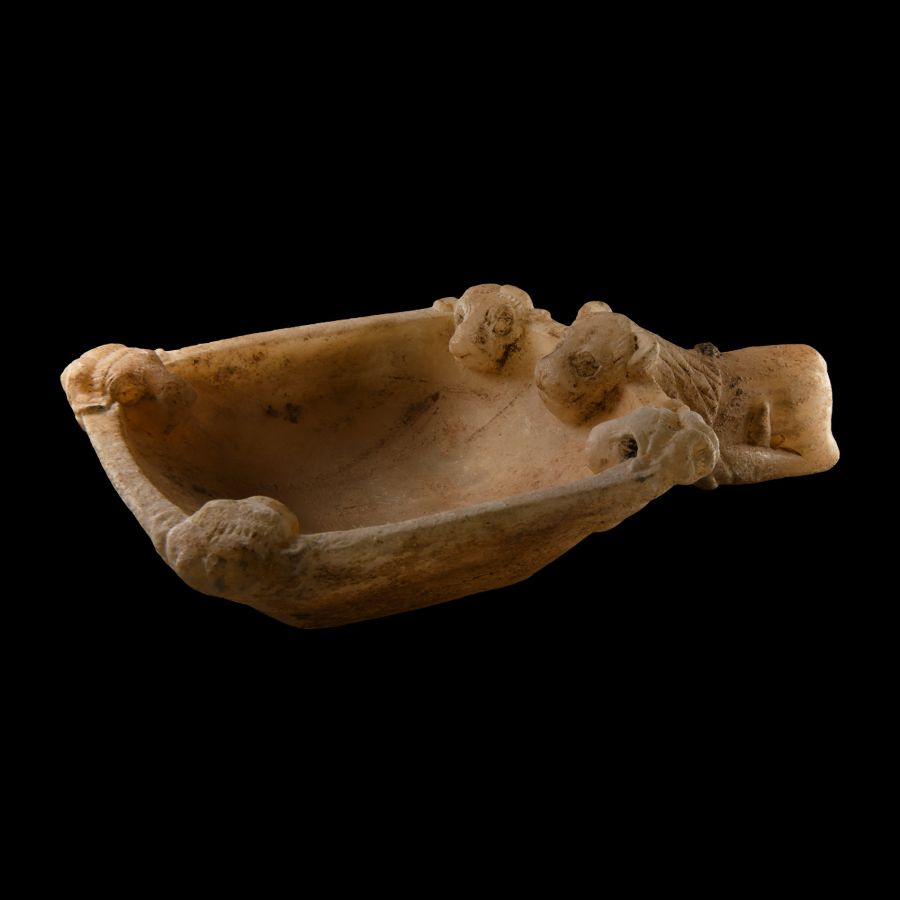
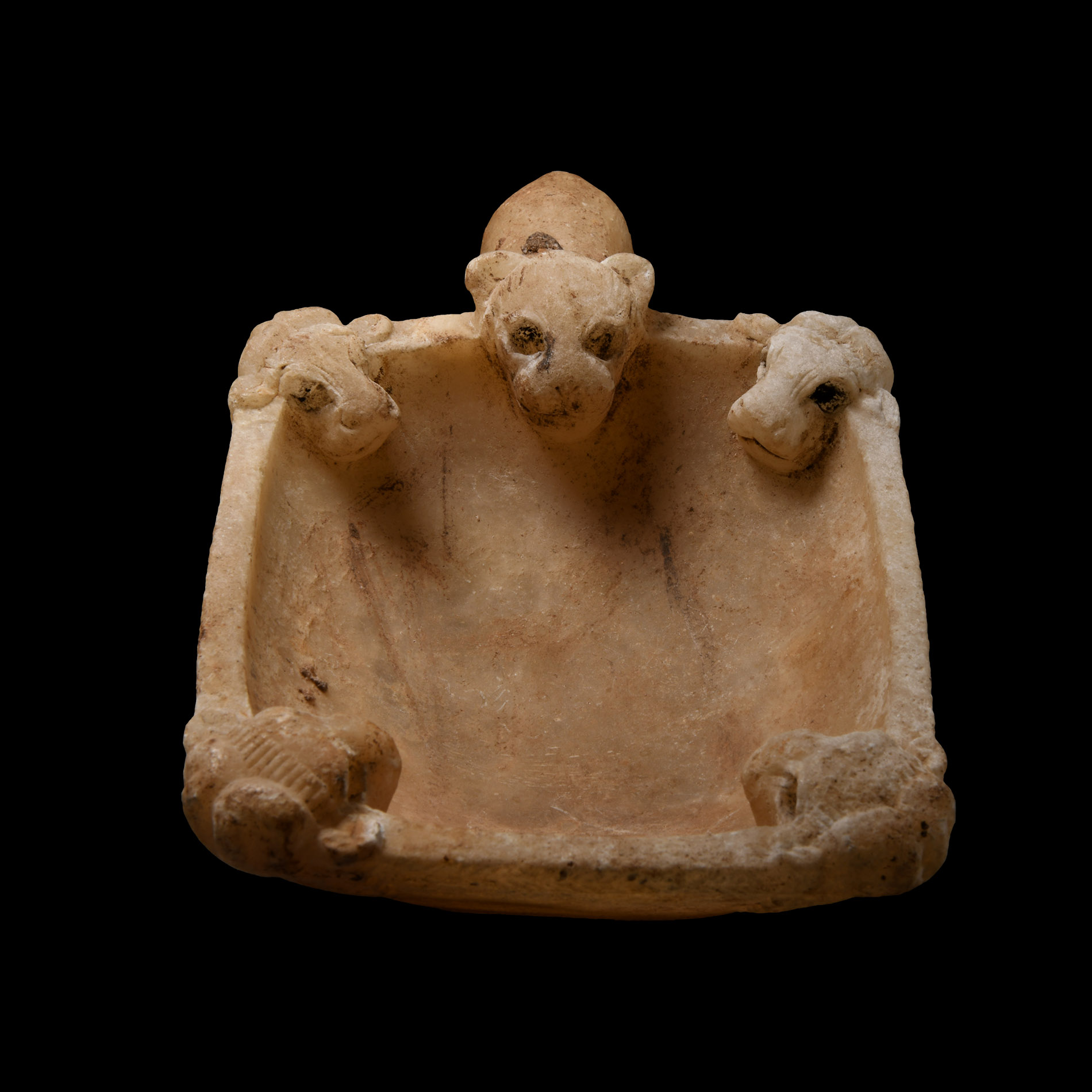
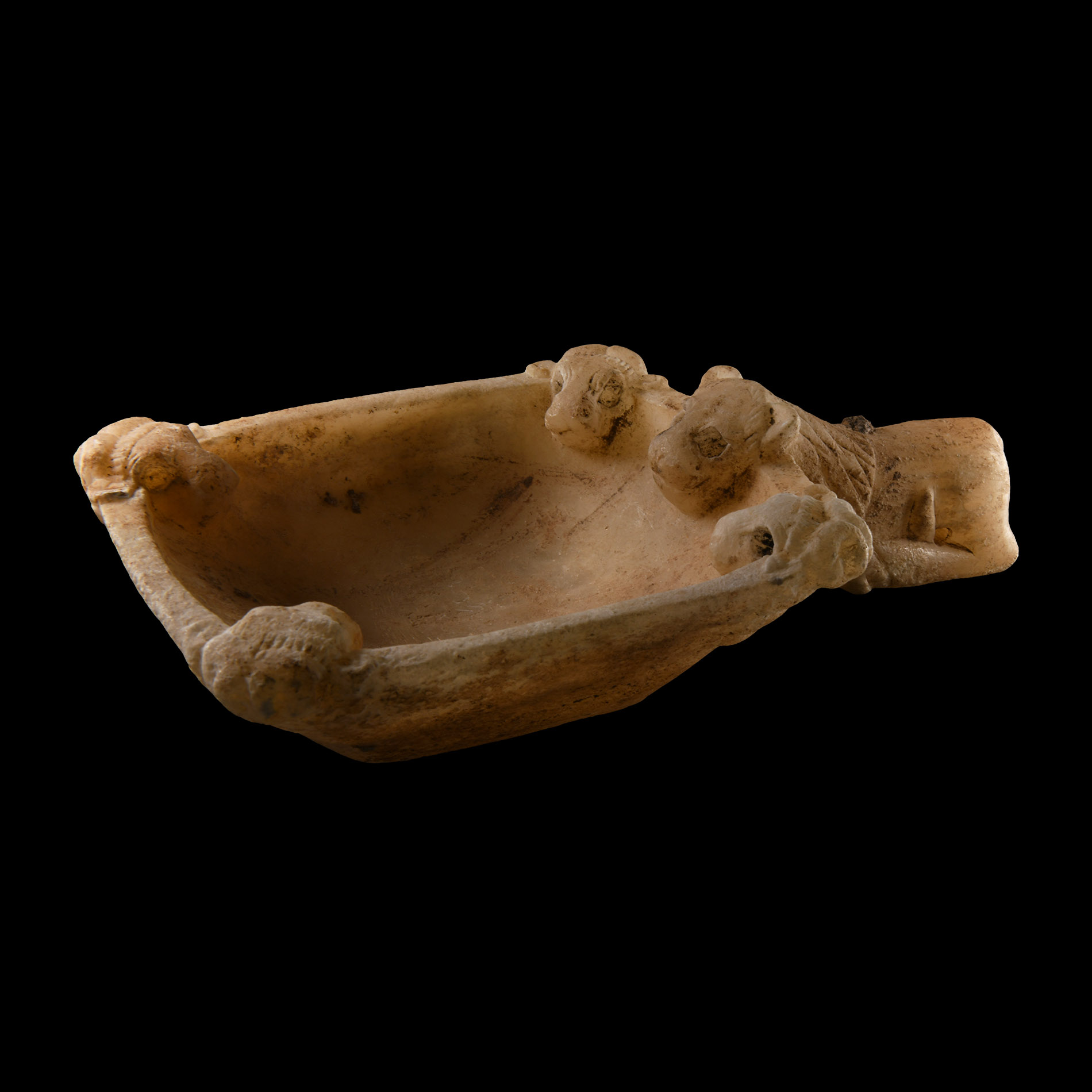
Mesopotamian Alabaster Offering Dish with Lion Handle
2ND-EARLY 1ST MILLENNIUM B.C.
8 3/4 in. (698 grams, 22 cm).
An Aramean rectangular dish with sloping sides, an inward-facing goat-head at each corner; handle formed as a recumbent lion biting the rim; each beast with recessed eyes to accept inserts; ropework band to the underside.
ProvenanceWindermere Collection, Germany, 1960s.
American collection, Phillips, 1960s-1980s.
with Fortuna Fine Arts, 2012.
From the S.M. collection, 2012-2016.
From an important London collection, 2016.
Private collection.
Accompanied by a copy of an Art Loss Register certificate no.S00118561.
Accompanied by an academic report by Dr Raffaele D’Amato.
This lot has been checked against the Interpol Database of stolen works of art and is accompanied by search certificate number no.12164-218579.
Cf. Settgast, J.,Von Troja bis Amarna, The Norbert Schimmel Collection, Mainz, 1978, no.146, for a vessel with similar lion heads; Moorey, P.R.S., Bunker, E.C., Porada, E., and Markoe, G., Ancient Bronzes Ceramics and Seals, The Nasli M. Heeramaneck Collection of Ancient Near Eastern, Central Asiatic and European Art, Los Angeles, 1981, cat.1305, for similar vessel with lion head biting the rim, carved in steatite.
FootnotesThe Aramean civilisation produced superb specimens of vessels, in which the lion, symbol of royal power, was one of the most relevant decorative motifs. Vessels of this typology are already known from the Anatolian culture of Kültepe, the first Hittite capital, since the Middle Bronze Age. Also the culture of Ugarit (Ras Shamarra) produced cups with similar lion heads, in a period of 1500 and 1300 B.C.
CONDITIONTimeLine Auctions follows a vetting process to ensure the authenticity and legality of all items, reinforcing our commitment to integrity and responsible trading. Each antiquity, antique, and coin lot undergoes thorough examination by a vetting committee of at least ten external specialists, professional trade association members, scientists, and archaeologists: Our Vetting Process
AUCTIONS:
TimeLine is a leading auction house specialising in antiquities, ancient art, collectables, natural history, coins, medals, and books. Our auctions offer museums, collectors, historians, and enthusiasts the opportunity to acquire unique and historically significant pieces.
LOT 0231
Mesopotamian Alabaster Offering Dish with Lion Handle
Estimate £18,000 - 24,000€20,880 - 27,840 (for guidance only)$24,300 - 32,400 (for guidance only)
-

Assyrian Bronze Arm and Hand Type Brooch
Circa 7th-5th century B.C.Sold for (Inc. bp): £59
The bow decorated with circumferential grooves, one arm ending with the partially preserved wire coil; the catchplate in the form of a hand engraved with an X; accompanied by a display frame with information ticket. 186 grams total, 10 x 10.3 cm including frame
Ex Robin Symes Gallery, London, UK, 1990s. From a Leicestershire, UK, collection.
Fibulae with triangular bows (type 3 of Curtis classification) were the most common in Assyria. At least 66 bronze examples have been found at Nimrud, 32 in the graves and tombs at Ashur, 14 at Kouyunjik (some of them represented only by fragments), three at Nebbi Yunus, six at Khorsabad, three at Sharif Khan, all fragmentary, and single examples at Tell Billa and Tell al Rimah. -
Western Asiatic Mixed Stone and Glass Necklace Bead Collection
1st millennium B.C. and laterSold for (Inc. bp): £234
Comprising a large quantity of variously shaped beads in lapis lazuli, carnelian, agate, glass and other materials. 87.1 grams total, 2-21 mm
UK gallery, early 2000s.
Glass is the premier bead material. Invented in the Middle East around 2500 B. C., glass making spread slowly. There are mainly two types of beads, drawn beads (when the tubes are cut in a short segments, which are usually agitated over heat to smooth off the sharp edges) or wound beads (made by wrapping molten glass around a rock, stick or wire. Once the bead is built up, it can be further pressed or paddled into shape, placed in a mold, or decorated with other colours of glass. -
Large Western Asiatic Bronze Animal-Headed Cloak Pin
1st millennium B.C.Sold for (Inc. bp): £143
With barrel-shaped upper and tapering body, modelled with coil detailing around the upper body, tiered rings above and finial of an ibex's head with horns returned to form a collar; mounted on a custom-made stand. 347 grams total, 25.5 cm including stand
From a collection acquired on the UK art market from various auction houses and collections mostly before 2000. From an important Cambridgeshire estate; thence by descent.
