
Loading, please wait...
LOT 1618
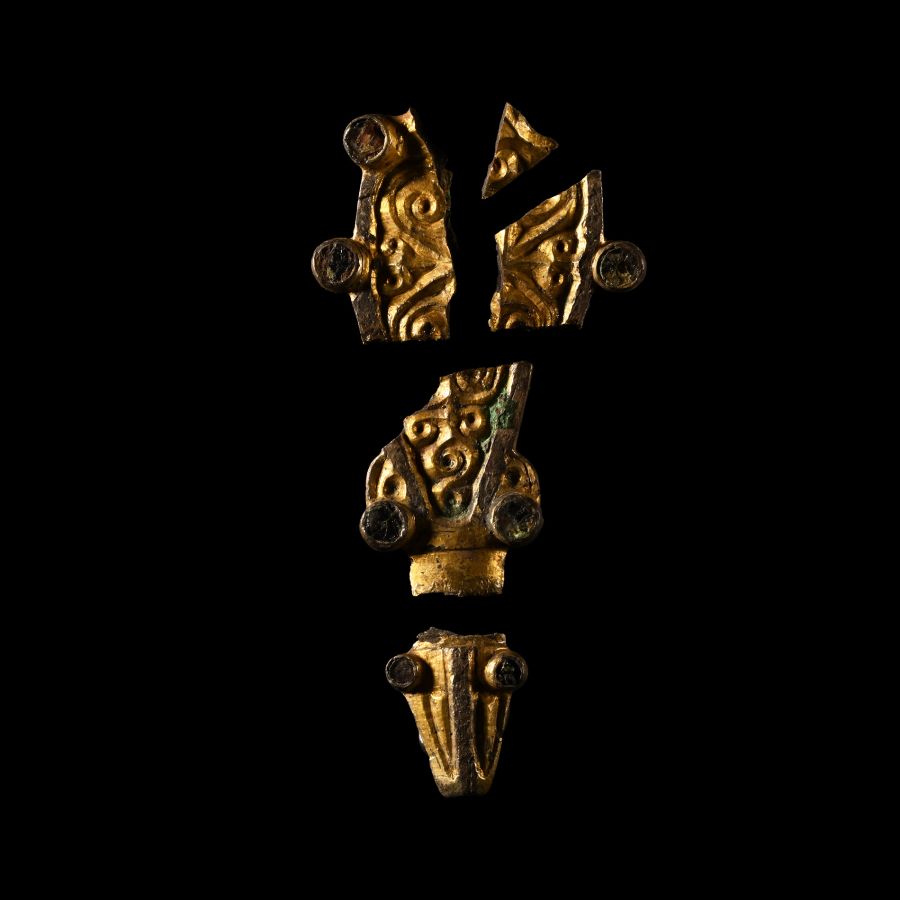
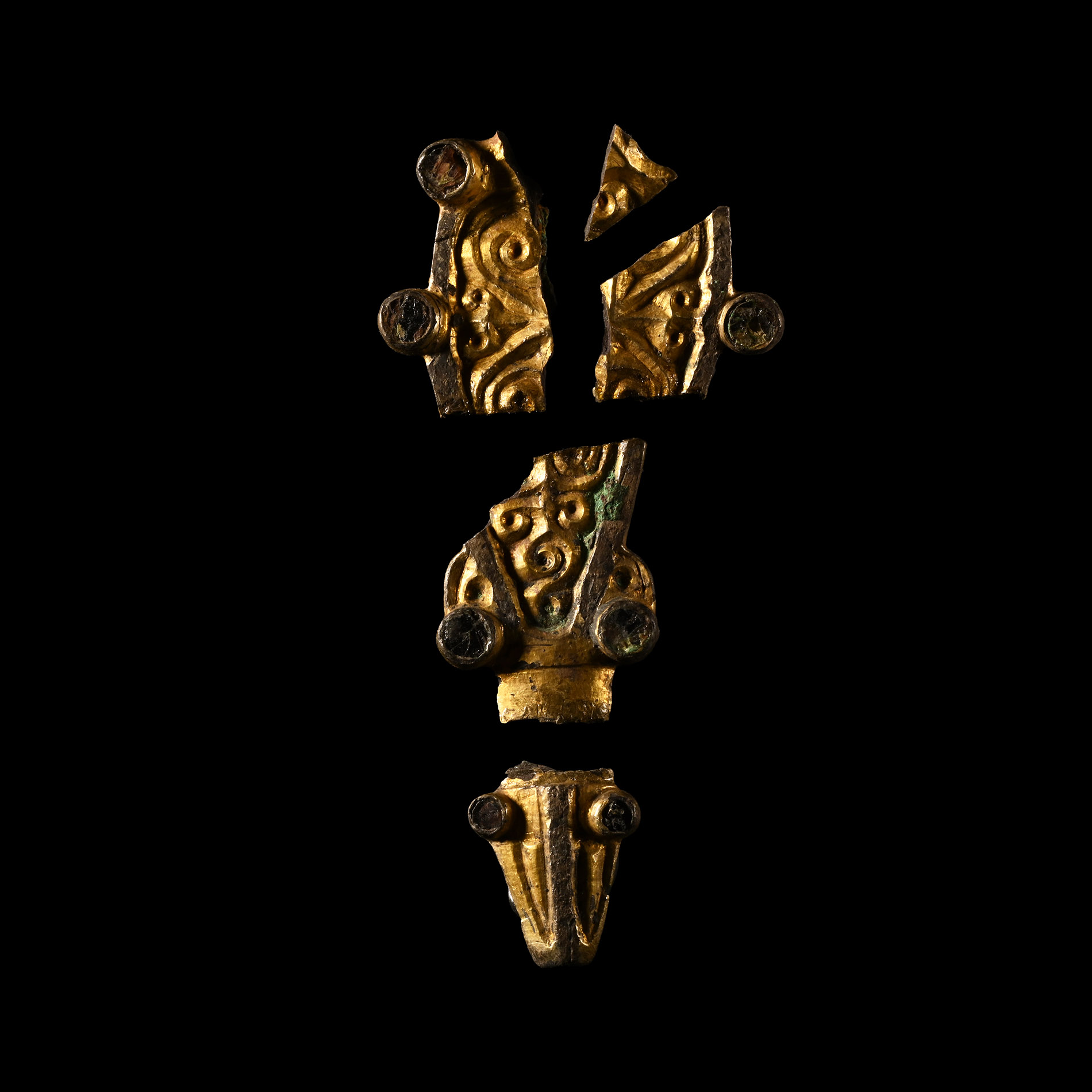
Merovingian Gilt Bronze Brooch Fragments
5TH-6TH CENTURY A.D.
3/8 - 1 1/4 in. (15.4 grams total, 11-31 mm).
Group of gilt-bronze fragments from a bow brooch with beast-head finial and scrolled motifs to the footplate, lateral lugs with inset garnet cloisons; catchplate to reverse. [6]
ProvenancePrivate collection of Mr S.A., Switzerland, 1990s, thence by descent.
LiteratureCf. Heynowski, R., Bestimmungsbuch Archaeologie: Fibeln, Munich, 2012, item 3.24.3.2, for type.
CONDITIONTimeLine Auctions follows a vetting process to ensure the authenticity and legality of all items, reinforcing our commitment to integrity and responsible trading. Each antiquity, antique, and coin lot undergoes thorough examination by a vetting committee of at least ten external specialists, professional trade association members, scientists, and archaeologists: Our Vetting Process
AUCTIONS:
TimeLine is a leading auction house specialising in antiquities, ancient art, collectables, natural history, coins, medals, and books. Our auctions offer museums, collectors, historians, and enthusiasts the opportunity to acquire unique and historically significant pieces.
-
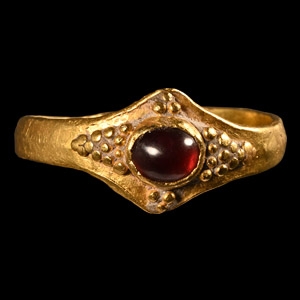
Merovingian Gold Ring with Garnet Cabochon
6th-7th century A.D.Sold for (Inc. bp): £1,560
Comprising a keeled hoop with a lozenge-shaped bezel, raised cell set with garnet cabochon, applied granules framing the bezel. 3.64 grams, 22.80 mm overall, 18.49 mm internal diameter (approximate size British P 1/2, USA 7 3/4, Europe 16.86, Japan 16)
Acquired from London galleries during the 1990s. From the jewellery collection of a London, UK, gentleman.
The Merovingian rings typically have bezels in the form of four-sided pyramids decorated with filigree, granulation, and sometimes inlay. Around the bezel, as in this case, are often triangular clusters of granulation and gold pellets. -
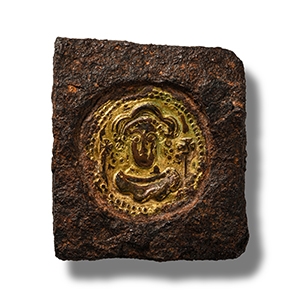
Merovingian Frankish Gilt Bronze Face in Iron Die
6th-8th century A.D.Estimate: £1,800 - 2,400 (+bp*)
Opening Bid: £500
Gilded bronze panel set into a square iron matrix; the panel with facing bust with curls of hair and earrings of three pellets, flanked by two processional crosses and surrounded by a border of pellets. 38.6 grams, 38 mm
From the collection of a London antiquarian, 1980s. -
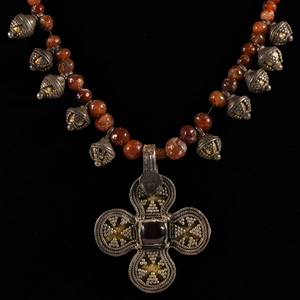
Slavic Silver and Carnelian Bead Necklace with Silver Cross Pendant
Circa 10th century A.D.Sold for (Inc. bp): £1,560
Restrung group of carnelian oblate and spherical beads, parcel-gilt silver dangles with applied granules, silver lobed cross pendant with granules and central cabochon garnet. 82 grams, 58 cm long
From the private collection of a London gentleman, from his grandfather's collection formed before the early 1970s.
