
Loading, please wait...
_900x900.jpg "Medieval 'Thames' Iron Dagger with Wood Handle")
_200x200.jpg "Medieval 'Thames' Iron Dagger with Wood Handle")
.jpg "Medieval 'Thames' Iron Dagger with Wood Handle")
LOT 1415
Medieval 'Thames' Iron Dagger with Wood Handle
CIRCA 15TH CENTURY A.D.
13 3/8 in. (137 grams, 34 cm).
Sturdy single-edged triangular whittle-tang blade with thick back; with reproduction wooden handle. [No Reserve]
ProvenanceFound Billingsgate spoil from the Thames foreshore, London, UK, circa 1984.
Property of an Essex collector.
TimeLine Auctions follows a vetting process to ensure the authenticity and legality of all items, reinforcing our commitment to integrity and responsible trading. Each antiquity, antique, and coin lot undergoes thorough examination by a vetting committee of at least ten external specialists, professional trade association members, scientists, and archaeologists: Our Vetting Process
AUCTIONS:
TimeLine is a leading auction house specialising in antiquities, ancient art, collectables, natural history, coins, medals, and books. Our auctions offer museums, collectors, historians, and enthusiasts the opportunity to acquire unique and historically significant pieces.
-
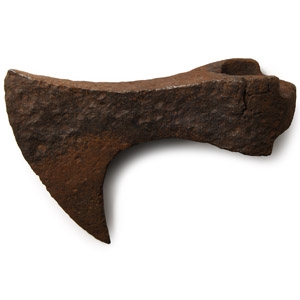
Viking Age Bearded Iron Axehead
11th-13th century A.D.Sold for (Inc. bp): £182
With broad curved blade and pointed chin, broad neck, deep socket with lateral flanges. 698 grams, 15.5 cm
From the collection of a Californian, USA, gentleman, dating back to the late 1960s.
During the mid 13th century, the axes were favourite weapons among Baltic people. For instance the Curonian army included lightly armed soldiers who fought with spears, shields, fighting knives and axes. A heavily armed soldier could also carry a sword, a helmet, a shield and a wide-bladed axe. -
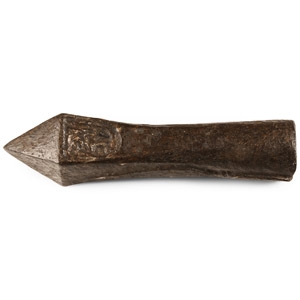
Medieval Socketted Iron Crossbow Bolt Head with Heraldic Shield Maker's Mark
15th-16th century A.D.Sold for (Inc. bp): £286
With pyramidal point, square-section shaft, tubular socket and heater shield displaying a lion passant maker's mark. 46.2 grams, 73 mm
Tucker collection, Buckinghamshire, UK; formed in the 1980s. Property of a Kent lady collector. -
.jpg)
Migration Period Iron Sword with Bronze Pommel
5th-6th century A.D.Estimate: £2,000 - 3,000 (+bp*)
Opening Bid: £600
A spatha with a double-edged parallel-sided blade, battle nicks to both cutting edges; long tang with a fastening rivet in situ; small trapezoidal bronze pommel. 707 grams, 91 cm
From the private collection of a London gentleman, from his grandfather's collection formed before the early 1970s. Accompanied by an academic report by Dr Raffaele D’Amato. This lot has been checked against the Interpol Database of stolen works of art and is accompanied by a search certificate number no.12040-216429.
The spatha, often with an elegantly decorated hilt with golden elements, was characterised by a relatively light handle so that the centre of gravity of the weapon was moved towards the tip. The evolution of the 'barbarian' long sword in the west, during the invasions, began around the 5th century.
