
Loading, please wait...


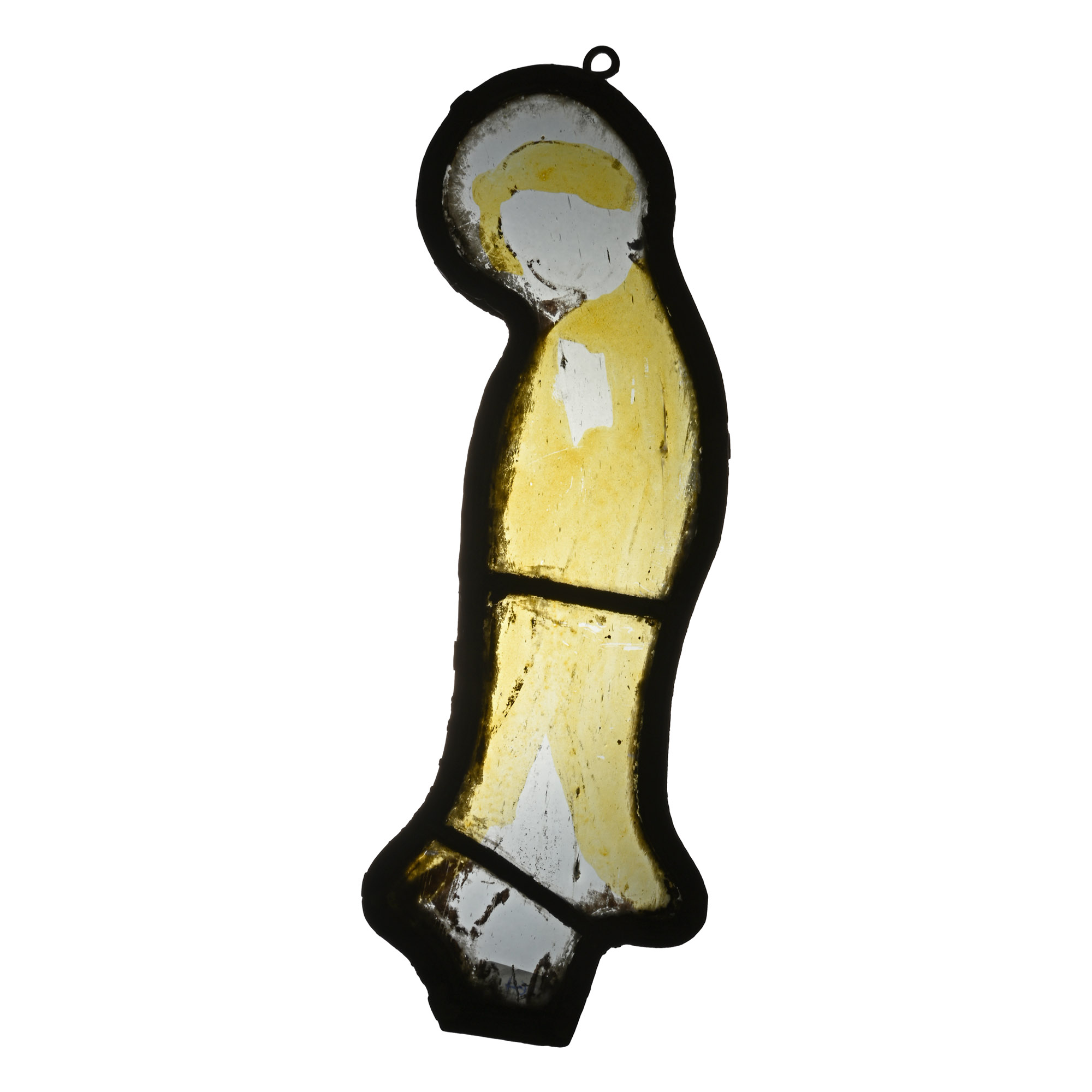
LOT 0397
Medieval Stained Glass Panel of a Praying Angel
ENGLAND, 15TH CENTURY A.D.
8 in. (100 grams, 20.3 cm).
Figural panel with nimbate angel, head bent forward and hands clasped before the chest in prayer; yellow-amber pigment to robes and hair, drawn up in a top-knot; lead cames with loop to the upper edge; old collector's label '12764 001'. [No Reserve]
ProvenanceKees Berserik, 2008.
Ex central London gallery.
TimeLine Auctions follows a vetting process to ensure the authenticity and legality of all items, reinforcing our commitment to integrity and responsible trading. Each antiquity, antique, and coin lot undergoes thorough examination by a vetting committee of at least ten external specialists, professional trade association members, scientists, and archaeologists: Our Vetting Process
AUCTIONS:
TimeLine is a leading auction house specialising in antiquities, ancient art, collectables, natural history, coins, medals, and books. Our auctions offer museums, collectors, historians, and enthusiasts the opportunity to acquire unique and historically significant pieces.
-

Medieval Bronze Spur
Circa 15th-16th century A.D.Sold for (Inc. bp): £13
Comprising a U-shaped body with hinged terminals, curved extension to the rear to accept a rowel. 28.3 grams, 60 mm
From an old English collection, 1990s. Property of an Essex, UK, gentleman. -
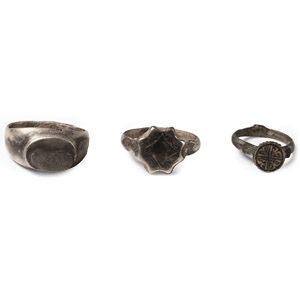
Medieval Period Decorated Silver Ring Group
Circa 14th-16th century A.D.Sold for (Inc. bp): £98
One hollow-formed with ellipsoid bezel, one with hexagonal rosette bezel, one with scooped shoulders and disc bezel with scroll motifs, possibly Ottoman or Eastern Mediterranean. 10.3 grams total, 19-21 mm
UK private collection before 2000. Acquired on the UK art market. Property of a London gentleman. -
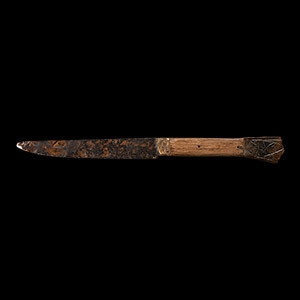
Medieval Iron Knife with Bronze Pommel
15th-16th century A.D.Estimate: £120 - 170 (+bp*)
Opening Bid: £67
Comprising a single cutting edge and scale tang; bifacial pommel engraved with a female figure to one face and an enigmatic design to the other. 35 grams, 17 cm
Acquired 1960s-1990s. Late Alison Barker collection, a retired London barrister.
There were four essential ways to carry the small knifes in late Middle Ages: a) with the scabbard tucked diagonally behind belt, without suspension loop; b) without scabbard, simply thrust through the purse of the belt; c) with the scabbard tied horizontally at waist with suspension holes in the widened handle flap; d) suspended vertically from thong looped over the belt, in the scabbard.
