
Loading, please wait...


LOT 1635
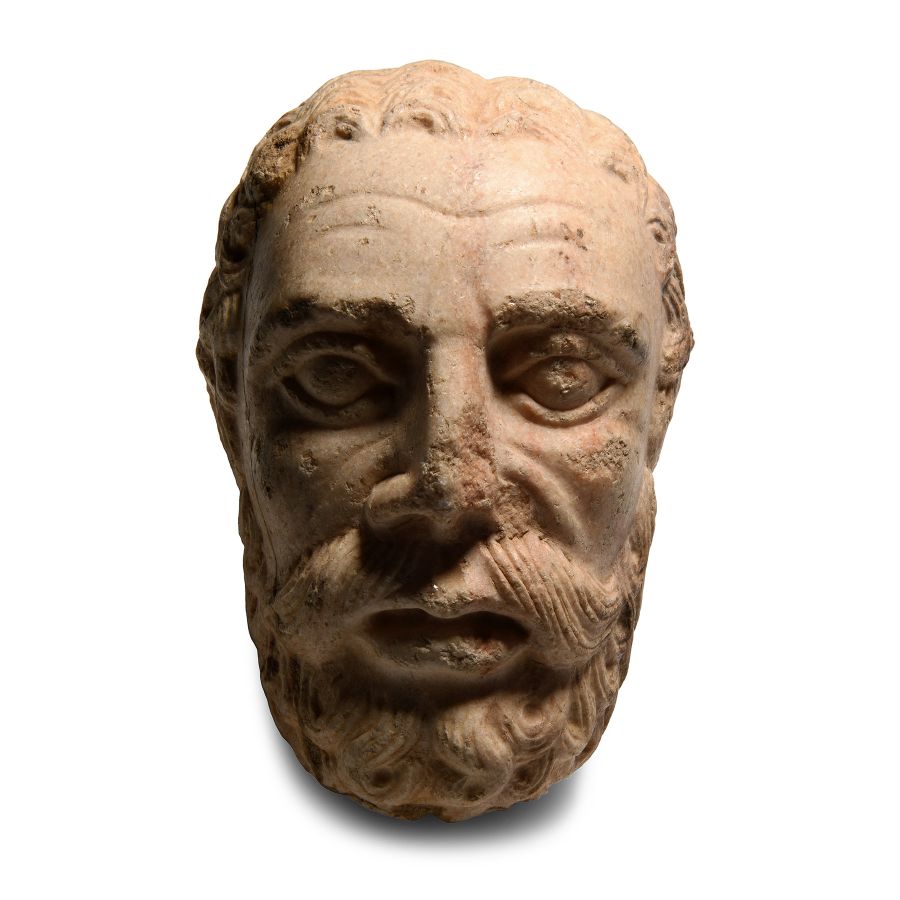
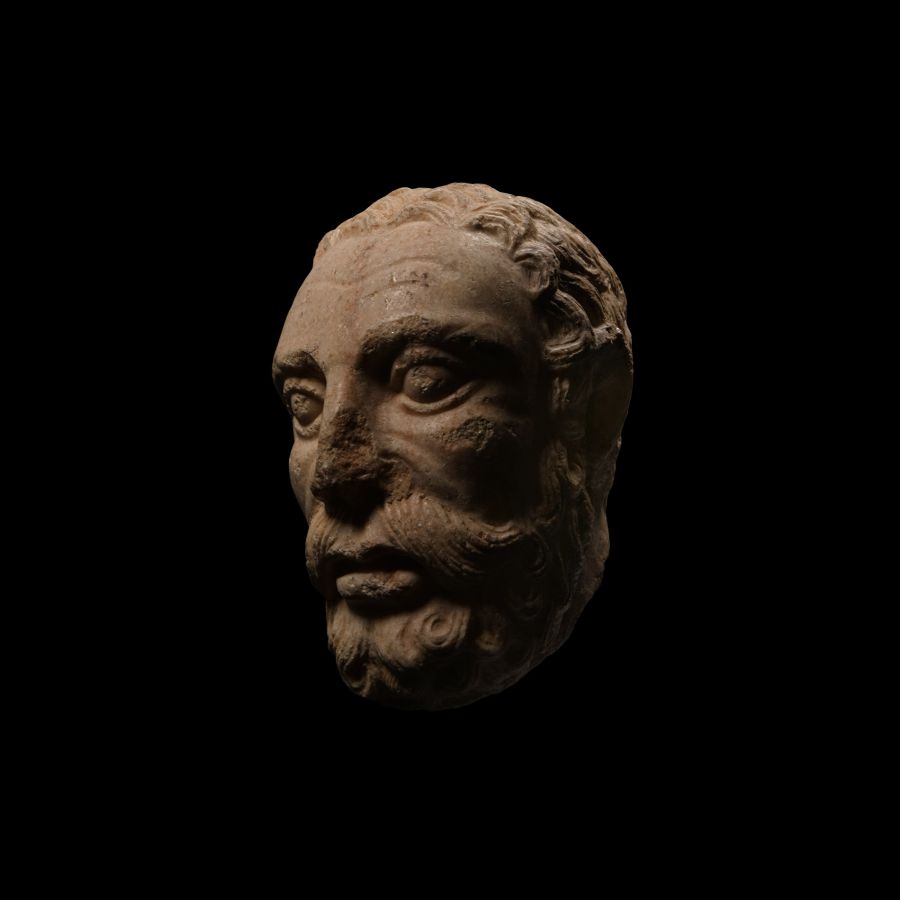
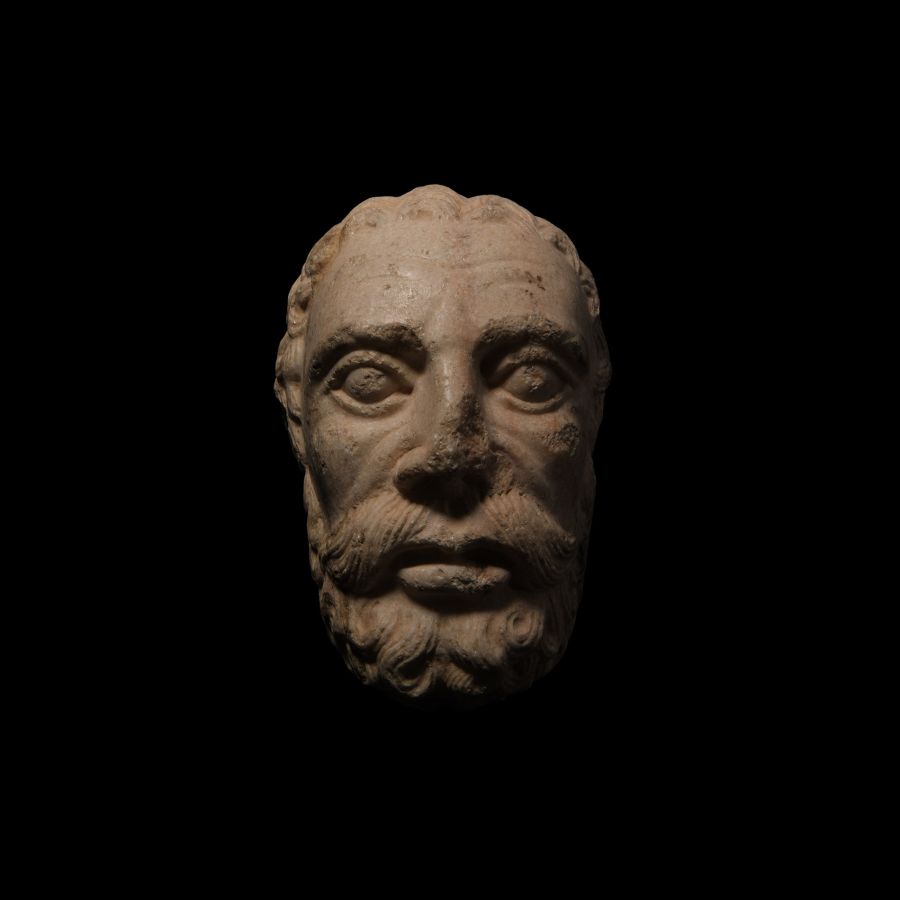
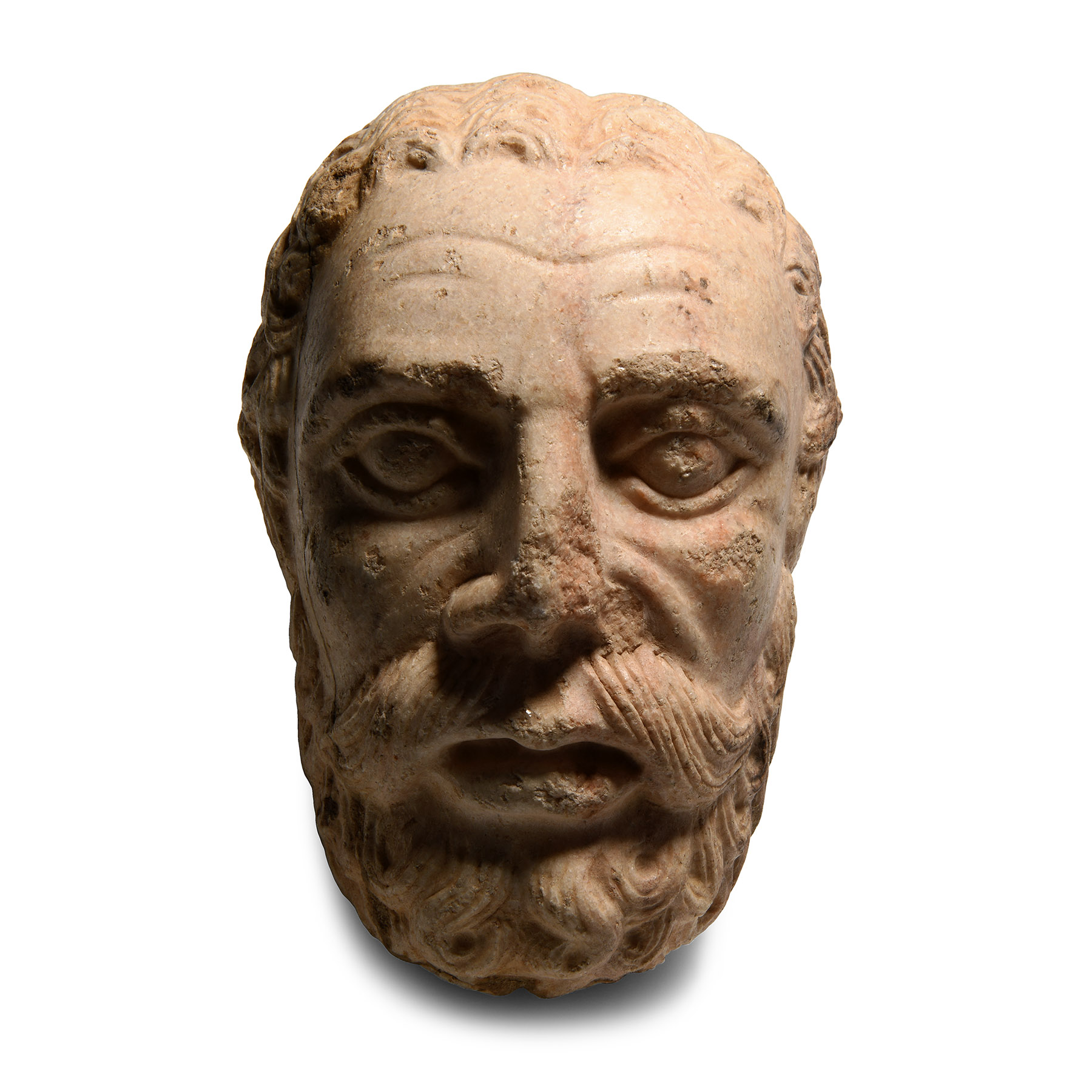
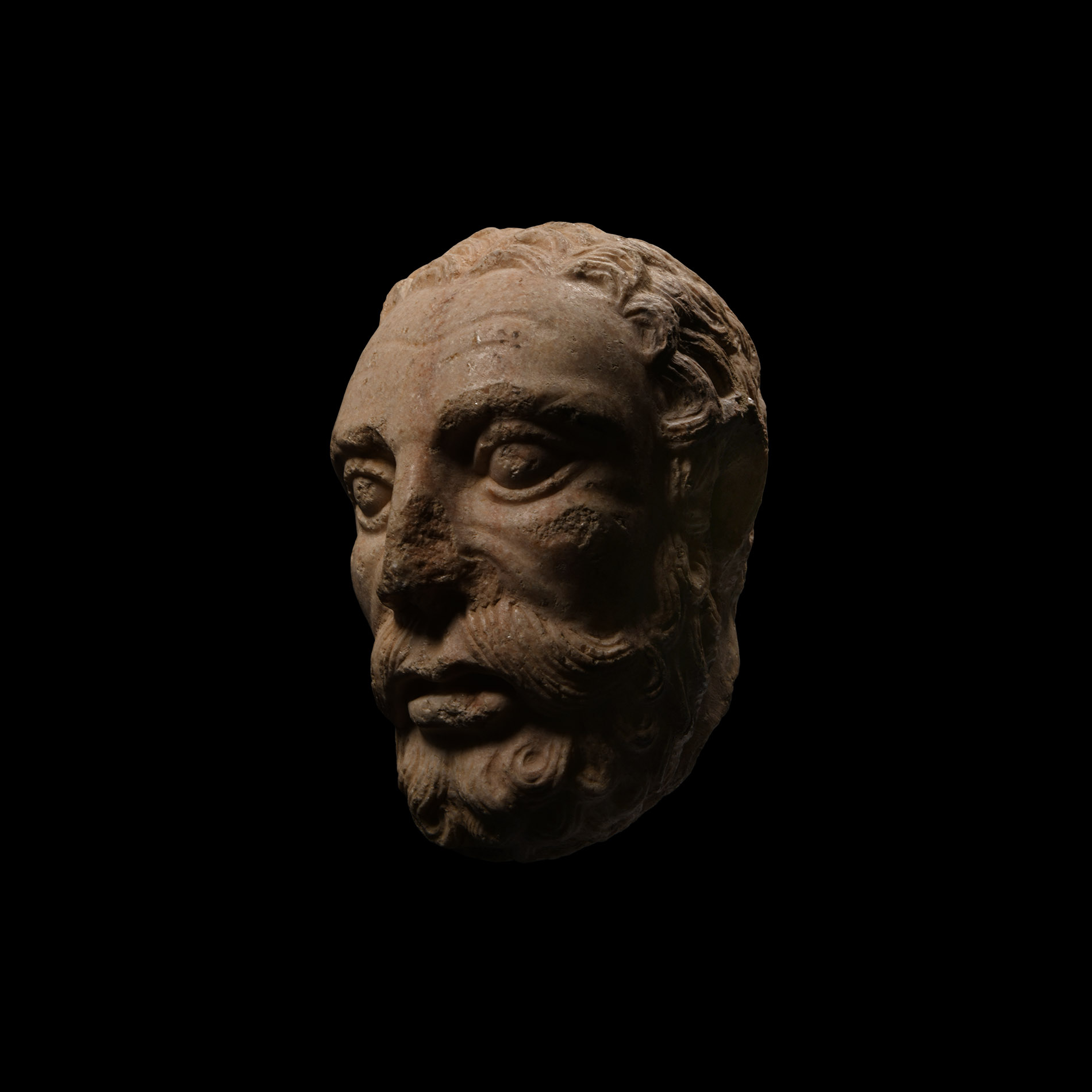
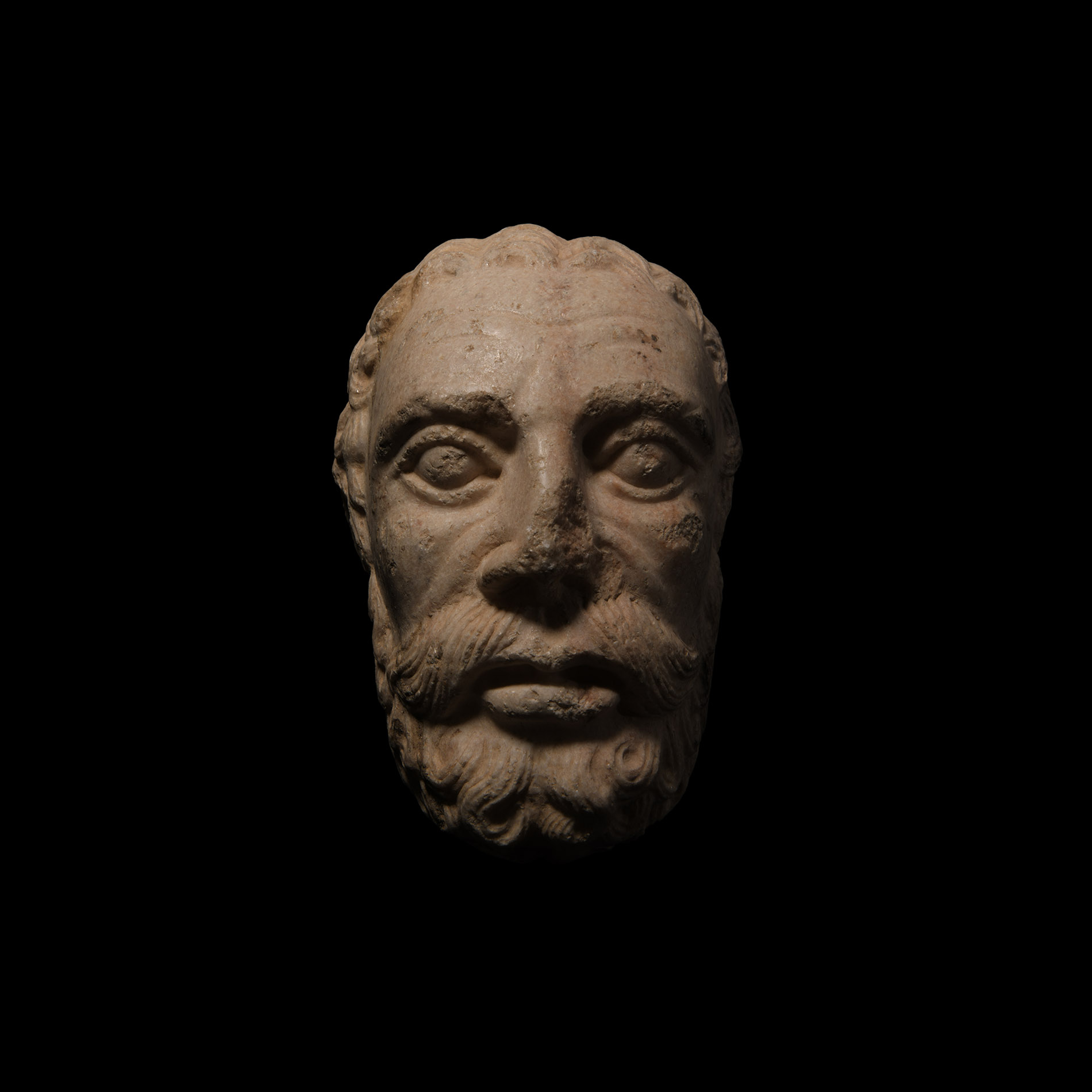
Medieval Romanesque Marble Head of a Saint
LATE 12TH-13TH CENTURY A.D.
7 in. (3.8 kg, 18 cm).
Carved naturalistically in the round as a mature male figure with short wavy hair, full beard and moustache, his brow furrowed and mouth held slightly ajar; repaired.
ProvenanceAcquired in Europe before 1996.
Accompanied by an academic report by Dr Raffaele D’Amato.
This lot has been checked against the Interpol Database of stolen works of art and is accompanied by search certificate no.11809-206816.
See Sauerländer, W., Gothic Sculpture in France 1140-1270, Ambrams, 1972; Cahn, W. and Seidel, L., Romanesque Sculpture in American Collections, 1: New England Museums, New York, 1979; Williamson, P., Gothic Sculpture 1140-1300, Yale University Press, 1995; Fogg, S., 30 Heads, stone heads from the 12th to the 15th century, London-New York, 2018.
FootnotesThe head was carved as an image of a saint, Apostle or a prophet. The accomplished and sophisticated style of carving on this head can be compared to some of the most celebrated Romanesque buildings of Southern France. The carving of the head resembles the representations of heads and faces of 12th century French Romanesque art, for example those of Saint Trophime in Arles. This imposing head once served as an important architectural part of a lavishly decorated church, possibly in western France. Its form and the size suggest that the head was not only decorative but that it would have been structurally important – perhaps part of a row of statues of apostles and prophets like those depicted on the Saint Trophime façade.
CONDITIONTimeLine Auctions follows a vetting process to ensure the authenticity and legality of all items, reinforcing our commitment to integrity and responsible trading. Each antiquity, antique, and coin lot undergoes thorough examination by a vetting committee of at least ten external specialists, professional trade association members, scientists, and archaeologists: Our Vetting Process
AUCTIONS:
TimeLine is a leading auction house specialising in antiquities, ancient art, collectables, natural history, coins, medals, and books. Our auctions offer museums, collectors, historians, and enthusiasts the opportunity to acquire unique and historically significant pieces.
LOT 1635
Medieval Romanesque Marble Head of a Saint
Estimate £3,500 - 4,500€4,060 - 5,220 (for guidance only)$4,730 - 6,080 (for guidance only)
-

Medieval Bronze Knight's Holy Sepulchre Badge
Circa 13th-14th century A.D.Sold for (Inc. bp): £1,300
Formed as a cross-crosslet, the symbol of the Knights of the Holy Sepulchre, with punched-point border. 0.99 grams, 22.41 mm
Found Norfolk, UK.
The 'Equestrian Order of the Holy Sepulchre of Jerusalem' was an order of knighthood under the protection of the Pope, formed around 1099 AD by Duke Godfrey of Bouillon, the leader of the First Crusade. It was established for the protection of pilgrims travelling to the Holy Land and was recognised by a Papal Bull in about 1113 AD. -

Medieval Gold Heart-Shaped Pendant
Circa 14th-16th century A.D.Estimate: £100 - 140 (+bp*)
Opening Bid: £50
Wit beaded wire border and applied filigree detailing. 0.68 grams, 14 mm
From a late Japanese specialist collector, 1970-2000s. -

'The Drayton' Medieval Gold Stirrup-Shaped Bishop's Ring with Sapphire and Magical Inscription
1200-1300 A.D.Estimate: £5,000 - 7,000 (+bp*)
Opening Bid: £2,778
The bezel expanding into a low flat topped triangle with facetted corners surmounted by a cabochon sapphire set within an asymmetrical hexagonal cell; expanded quatrefoils flanking the base of the bezel leading on to the angled hoop with a central ridge running around its circumference; three further quatrefoil panels evenly spaced around the band- one on both sides and the third at the base of the hoop; the bevelled sides of the hoop engraved with the inscription '+NI ONAN NRIO ONIC / NIAI AINO ANIOI NAN', which may not be meaningful, but these groups of letters may have been felt to be 'magical'. 3.95 grams, 25.72 mm overall, 19.75 x 18.44 mm internal diameter (approximate size British R, USA 8 1/2, Europe 18 3/4, Japan 18)
Found whilst searching with a metal detector near Drayton, Vale of the White Horse, Oxfordshire, UK, on Sunday 16th September 2018 by Chris Weir. Declared as treasure under the Treasure Act with reference no.2018T853, subsequently disclaimed and returned to the finder. Accompanied by a copy of the British Museum's Portable Antiquities Scheme (PAS) report no.GLO-0BFB91. Accompanied by a letter from the finder describing the circumstances of finding. This lot has been checked against the Interpol Database of stolen works of art and is accompanied by search certificate no.12118-214086.
Many late medieval rings and brooches bear similarly meaningless inscriptions, perhaps due to the illiteracy of the engraver who nevertheless was aware that customers required an inscription, so provided one. For discussion of such inscriptions see Evans, J., Magical Jewels of the Middle Ages and the Renaissance, Oxford, 1922, pp.121-132, for inscribed jewels.
