
Loading, please wait...
LOT 0266
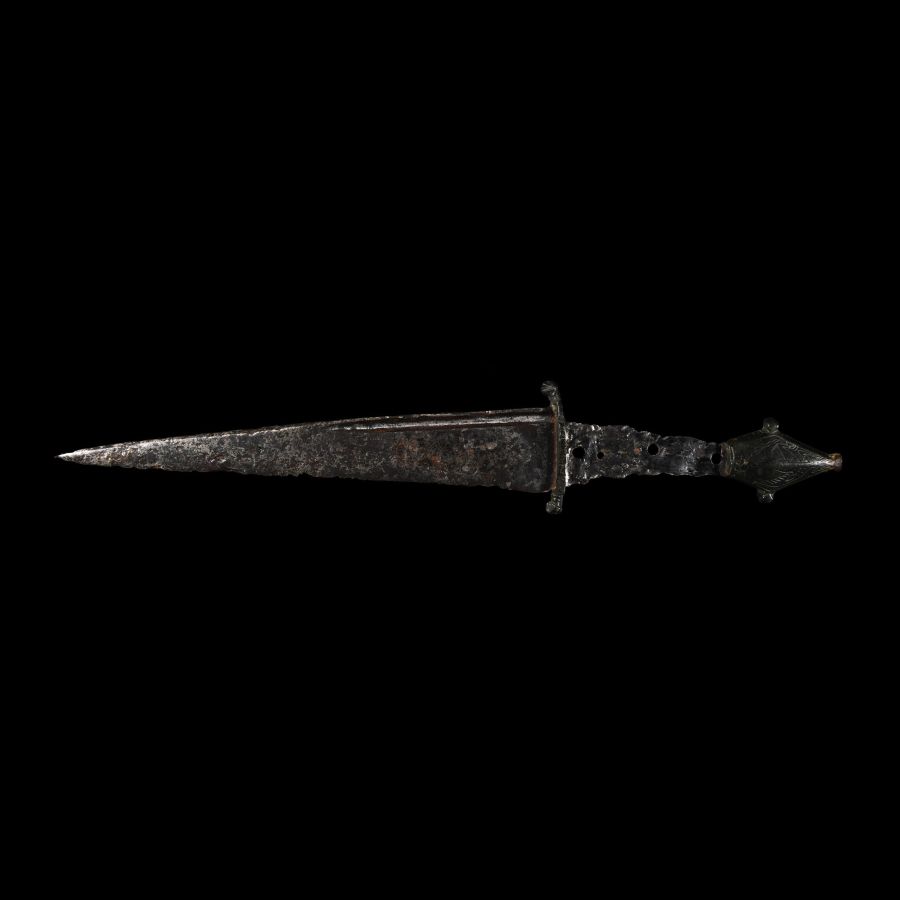
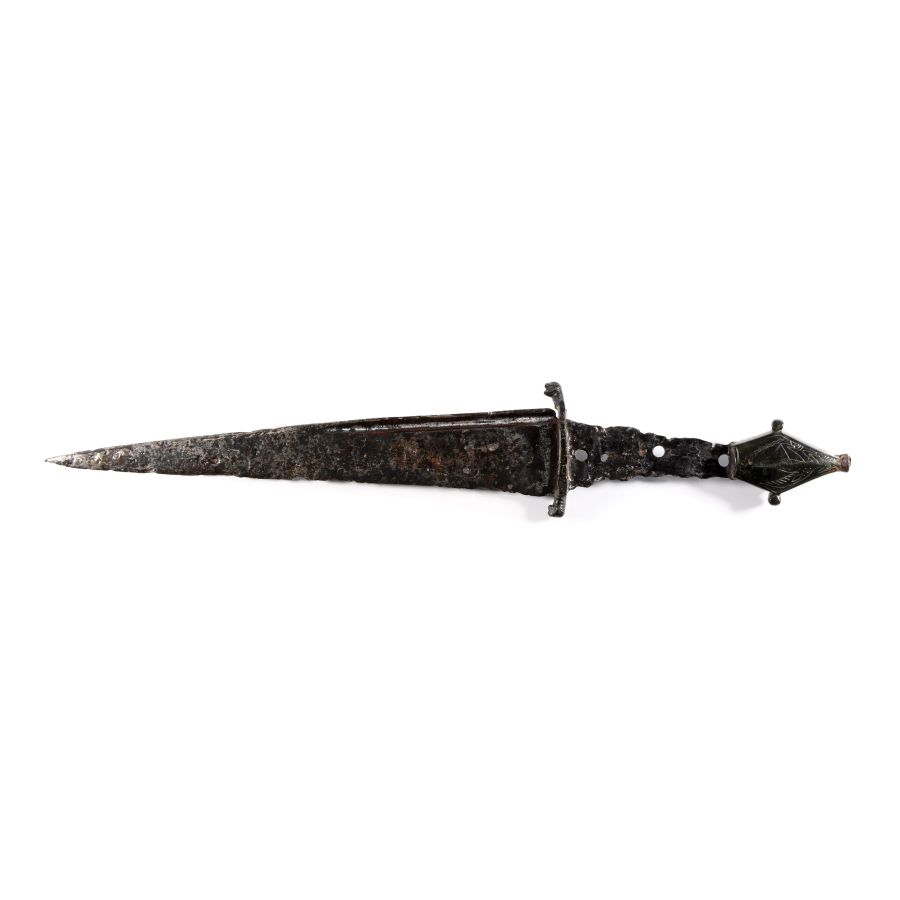
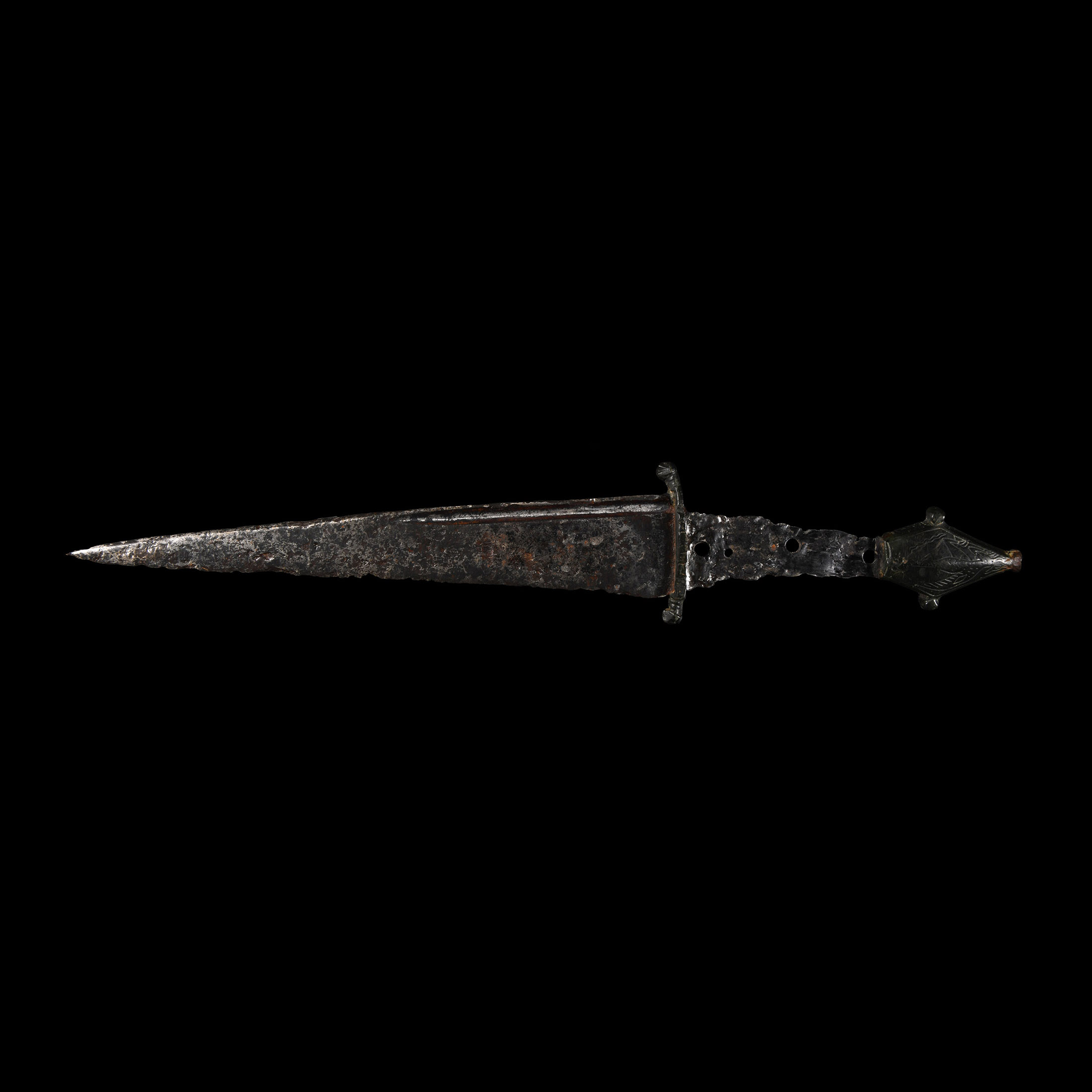
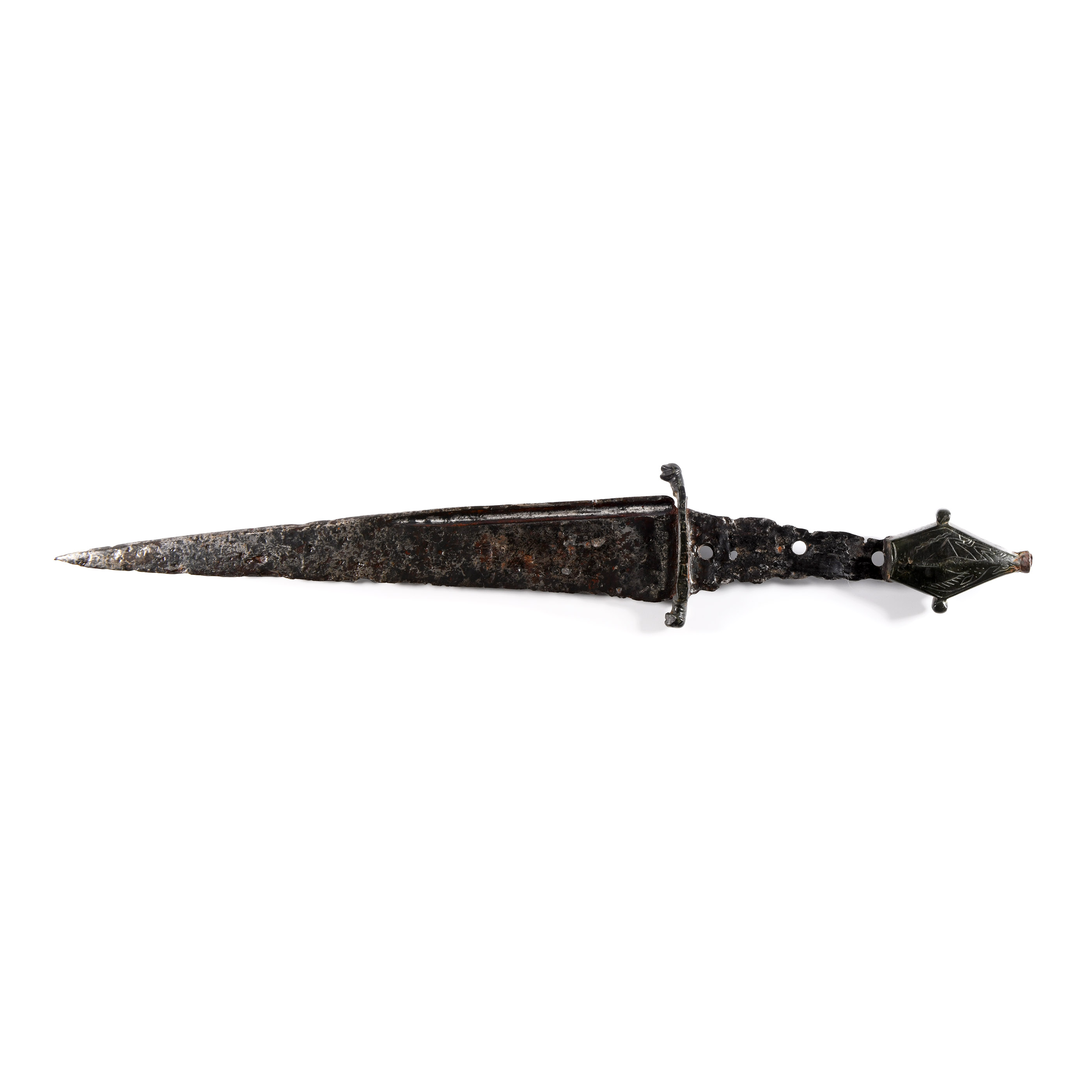
Medieval Quillon Dagger with Bronze Pommel
ENGLAND OR GERMANY, 16TH CENTURY A.D.
13 3/8 in. (177 grams, 34 cm).
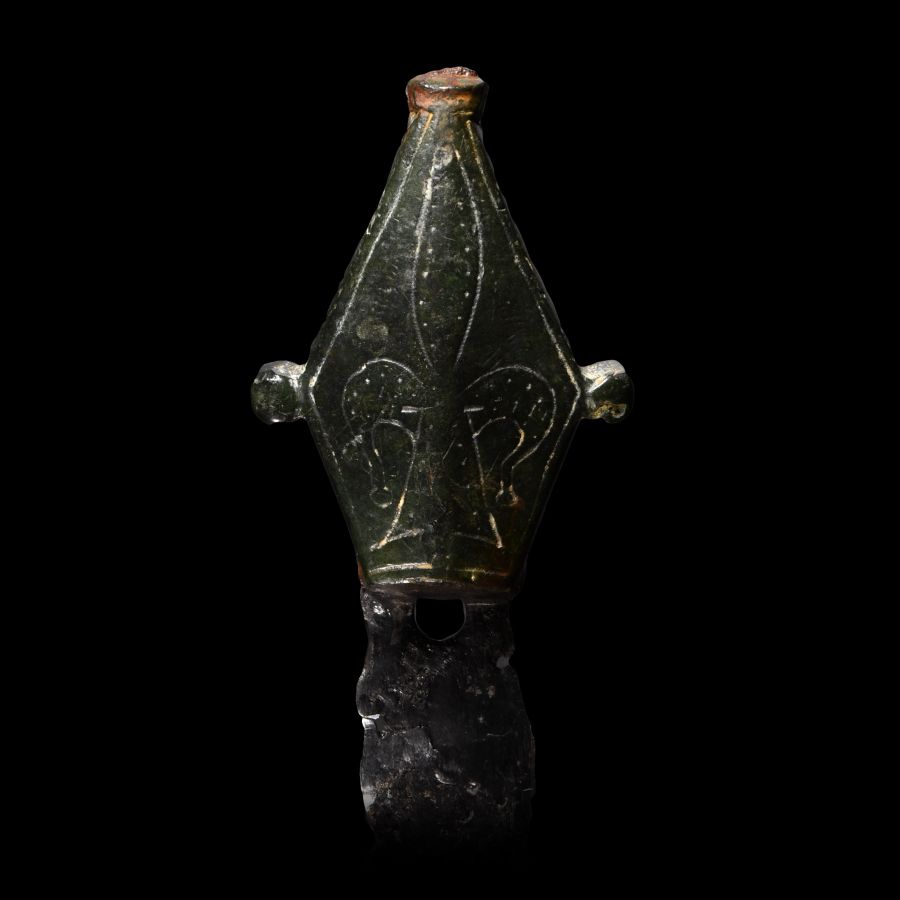
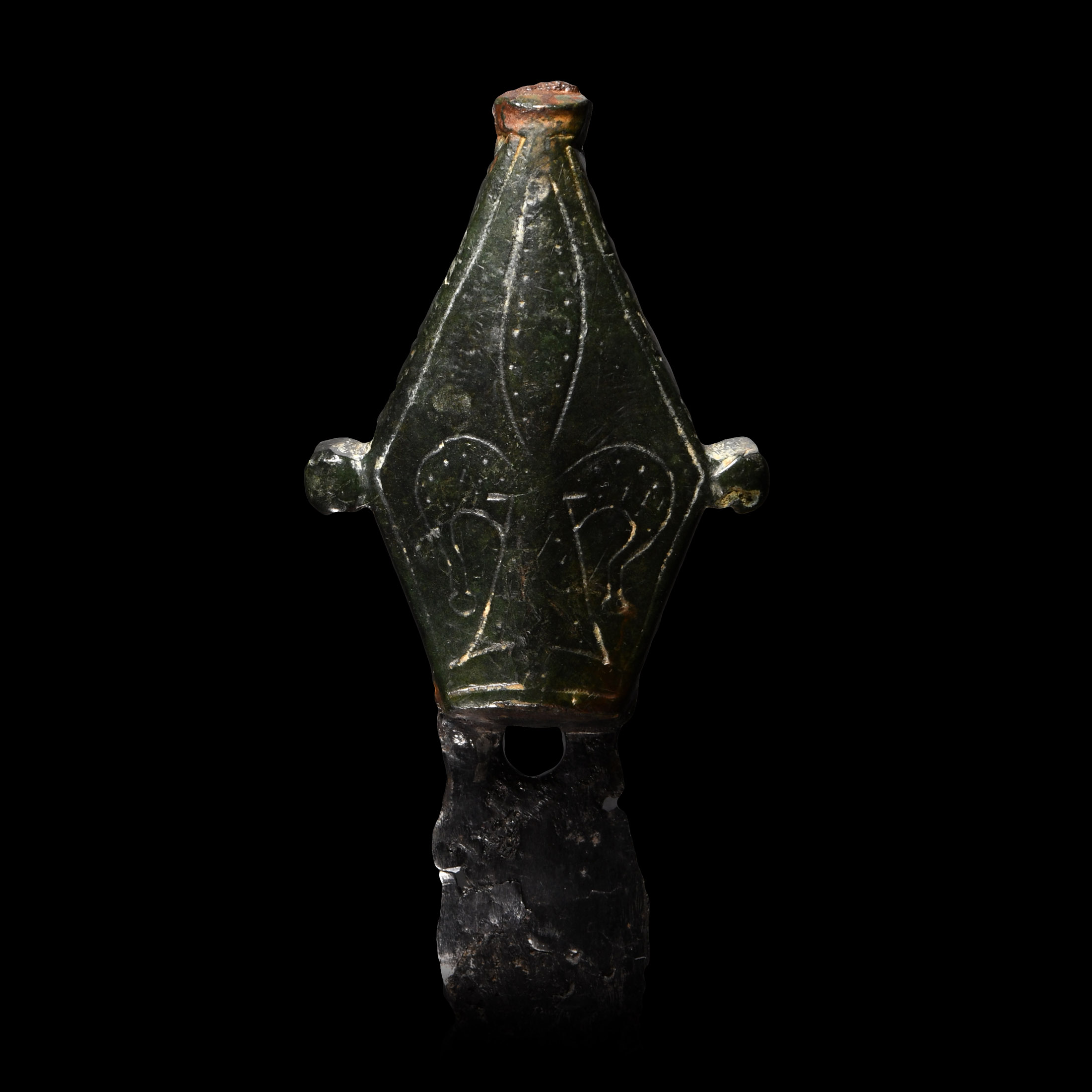
Featuring a hexagonal brass pommel engraved with a fleur-de-lis to one side and a dragon to the other; pierced tang, two short quillons inclining towards the blade, terminating in lion head-shaped finials; straight single-edged blade, with side ridges to both faces of the blade, tapering to a fine point.
ProvenanceAcquired 1960s-1990s.
Late Alison Barker collection, a retired London barrister.
Cf. Leeds Armoury inventory no.X 797, for a similar double-edged quillon dagger blade with identical guard, excavated from the Thames at Cannon Street Bridge, believed to be the site of a steelyard of the Hanseatic League.
FootnotesQuillon daggers were predominantly employed as a military weapon. During the 16th century, this dagger continued to be popular, although the hilt no longer resembled that of the contemporary sword, as sword hilts had developed into more intricate forms.
CONDITIONTimeLine Auctions follows a vetting process to ensure the authenticity and legality of all items, reinforcing our commitment to integrity and responsible trading. Each antiquity, antique, and coin lot undergoes thorough examination by a vetting committee of at least ten external specialists, professional trade association members, scientists, and archaeologists: Our Vetting Process
AUCTIONS:
TimeLine is a leading auction house specialising in antiquities, ancient art, collectables, natural history, coins, medals, and books. Our auctions offer museums, collectors, historians, and enthusiasts the opportunity to acquire unique and historically significant pieces.
-
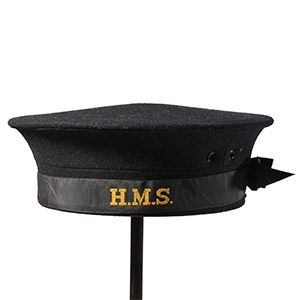
Royal Navy Rating's Cap
Dated 1942 A.D.Sold for (Inc. bp): £20
Standard British naval issue dark blue rating's cap with Toronto maker's ink stamp and date inside, fitted with black fabric 'H.M.S.' ribbon and chin-strap. 196 grams, 25 cm
Acquired from The Historic Flying Clothing Company, 2014. The Kusmirek Collection, UK. Accompanied by a copy of a previous invoice. -
.jpg)
Roman Bronze Military Helmet Section
3rd century A.D.Sold for (Inc. bp): £975
From the right side of the face mask, the upper edge with an embossed band of diagonal lines, Jupiter’s eagle embossed to the centre, looking back and holding a laurel crown in its beak; a hole for the fastening thongs at ear-level. 87 grams, 19.7 cm
Acquired 1960s-1990s. Late Alison Barker collection, a retired London barrister.
The decoration of Roman weaponry contained themes that were directly associated with state propaganda, as well as with the Imperial cult. As the god-protector of the state and the army, Jupiter was the most esteemed. The combination of an eagle (helmet), Minerva and bust of Mars (armour) can also be understood as an image of dii militares. -
.jpg)
Roman Bronze Armour Squama Scales Group
2nd-3rd century A.D.Sold for (Inc. bp): £715
Mixed group of semi-rigid bronze scales with scalloped lower edges, pierced for attachment; together with two small panels of articulated lamina scales. 30 grams total, 10-65 mm
Acquired in the late 1980s. The Kusmirek Collection, UK.
A new form of rigid scale-armour, typified by pieces found in Britannia (Corbridge, Carlisle), Pannonia (Musov), Moesia (Iron Gates) and in various other provinces of the empire, was introduced earlier in the Antonine Period, and continued for all of the 3rd and 4th centuries A.D. The new body protection was realised with scales attached by wire to each of their four neighbouring scales. These new scales tended to be not only very small, but also long and slender and needed to be carefully shaped around the neck.
