Loading, please wait...

Medieval Prophet Cutting from an Illustrated Manuscript Medieval Prophet Cutting from an Illustrated Manuscript Medieval Prophet Cutting from an Illustrated Manuscript
Use mousewheel to zoom in and out, click to enlarge
Details

LOT 0361

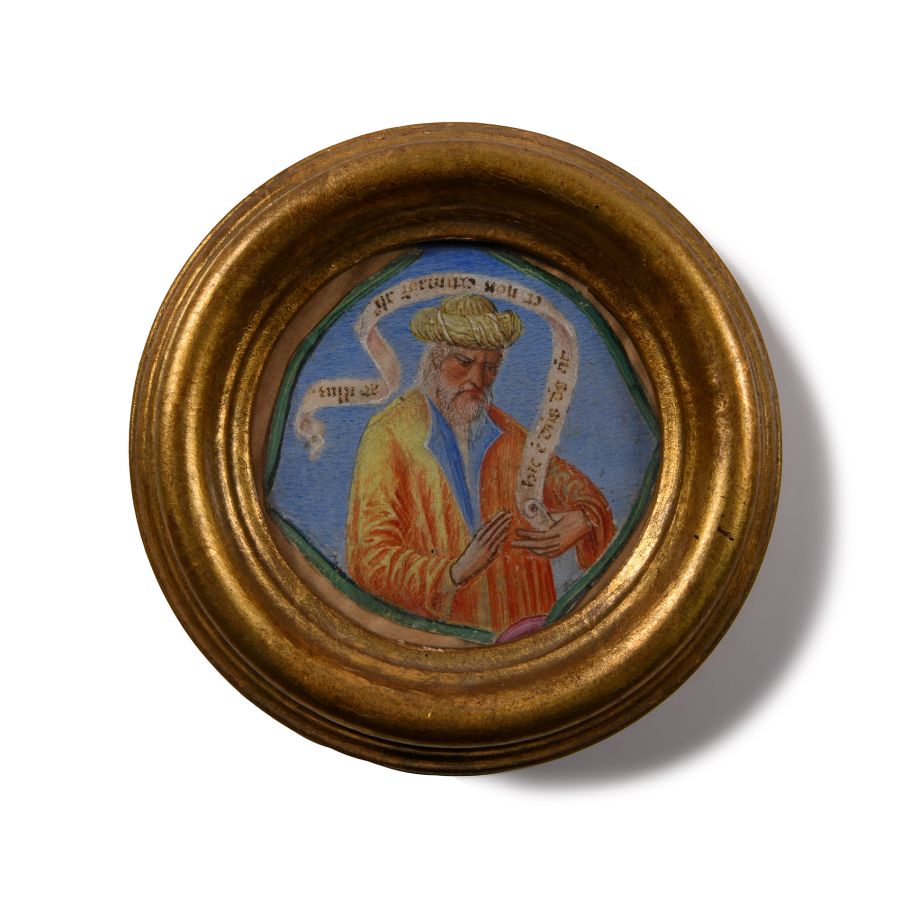
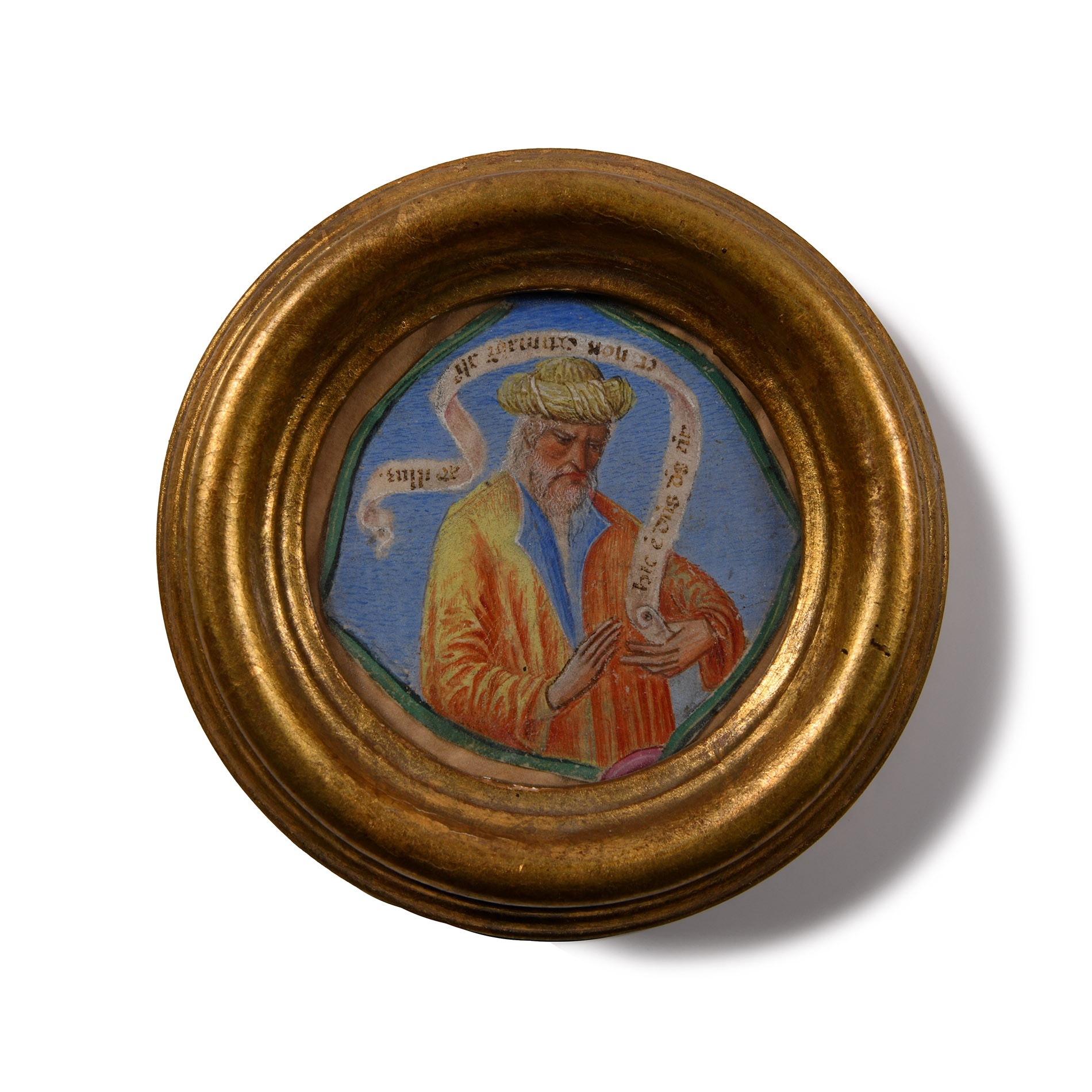
Medieval Prophet Cutting from an Illustrated Manuscript

FLORENCE, ITALY, CIRCA 1470 A.D.

4 1/2 in. (57 grams, 11.4 cm).

Discoid glazed mount with tiered profile, painted miniature of an Old Testament prophet with epigraphic scroll and incomplete Latin inscription reciting 'Hic e Deus tuus..et non estimavi ali...ac illus' [He is your God...and I did not estimate other...and He...' [No Reserve]

Provenance

Private collection, Tuscany, inherited, 1969.

This lot has been checked against the Interpol Database of stolen works of art and is accompanied by a search certificate number no.12059-217465.

Literature

Cf. similar in Tóvizi Á., 'Some newly discovered Quattrocento illuminations in Székesfehérvár', in Arte cristiana, 96 (2008), pp.307-12.

Footnotes

The illumination is from a cutting of dismembered codex, likely representing a book of the Old Testament. In 15th century North Italy there were proficient artists realising images on vellum, like the Master of Murano Gradual (active between 1430-1460). The miniature represents an Eastern Prophet, dressed with turban and long coat, maybe Ezekiel, or Abacuc, or even Moses, a prophet linked with the prophecies related to the Messiah.

CONDITION
VETTING:

TimeLine Auctions follows a vetting process to ensure the authenticity and legality of all items, reinforcing our commitment to integrity and responsible trading. Each antiquity, antique, and coin lot undergoes thorough examination by a vetting committee of at least ten external specialists, professional trade association members, scientists, and archaeologists: Our Vetting Process


AUCTIONS:

TimeLine is a leading auction house specialising in antiquities, ancient art, collectables, natural history, coins, medals, and books. Our auctions offer museums, collectors, historians, and enthusiasts the opportunity to acquire unique and historically significant pieces.

LOT 0361

Medieval Prophet Cutting from an Illustrated Manuscript

Sold for (Inc. bp): £780

Print page

RELATED LOTS
  • Medieval Silver Seal Matrix for John the Evangelist with Roman Eagle Gemstone
    Medieval Silver Seal Matrix for John the Evangelist with Roman Eagle Gemstone
    13th-14th century A.D.

    Sold for (Inc. bp): £3,380

    The outer band with incuse legend '+ AQUILA IOhANNIS' (Eagle of [Saint] John]), suspension loop above with a leaf terminal to the reverse; set with a 2nd century A.D. Roman carnelian intaglio with a military eagle standing with spread wings, a laurel crown held in its beak, the claws gripping the base, two military standards at its sides; both shafts decorated with alternating phalerae, and lunulae. 3.74 grams, 21 mm


    From the Smith family collection, formed in the late 1940s-1980s. Accompanied by an academic report by Dr Raffaele D’Amato. This lot has been checked against the Interpol Database of stolen works of art and is accompanied by a search certificate number no. 12045-217155.

    Often the military intaglio gemstones of the ancient Rome were carved with an eagle between two standards. These intaglios could have been inserted in rings that belonged to an officer with the rank of Aquilifer (bearer of the legionary eagle). From the 4th century A.D., the vision of Ezekiel and John's Apocalypse, assigned the lion, the angel, the eagle, and the ox a place in the iconography of the Tetramorph to represent the four evangelists.

    Lot Details

  • The Witham on the Hill Medieval Gold The Beautiful Game Posy Ring with Matched Pairs of Flowers
    'The Witham on the Hill' Medieval Gold 'The Beautiful Game' Posy Ring with Matched Pairs of Flowers
    Circa 1400-1500 A.D.

    Sold for (Inc. bp): £4,160

    Flat-section straightened hoop with incised blackletter text 'le belle ie[u]' translating to 'the beautiful game' with interposed flowers and stalks. 1.68 grams, 16.92 mm overall, 15.39 mm internal diameter (approximate size British I 1/2, USA 4 1/2, Europe 8.07, Japan 7)


    Found whilst searching with a metal detector near Witham on the Hill, South Kesteven, Lincolnshire, UK, on Sunday 9th January 2022, by Mark Bowen. Accompanied by a copy of the British Museum's Portable Antiquities Scheme (PAS) report no.CAM-D675E8. Accompanied by a copy of the Department for Digital, Culture, Media and Sport Treasure receipt and and disclaimed with Treasure case tracking no.2022T153. This lot has been checked against the Interpol Database of stolen works of art and is accompanied by a search certificate number no.12139-214843.

    The final word of the inscription is ie for ie[u], an Anglo-Norman spelling of modern French jeu ‘game’. The game in question is, of course, love (not football!). The ‘game’ of love here is what we now refer to as Courtly Love (amour courtois, fin amor) and the phrase ‘beautiful game’ is also found on another ring recorded on the PAS database as YORYM-0A0FD2, the whole, a rhyming couplet, reading AMIE EN VV/ [E]ST MA VIE BELE GIEV [Beloved, in you my life is a beautiful game].

    Lot Details

  • Medieval Embroidered Orphrey with Six Saints
    Medieval Embroidered Orphrey with Six Saints
    Southern Netherlands, 15th century A.D.

    Sold for (Inc. bp): £1,560

    Rectangular textile panel with six figural scenes within laid work borders; each figure a nimbate saint with couched robes, satin stitch facial features, threaded sequins and other detailing; modern fabric backing. 502 grams, 104 cm


    with SVV Prunier, 20 May 2018, no.86. Ex central London gallery.

    This substantial embroidered panel comes from an ecclesiastic Dalmatic composed up of various sections, each section comprising an applied figure embroidered in yellow-brown colours with the addition of light blue in some figures. From top to bottom two female saints, probably the Virgin Mary and her Holy Mother Anna; in the second central panels are represented Saint Peter, keys in hand, and probably his brother Andrew. Saint Augustine and Saint Thomas Aquinas are possibly the subjects of the last two vertical panels. The embroidery technique used is including fine worked nué, in which metallic threads are laid down and worked over in silk, with split stitch.

    Lot Details

Stay up-to-date with the latest from TimeLine Auctions by joining our mailing list