
Loading, please wait...
LOT 1105
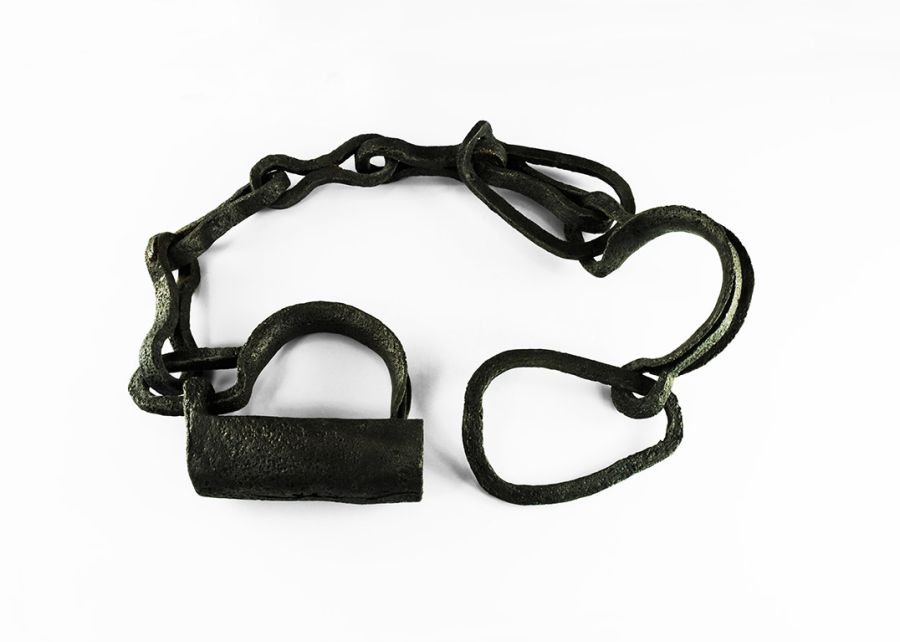
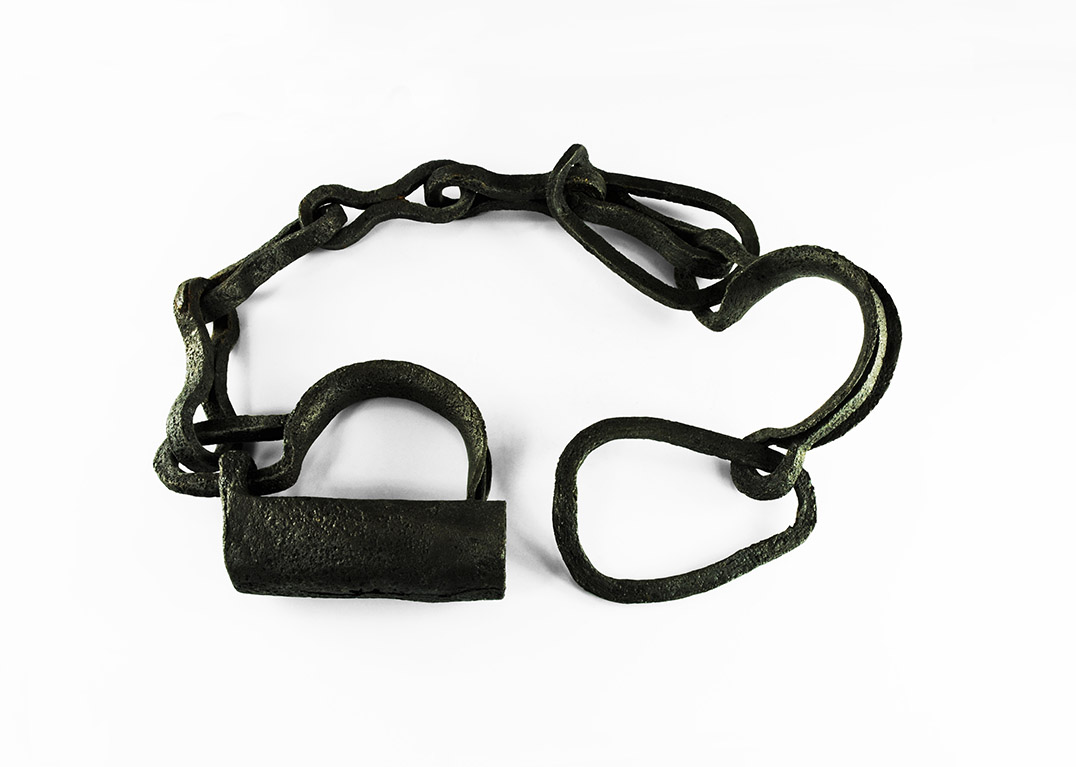
Medieval Prisoner's Iron Shackle and Fetter
14TH-15TH CENTURY A.D.
34 1/4 in. (2.2 kg, 87 cm).
Comprising five rectangular-section doubled links with curved fetter and two loops to one end, barrel lock and hasp to the other.
ProvenanceAcquired in the 1990s. From an important English collection.
CONDITIONTimeLine Auctions follows a vetting process to ensure the authenticity and legality of all items, reinforcing our commitment to integrity and responsible trading. Each antiquity, antique, and coin lot undergoes thorough examination by a vetting committee of at least ten external specialists, professional trade association members, scientists, and archaeologists: Our Vetting Process
AUCTIONS:
TimeLine is a leading auction house specialising in antiquities, ancient art, collectables, natural history, coins, medals, and books. Our auctions offer museums, collectors, historians, and enthusiasts the opportunity to acquire unique and historically significant pieces.
-
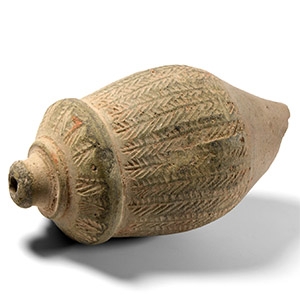
Byzantine Ceramic 'Greek Fire' Fire Bomb or Hand Grenade
9th-11th century A.D.Sold for (Inc. bp): £163
Composed of a piriform body with 'feather' design and eccentrically placed domed mouth; intended to be filled with explosive liquid and wick, and used as a hand grenade; chipped foot. 613 grams, 17 cm
Collected before 1970. Ex gallery of C.M., UK. Accompanied by an academic paper by military specialist Dr Raffaele D'Amato, dated 15 July 2019 and titled 'Eastern Roman Empire - Greek Fire Bomb or Hand Grenade (μεσαίον kακάβιον) 9th-11th century AD'.
Apart from the use of siphons or manual flame-throwers called cheirosiphona, special corps of Roman soldiers employed terracotta grenades, in the form of small jars, abundantly evidenced in archaeological excavations. Such were the γανωτα, vessels (sometimes also of bronze) used for Greek fire. They were called μεσαία kακαβιά or κυτροκακάβια where the former had a bulbous shape and the latter a more cylindrical form. -
.jpg)
Belgian Simonis 12 Shot Pinfire Revolver
1877-1890 A.D.Estimate: £1,000 - 1,400 (+bp*)
Opening Bid: £472
Single and double action twelve shot 9mm calibre revolver with 13cm (5¼") round barrel with extractor rod mounted at right and hinged loading gate with Liege proof marks and marked 'CAL 9mm' to right frame with serial number 2676; fitted with plain wood scale grips and lanyard ring (usually fitted to revolvers intended for military use); action working well. 975 grams, 25 cm
Acquired from Bolk Antique Arms, Netherlands, 2016. The Kusmirek Collection, UK. Accompanied by Bolk invoice and details.
Sold as an exempt item under Section 58 (2) of the Firearms Act, 1968, to be held as a curiosity or ornament. No license required but buyer must be over 18 years of age. Overseas bidders should note that, due to UK regulations governing export of all firearms, overseas buyers will need to make arrangements for shipping this lot out of the UK directly, by air freight, with a specialist company or agent. -
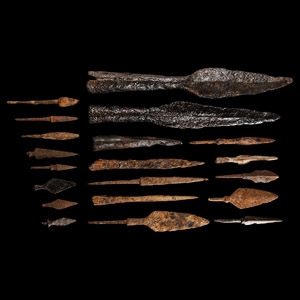
Medieval Iron Spear and Arrowhead Group
Circa 10th-15th century A.D.Sold for (Inc. bp): £156
Mainly comprising socketted spearheads and tanged arrowheads of various types, including conical, triangular-section, bodkin and lanceolate types. 408 grams total, 3.3-20 cm
UK private collection, 1990s. Acquired from a provincial auction.
