
Loading, please wait...
_900x900.jpg "Medieval Pewter Pilgrim's Badge for Romano-British Saint Ursula")
_200x200.jpg "Medieval Pewter Pilgrim's Badge for Romano-British Saint Ursula")
.jpg "Medieval Pewter Pilgrim's Badge for Romano-British Saint Ursula")
LOT 0377
Medieval Pewter Pilgrim's Badge for Romano-British Saint Ursula
15TH CENTURY A.D.
3 3/8 in. (13.78 grams, 85 mm).
Openwork design with figural detailing in three registers comprising: upper: lancet arch with crouching figure holding a sword; standing female with infant; fragment of figure; standing robed nimbate figure; fragment of building frame with figure; middle: crouching figure (shepherd) looking towards seated female with infant (Mary) beneath star, and three advancing figures with arms raised (Magi); lower: galley with three oars, mast and sail, various figures partly visible above the gunwale and seated figure in stern.
ProvenanceEx European collection, 1990s.
Property of a Cambrigeshire, UK, gentleman.
This lot has been cleared against the Art Loss Register database, and is accompanied by an illustrated lot declaration signed by the Head of the Antiquities Department, Dr Raffaele D'Amato.
Cf. van Beuningen, H.J.E. & Koldeweij, A.M., Rotterdam paper VIII. Heilig en Profaan 1000 Laatmiddeleeuwse Insignes, Koninklijke Bibliotheek, Den Haag, 1993, item 175.
FootnotesUrsula was a Romano-British martyr of possible royal origin. She is venerated as a saint in the Roman Catholic Church, Eastern Orthodox Church and the Anglican Communion.
CONDITIONTimeLine Auctions follows a vetting process to ensure the authenticity and legality of all items, reinforcing our commitment to integrity and responsible trading. Each antiquity, antique, and coin lot undergoes thorough examination by a vetting committee of at least ten external specialists, professional trade association members, scientists, and archaeologists: Our Vetting Process
AUCTIONS:
TimeLine is a leading auction house specialising in antiquities, ancient art, collectables, natural history, coins, medals, and books. Our auctions offer museums, collectors, historians, and enthusiasts the opportunity to acquire unique and historically significant pieces.
LOT 0377
Medieval Pewter Pilgrim's Badge for Romano-British Saint Ursula
Estimate £1,500 - 2,000€1,740 - 2,320 (for guidance only)$2,030 - 2,700 (for guidance only)
-
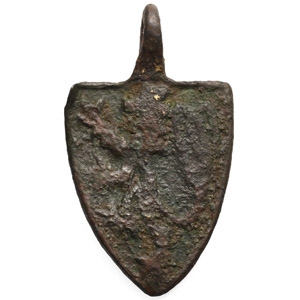
Medieval Bronze Heraldic Pendant with Lion
13th-14th century A.D.Sold for (Inc. bp): £65
Shield-shaped with lion rampant, loop above, some gilding on the obverse. 4.2 grams, 31 mm
Acquired on the UK art market before 2000. Property of an Essex, UK, gentleman. This lot is accompanied by an illustrated lot declaration signed by the Head of the Antiquities Department, Dr Raffaele D'Amato. -
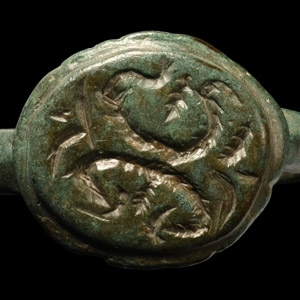
Medieval Bronze Decorated Ring
14th-16th century A.D.Sold for (Inc. bp): £46
Comprising a D-section hoop with a raised boss to the base, discoid bezel with foliate scrolls. 6.58 grams, 25.27 mm overall, 19.41 mm internal diameter (approximate size British S 1/2, USA 9 1/4, Europe 20.63, Japan 19)
Ex German art market, 2000s. Acquired from an EU collector living in London. From the collection of a Surrey, UK, gentleman. This lot is accompanied by an illustrated lot declaration signed by the Head of the Antiquities Department, Dr Raffaele D'Amato. -
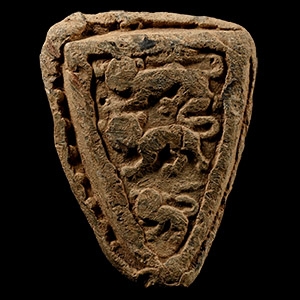
Medieval Lead Trade Weight with Three Lions of England
Circa 13th century A.D.Sold for (Inc. bp): £208
Heater-shaped with pellets to the rim, heraldic design of three lions passant gardant (the royal arms of England). 230 grams, 64 mm
Found Yorkshire, UK. From the private collection of Robin Sykes, Yorkshire, UK, formed since the late 1990s. This lot is accompanied by an illustrated lot declaration signed by the Head of the Antiquities Department, Dr Raffaele D'Amato.
