
Loading, please wait...
LOT 1683
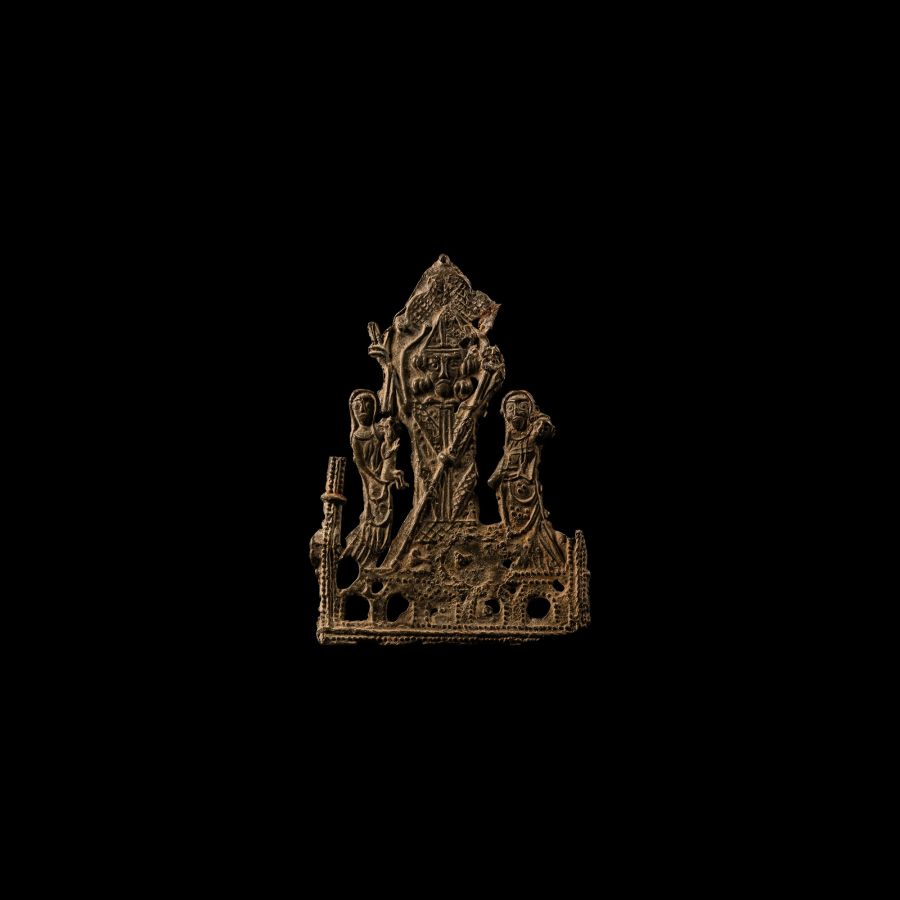
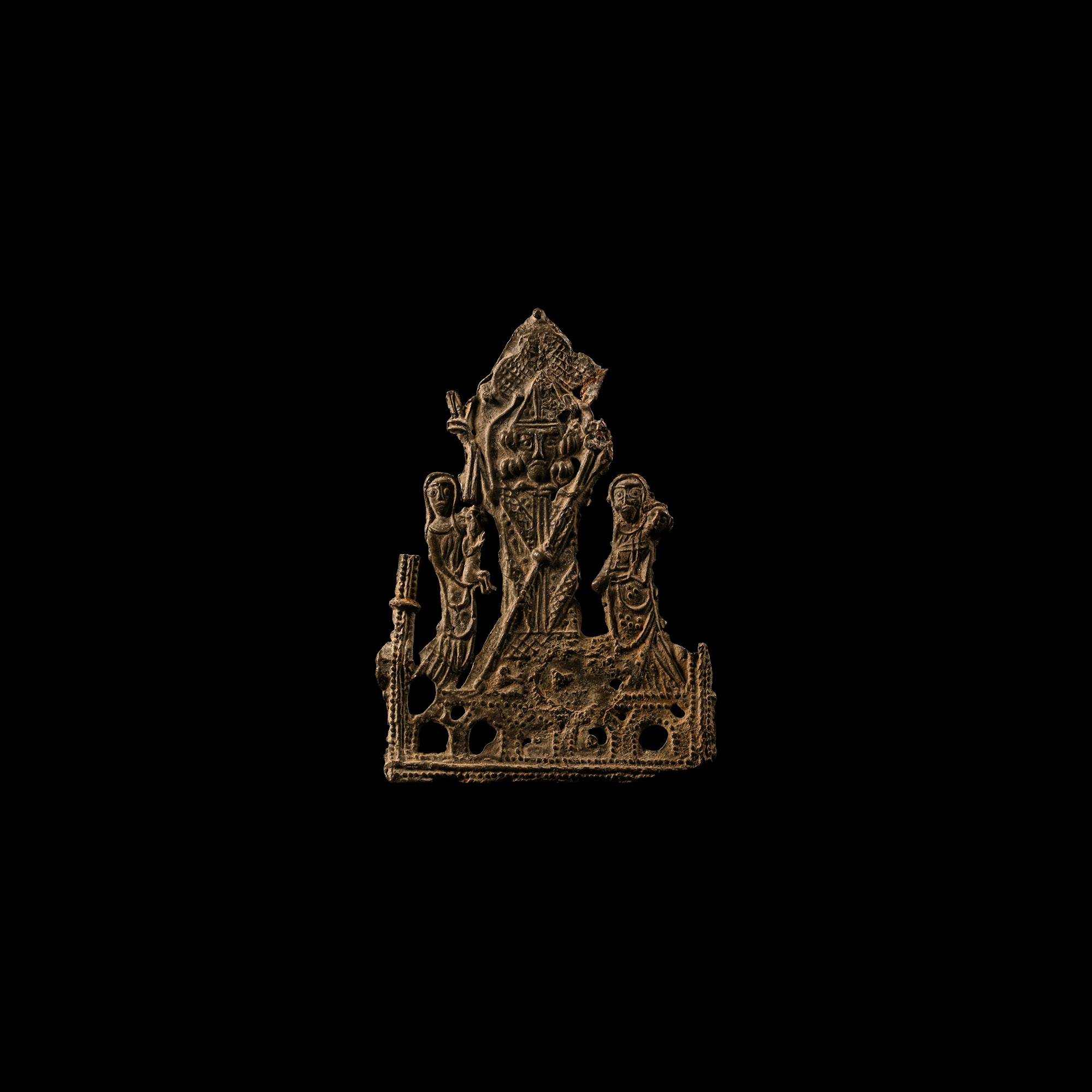
Medieval Pewter Pilgrim Badge of a Bishop
CIRCA 1300 A.D.
2 1/2 in. (8.78 grams, 63 mm).
Standing figure in bishop's mitre and robes beneath a hatched canopy holding a long processional cross, flanked by two facing robed females each holding an infant; arcade to the base with pellet detailing. [No Reserve]
ProvenanceFrom the Forgeais (1822-1878) collection, France, thence by family descent.
with Gallery 51, 21 June 2013, lot 77.
Cf. van Beuningen, H.J.E. & Koldeweij, A.M., Rotterdam paper VIII. Heilig en Profaan 1000 Laatmiddeleeuwse Insignes, Koninklijke Bibliotheek, Den Haag, 1993, no.521, or type.
CONDITIONTimeLine Auctions follows a vetting process to ensure the authenticity and legality of all items, reinforcing our commitment to integrity and responsible trading. Each antiquity, antique, and coin lot undergoes thorough examination by a vetting committee of at least ten external specialists, professional trade association members, scientists, and archaeologists: Our Vetting Process
AUCTIONS:
TimeLine is a leading auction house specialising in antiquities, ancient art, collectables, natural history, coins, medals, and books. Our auctions offer museums, collectors, historians, and enthusiasts the opportunity to acquire unique and historically significant pieces.
-
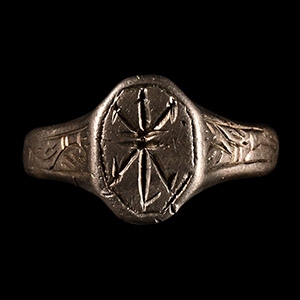
Medieval Silver Stirrup-Shaped Ring with Motif
Circa 13th-14th century A.D.Sold for (Inc. bp): £234
Composed of a convex hoop and oval bezel engraved with a geometric motif, stylised vegetal forms to the shoulders. 6.29 grams, 24.81 mm overall, 18.75 mm internal diameter (approximate size British P, USA 7 1/2, Europe 16.23, Japan 15)
Acquired 1990s-early 2000s. East Anglian private collection. -
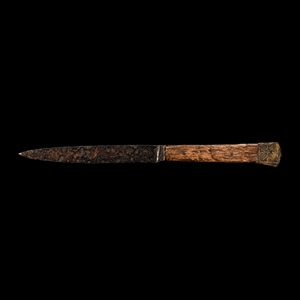
Medieval Iron Knife with Bronze Pommel
Circa 1500 A.D.Sold for (Inc. bp): £234
Comprising a single cutting edge; scale tang with bifacial pommel engraved with a stylised rayed sun or flowerhead motif. 37 grams, 19 cm
Acquired 1960s-1990s. Late Alison Barker collection, a retired London barrister.
The basic elements of any medieval knife were the blade, the tang and the handle. The junction of blade and tang is termed the shoulder, its shape varying according to the position of the tang on the blade. -
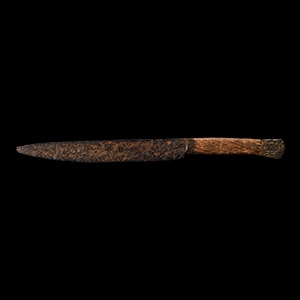
Medieval Iron Knife with Bronze Pommel
Circa 1500 A.D.Estimate: £200 - 300 (+bp*)
Opening Bid: £80
Comprising a single cutting edge and scale tang, bifacial pommel incised with a female figure possibly holding an arrow to one face and what is apparently a mythical beast or other animal to the other. 23 grams, 18.7 cm
Acquired 1960s-1990s. Late Alison Barker collection, a retired London barrister.
Examining the medieval miniatures, the knives were diagonally suspended, but the vertical suspension was the most common method in all periods. With the contrivance of an additional inner scabbard it was possible to carry more than one knife.
