
Loading, please wait...
LOT 0352
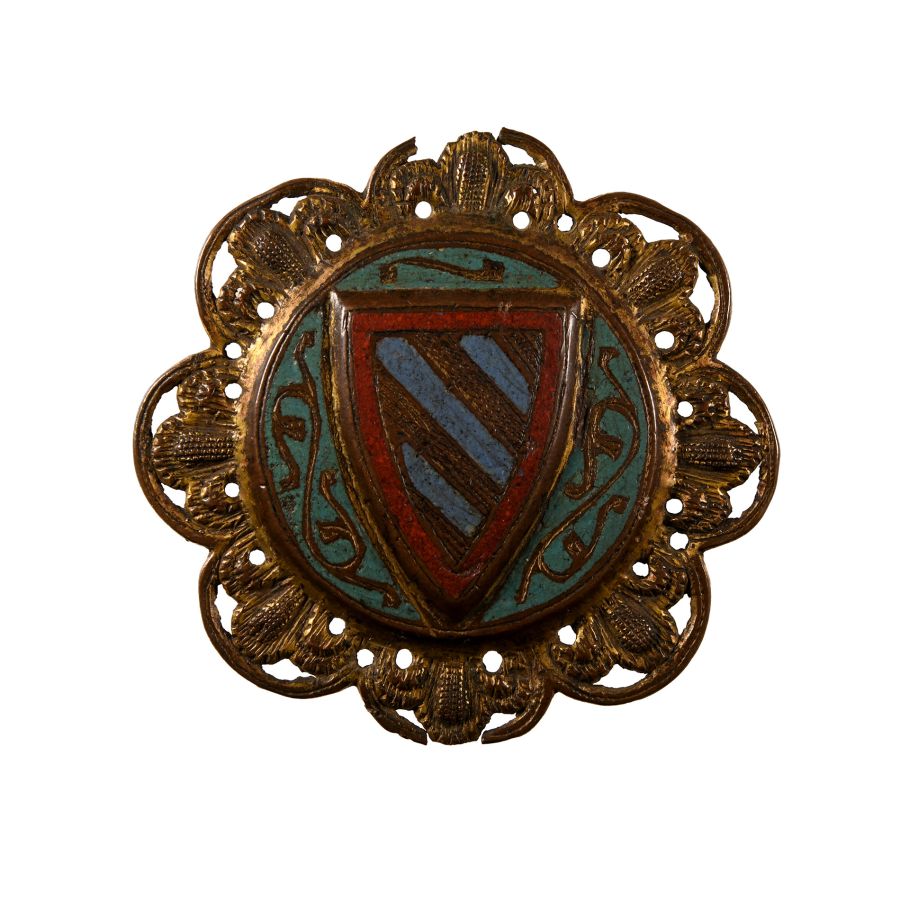
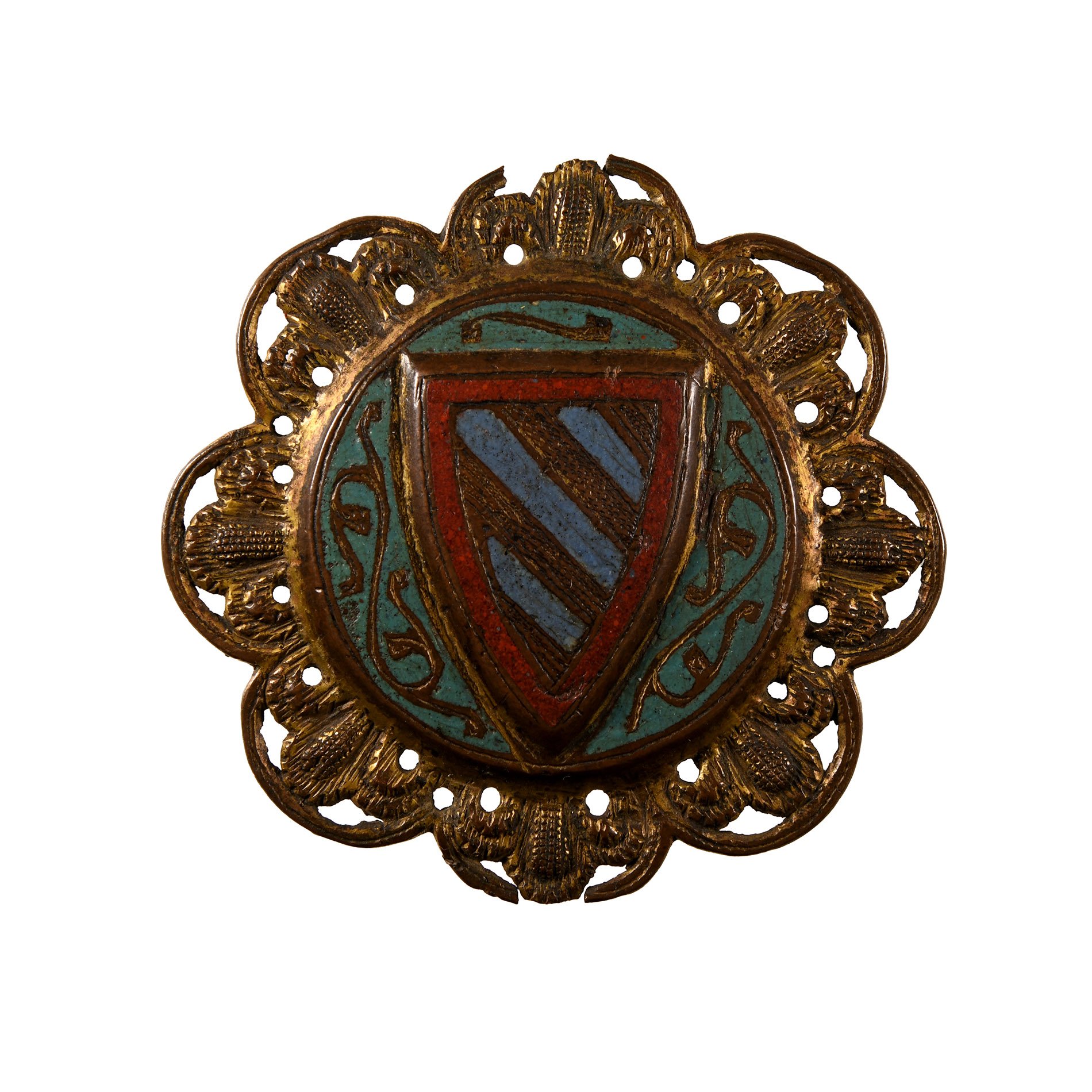
Medieval Limoges 'House of Burgundy' Bronze Heraldic Medallion with Champlevé Enamel
LIMOGES, CIRCA 1300 A.D.
4 in. (75 grams, 99 mm).
Parcel-gilt plaque from a coffre, with openwork foliage border, central disc with raised heater shield flanked by reserved scrolled tendrils; shield with red border and field of diagonal stripes; Limoges workmanship; blazoned 'bendy of seven azure an or within a bordure gules', the arms of the house of Burgundy. [No Reserve]
ProvenancePrivate collection, Paris, France.
with Pierre-Richard Royer, 2006.
Ex private collection, Suffolk, UK.
This lot has been checked against the Interpol Database of stolen works of art and is accompanied by a search certificate number no.12148-217468.
TimeLine Auctions follows a vetting process to ensure the authenticity and legality of all items, reinforcing our commitment to integrity and responsible trading. Each antiquity, antique, and coin lot undergoes thorough examination by a vetting committee of at least ten external specialists, professional trade association members, scientists, and archaeologists: Our Vetting Process
AUCTIONS:
TimeLine is a leading auction house specialising in antiquities, ancient art, collectables, natural history, coins, medals, and books. Our auctions offer museums, collectors, historians, and enthusiasts the opportunity to acquire unique and historically significant pieces.
LOT 0352
Medieval Limoges 'House of Burgundy' Bronze Heraldic Medallion with Champlevé Enamel
Sold for (Inc. bp): £4,160
-
.jpg)
Medieval 'Essex' Bronze Knight's Holy Sepulchre Plaque Badge
13th-14th century A.D.Sold for (Inc. bp): £338
Formed as a cross-crosslet on a square sheet plaque, the symbol of the Knights of the Holy Sepulchre, with the remains of an iron pin to verso; very rare formed as a square plaque. 2.05 grams, 21 mm
Found Essex, UK. Property of an Essex collector.
The 'Equestrian Order of the Holy Sepulchre of Jerusalem' was an order of knighthood under the protection of the Pope, formed around 1099 AD by Duke Godfrey of Bouillon, the leader of the First Crusade. It was established for the protection of pilgrims travelling to the Holy Land and was recognised by a Papal Bull in about 1113 AD. -
.jpg)
Medieval Silver Seal Matrix for John the Evangelist with Roman Eagle Gemstone
13th-14th century A.D.Sold for (Inc. bp): £3,380
The outer band with incuse legend '+ AQUILA IOhANNIS' (Eagle of [Saint] John]), suspension loop above with a leaf terminal to the reverse; set with a 2nd century A.D. Roman carnelian intaglio with a military eagle standing with spread wings, a laurel crown held in its beak, the claws gripping the base, two military standards at its sides; both shafts decorated with alternating phalerae, and lunulae. 3.74 grams, 21 mm
From the Smith family collection, formed in the late 1940s-1980s. Accompanied by an academic report by Dr Raffaele D’Amato. This lot has been checked against the Interpol Database of stolen works of art and is accompanied by a search certificate number no. 12045-217155.
Often the military intaglio gemstones of the ancient Rome were carved with an eagle between two standards. These intaglios could have been inserted in rings that belonged to an officer with the rank of Aquilifer (bearer of the legionary eagle). From the 4th century A.D., the vision of Ezekiel and John's Apocalypse, assigned the lion, the angel, the eagle, and the ox a place in the iconography of the Tetramorph to represent the four evangelists. -
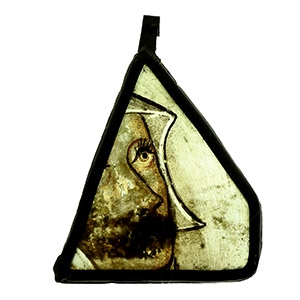
Medieval Stained Glass Panel with Lady in a Wimple
France, Burgundy, circa 1450 A.D.Sold for (Inc. bp): £195
Triangular fragment in frame with hook; three-quarter view female face with scooped wimple. 46 grams, 10 cm
with Galerie de Chartres, 8 March 2009, no.90 (Part). Ex central London gallery.
