
Loading, please wait...
_900x900.jpg "Medieval Limestone 'Pictish Type' Fish Carving")
_200x200.jpg "Medieval Limestone 'Pictish Type' Fish Carving")
.jpg "Medieval Limestone 'Pictish Type' Fish Carving")
LOT 1687
Medieval Limestone 'Pictish Type' Fish Carving
CIRCA 15TH-16TH CENTURY A.D. OR EARLIER
20 in. (24 kg total, 51 cm wide including stand).
Rectangular block with high-relief carving to the upper face, comprising two fishes placed side-by-side, one with heavy scale detailing, the other with a bifurcated tail; mounted on a custom-made display stand.
ProvenanceDiscovered in part of a stone garden wall during demolition.
Ex Stamford deceased estate, Lincolnshire, UK.
Property of a Cambridgeshire, UK, gentleman.
The carving style bears similarities to the low-relief carvings on Pictish picture stones, although a close match for the subject matter is absent. A stone recorded at Dunnicaer, Scotland, is carved with a fish symbol but its execution is very sparse and linear in comparison with the heavy detailing of the present piece. See Noble, G., The Problem with the Picts, in Current Archaeology, issue 134, June 2020.
CONDITIONTimeLine Auctions follows a vetting process to ensure the authenticity and legality of all items, reinforcing our commitment to integrity and responsible trading. Each antiquity, antique, and coin lot undergoes thorough examination by a vetting committee of at least ten external specialists, professional trade association members, scientists, and archaeologists: Our Vetting Process
AUCTIONS:
TimeLine is a leading auction house specialising in antiquities, ancient art, collectables, natural history, coins, medals, and books. Our auctions offer museums, collectors, historians, and enthusiasts the opportunity to acquire unique and historically significant pieces.
LOT 1687
Medieval Limestone 'Pictish Type' Fish Carving
Estimate £500 - 700€580 - 810 (for guidance only)$680 - 950 (for guidance only)
-
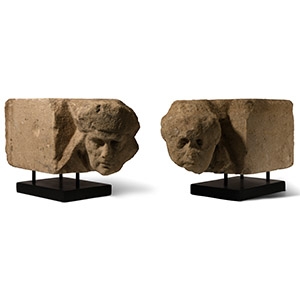
Medieval Pair of English Limestone Corbels
Circa 15th century A.D.Sold for (Inc. bp): £1,300
Each a rectangular block with carved male head; the figure looking to his right wearing a low chaperon with thick rolled brim; the other figure wearing a close-fitting cap with broad upturned rim; each mounted on a custom-made stand. 62.55 kg total including stands, 43.5-44.5 cm deep
Believed to be from a building in the West Country, UK. Acquired from Lichen Garden Antiques, Oxfordshire, UK, in 2012. Property of a Kent collector. -
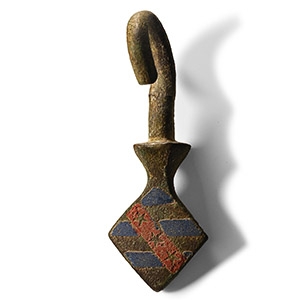
Medieval Knight's Enamelled Bronze 'Richard de Valoines' Heraldic Horse Harness Pendant
14th-15th century A.D.Sold for (Inc. bp): £520
With substantial hook, pyramidal collar and enamelled lozenge panels: obverse with a red bend bearing three reserved stars on a blue-striped field; reverse with reserved bend on blue field with six reserved stars, an extremely rare type. 38 grams, 78 mm
Found Grimsby, UK. From an East Anglian private collection.
The arms to the obverse are similar to those of Richard de Valoines (barry of six azure and or, a bend gules). -
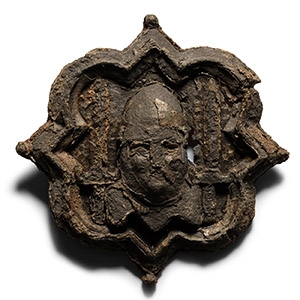
Medieval Pewter Pilgrim's Badge with Knight and Swords
14th-15th century A.D.Sold for (Inc. bp): £130
Quatrefoil panel with radiating spurs in the spandrels, high-relief mask of a helmetted warrior flanked by two drawn swords. 13.4 grams, 47 mm
From a Yorkshire, UK, collection, 1990s.
