
Loading, please wait...
_900x900.jpg "Medieval Limestone 'Pictish Type' Fish Carving")
_200x200.jpg "Medieval Limestone 'Pictish Type' Fish Carving")
.jpg "Medieval Limestone 'Pictish Type' Fish Carving")
LOT 0418
Medieval Limestone 'Pictish Type' Fish Carving
CIRCA 15TH-16TH CENTURY A.D. OR EARLIER
20 in. (24 kg total, 51 cm wide including stand).
Rectangular block with high-relief carving to the upper face, comprising two fishes placed side-by-side, one with heavy scale detailing, the other with a bifurcated tail; mounted on a custom-made display stand.
ProvenanceDiscovered in part of a stone garden wall during demolition.
Ex Stamford deceased estate, Lincolnshire, UK.
Property of a Cambridgeshire, UK, gentleman.
The carving style bears similarities to the low-relief carvings on Pictish picture stones, although a close match for the subject matter is absent. A stone recorded at Dunnicaer, Scotland, is carved with a fish symbol but its execution is very sparse and linear in comparison with the heavy detailing of the present piece. See Noble, G., The Problem with the Picts, in Current Archaeology, issue 134, June 2020.
CONDITIONTimeLine Auctions follows a vetting process to ensure the authenticity and legality of all items, reinforcing our commitment to integrity and responsible trading. Each antiquity, antique, and coin lot undergoes thorough examination by a vetting committee of at least ten external specialists, professional trade association members, scientists, and archaeologists: Our Vetting Process
AUCTIONS:
TimeLine is a leading auction house specialising in antiquities, ancient art, collectables, natural history, coins, medals, and books. Our auctions offer museums, collectors, historians, and enthusiasts the opportunity to acquire unique and historically significant pieces.
LOT 0418
Medieval Limestone 'Pictish Type' Fish Carving
Estimate £600 - 800€700 - 930 (for guidance only)$810 - 1,080 (for guidance only)
-
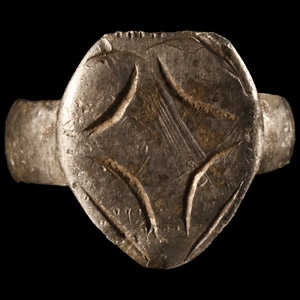
Medieval Silver Ring with Shield-Shaped Bezel
Circa 12th-14th century A.D.Sold for (Inc. bp): £130
Flat heater-shaped plaque with four incised arches creating a central cross motif. 7.97 grams, 24.22 mm overall, 19.12 mm internal diameter (approximate size British S 1/2, USA 9 1/4, Europe 20.63, Japan 19)
Acquired on the London art market in the late 1980s-1990s. From the family collection of an East London, UK, gentleman. -
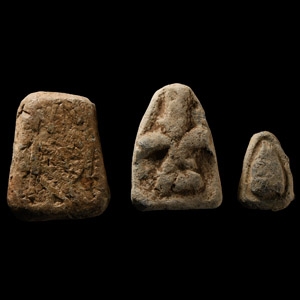
Medieval Lead Weight Collection
Circa 13th-16th century A.D.Sold for (Inc. bp): £13
Heater-shaped with reserved fleur-de-lys and cross decoration; one trapezoidal, plain. 958 grams total, 40-65 mm
Ex Simmons gallery, London, UK. Ex North London collection, 1990s. -
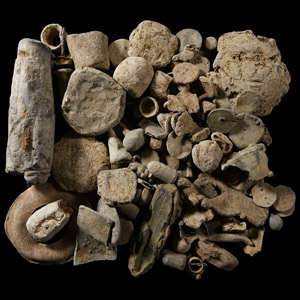
Medieval and Later Lead Artefact Group
Circa 14th-20th century A.D.Sold for (Inc. bp): £7
Mixed group including a model horse, a model ecclesiastical throne, musket and pistol balls, and other items. 5.13 kg total, 13-132 mm
Found Hertfordshire, UK.
