
Loading, please wait...
_900x900.jpg "Medieval Limestone Gargoyle of a Smiling Horned Devil")
_200x200.jpg "Medieval Limestone Gargoyle of a Smiling Horned Devil")
_900x900.jpg "Medieval Limestone Gargoyle of a Smiling Horned Devil")
_200x200.jpg "Medieval Limestone Gargoyle of a Smiling Horned Devil")
_900x900.jpg "Medieval Limestone Gargoyle of a Smiling Horned Devil")
_200x200.jpg "Medieval Limestone Gargoyle of a Smiling Horned Devil")
_900x900.jpg "Medieval Limestone Gargoyle of a Smiling Horned Devil")
_200x200.jpg "Medieval Limestone Gargoyle of a Smiling Horned Devil")
.jpg "Medieval Limestone Gargoyle of a Smiling Horned Devil")
.jpg "Medieval Limestone Gargoyle of a Smiling Horned Devil")
.jpg "Medieval Limestone Gargoyle of a Smiling Horned Devil")
.jpg "Medieval Limestone Gargoyle of a Smiling Horned Devil")
LOT 0375
Medieval Limestone Gargoyle of a Smiling Horned Devil
CIRCA 15TH CENTURY A.D.
12 in. (8.4 kg total, 30.5 cm high including stand).
Modelled with a threatening expression, his half-open mouth visibly contracted into an evil grin with exposed teeth, short beard to the chin and wavy locks of hair resting on the forehead with two small horns, large goat horns framing the face on both sides; mounted on a custom-made display stand. [No Reserve]
ProvenanceFrom a collection acquired on the UK art market.
Property of a West Midlands, UK, private collector.
This lot is accompanied by an illustrated lot declaration signed by the Head of the Antiquities Department, Dr Raffaele D'Amato.
Cf. Tindall Wildridge, The Grotesque…in Church Art…, London, 1899, pp.16ff., for similar grotesque masks.
FootnotesFrom the Romanesque era onwards, images of demons, often carved on the external sides of cathedrals and churches, were strongly linked to the fantastical and monstrous creatures of ancient myth and legend. For theologians, supernatural creatures which could not otherwise be explained were not of God and therefore had to be demonic: their incorporation in the ecclesiastic structures showed that their malevolent powers could be kept under control only through the protection of the church. This origin of Christian demons is likely to have influenced the visual representation in medieval culture as hybrid and monstrous, especially given the increased interest in Greek works from the twelfth century onwards in the West.
CONDITIONTimeLine Auctions follows a vetting process to ensure the authenticity and legality of all items, reinforcing our commitment to integrity and responsible trading. Each antiquity, antique, and coin lot undergoes thorough examination by a vetting committee of at least ten external specialists, professional trade association members, scientists, and archaeologists: Our Vetting Process
AUCTIONS:
TimeLine is a leading auction house specialising in antiquities, ancient art, collectables, natural history, coins, medals, and books. Our auctions offer museums, collectors, historians, and enthusiasts the opportunity to acquire unique and historically significant pieces.
LOT 0375
Medieval Limestone Gargoyle of a Smiling Horned Devil
Sold for (Inc. bp): £2,210
-
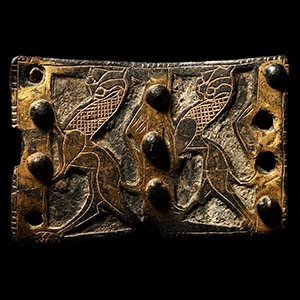
Medieval Henry II Period 'Aubigny Family, Chief Butlers of England' Heraldic Gilt Bronze Strap Fitting
Plantagenet, 1154-1189 A.D.Sold for (Inc. bp): £2,340
Rectangular plaque with three columns of attachment holes, most with rivet in situ; heraldry of two reserved lions in profile each with hatched neck and body on an (originally enamelled) field; a rare survival of a heraldic object from this early period. 17.44 grams, 45 mm
Acquired 1990 with inventory no.90.91 and cat.582. From an important London, UK, collection, in the late 1990s. Property of a South West London academic since circa 2010. Accompanied by an academic report by heraldry specialist Dr Paul A. Fox, FSA. This lot is accompanied by an illustrated lot declaration signed by the Head of the Antiquities Department, Dr Raffaele D'Amato. -
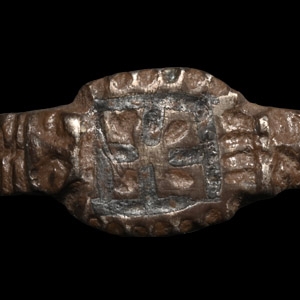
Norman Silver Ring with Niello Cross and Animal Heads
Circa 11th-12th century A.D.Sold for (Inc. bp): £124
Flat-section hoop with stylised beast-head shoulders supporting a plaque bezel with cross motif. 2.21 grams, 19.26 mm overall, 17.49 mm internal diameter (approximate size British M, USA 6, Europe 12.46, Japan 12)
Acquired on the UK art market. Property of K.P., a Cornish lady collector, UK. This lot is accompanied by an illustrated lot declaration signed by the Head of the Antiquities Department, Dr Raffaele D'Amato. -
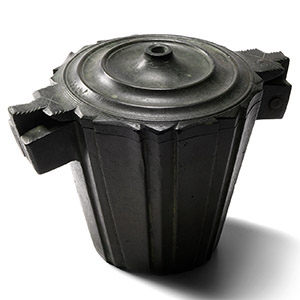
Large Medieval Bronze Trade Weight Container
14th-16th century A.D.Estimate: £500 - 700 (+bp*)
Opening Bid: £250
Comprising hinged lid incised with X-motifs and numerals IIIX (7) to lid top. 4.1 kg, 18.5 cm wide
Acquired 1990s-early 2000s. East Anglian private collection. This lot is accompanied by an illustrated lot declaration signed by the Head of the Antiquities Department, Dr Raffaele D'Amato.
