
Loading, please wait...
_900x900.jpg "Medieval Limestone Corbel of Jesus with Crown of Thorns")
_200x200.jpg "Medieval Limestone Corbel of Jesus with Crown of Thorns")
.jpg "Medieval Limestone Corbel of Jesus with Crown of Thorns")
LOT 1799
Medieval Limestone Corbel of Jesus with Crown of Thorns
CIRCA 14TH-15TH CENTURY A.D.
15 1/4 in. (31.9 kg, 39 cm deep).
Rectangular corbel with head of Christ modelled in the half-round, turned slightly with the eyelids drooping and lank hair framing the face; crown of thorns to the brow. [No Reserve]
ProvenanceFrom Lancashire, UK.
From a collection acquired on the UK art market.
Property of a West Midlands, UK, private collector.
TimeLine Auctions follows a vetting process to ensure the authenticity and legality of all items, reinforcing our commitment to integrity and responsible trading. Each antiquity, antique, and coin lot undergoes thorough examination by a vetting committee of at least ten external specialists, professional trade association members, scientists, and archaeologists: Our Vetting Process
AUCTIONS:
TimeLine is a leading auction house specialising in antiquities, ancient art, collectables, natural history, coins, medals, and books. Our auctions offer museums, collectors, historians, and enthusiasts the opportunity to acquire unique and historically significant pieces.
LOT 1799
Medieval Limestone Corbel of Jesus with Crown of Thorns
Sold for (Inc. bp): £221
-
.jpg)
Medieval Limestone Corbel of Jesus with Crown of Thorns
Circa 14th-15th century A.D.Sold for (Inc. bp): £221
Rectangular corbel with head of Christ modelled in the half-round, turned slightly with the eyelids drooping and lank hair framing the face; crown of thorns to the brow. 31.9 kg, 39 cm deep
From Lancashire, UK. From a collection acquired on the UK art market. Property of a West Midlands, UK, private collector. -
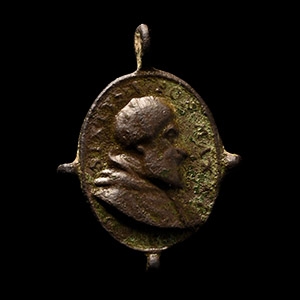
Pope Sixtus V Bronze Pendant
Dated 1585 A.D.Sold for (Inc. bp): £390
Ellipsoid bronze bifacial pendant with three radiating lugs and pierced lug above; reverse with kneeling nimbate figure (St. Jerome) in ankle-length robe, one hand extended and open book below, lion's head to his rear; obverse with profile bust in cassock and camauro (papal cap), legend above 'SIXTVS V PONS MAX A I'. 4.7 grams, 30 mm
Found Tuesday 1st April 2025 in Claydon, Suffolk, UK. Accompanied by a copy of the British Museum's Portable Antiquities Scheme (PAS) report no.SF-92A7E3.
This item is a rare example of a Catholic papal emblem made and used during Elizabeth I's reign, when the Protestant cause was dominant. This is only the second known example to be found in England. -
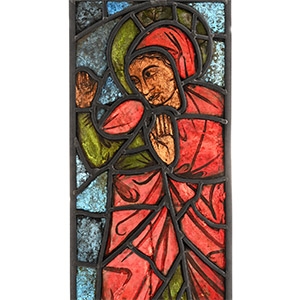
Medieval Stained Glass Panel of the Annunciate Virgin
Western France, 1250-1275 A.D.Sold for (Inc. bp): £5,460
Depicting Mary clad in red and green, with a green halo outlining her head, raising her hands in exclamation. 1.92 kg, 53 x 23.5 cm
Eglise Saint-Malo, Dinan, France, by repute. Acquired from the above by Mr and Mrs Junius P. Morgan, Princeton, New Jersey, USA. The Dalva Brothers collection. Accompanied by a previous cataloguing document. This lot has been checked against the Interpol Database of stolen works of art and is accompanied by search certificate number no.12994-246433.
Although her garments are uncharacteristic of figures of the Virgin, she nevertheless almost certainly represents Mary as she appeared in a scene of the Annunciation. Both in terms of the choice of colours, and in the style and treatment of her features and drapery folds, she can be compared very closely with window panels from the third quarter of the thirteenth century removed from the Church of Saint Radegonde in Poitiers, including a window now in the Glencairn Museum in Bryn Athyn which shows in its lowermost vignette an identically dressed Virgin riding side saddle on a donkey during her flight into Egypt (fig. 1a-b).
