
Loading, please wait...
LOT 1720
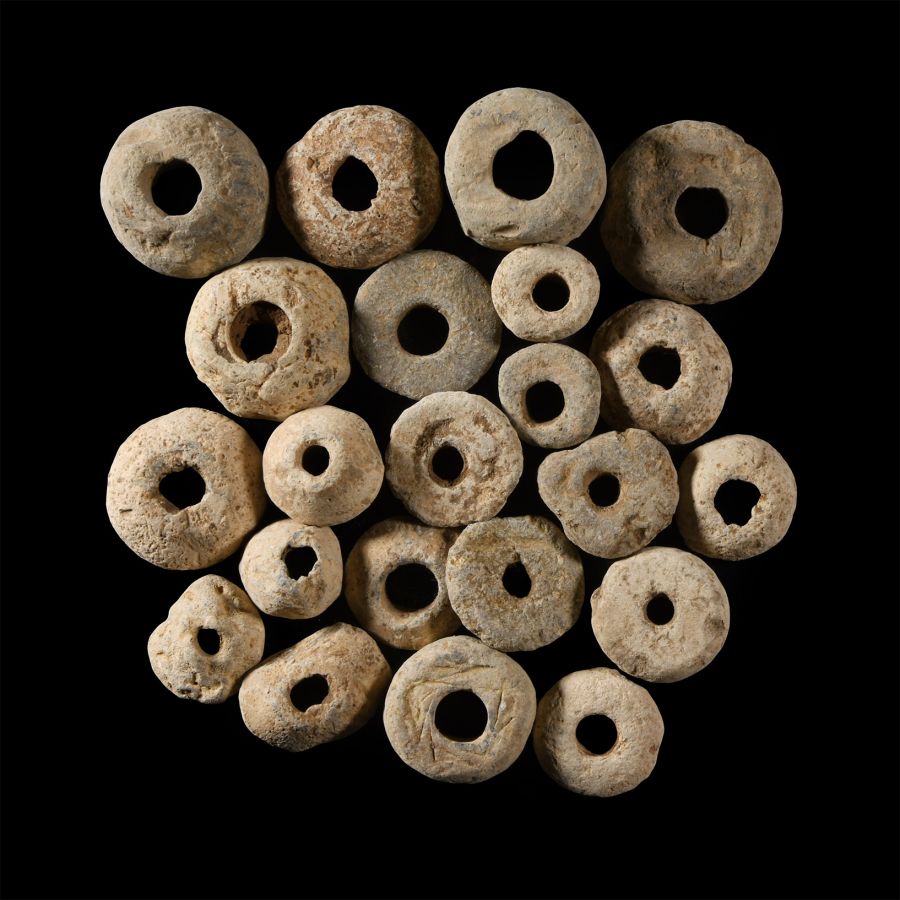
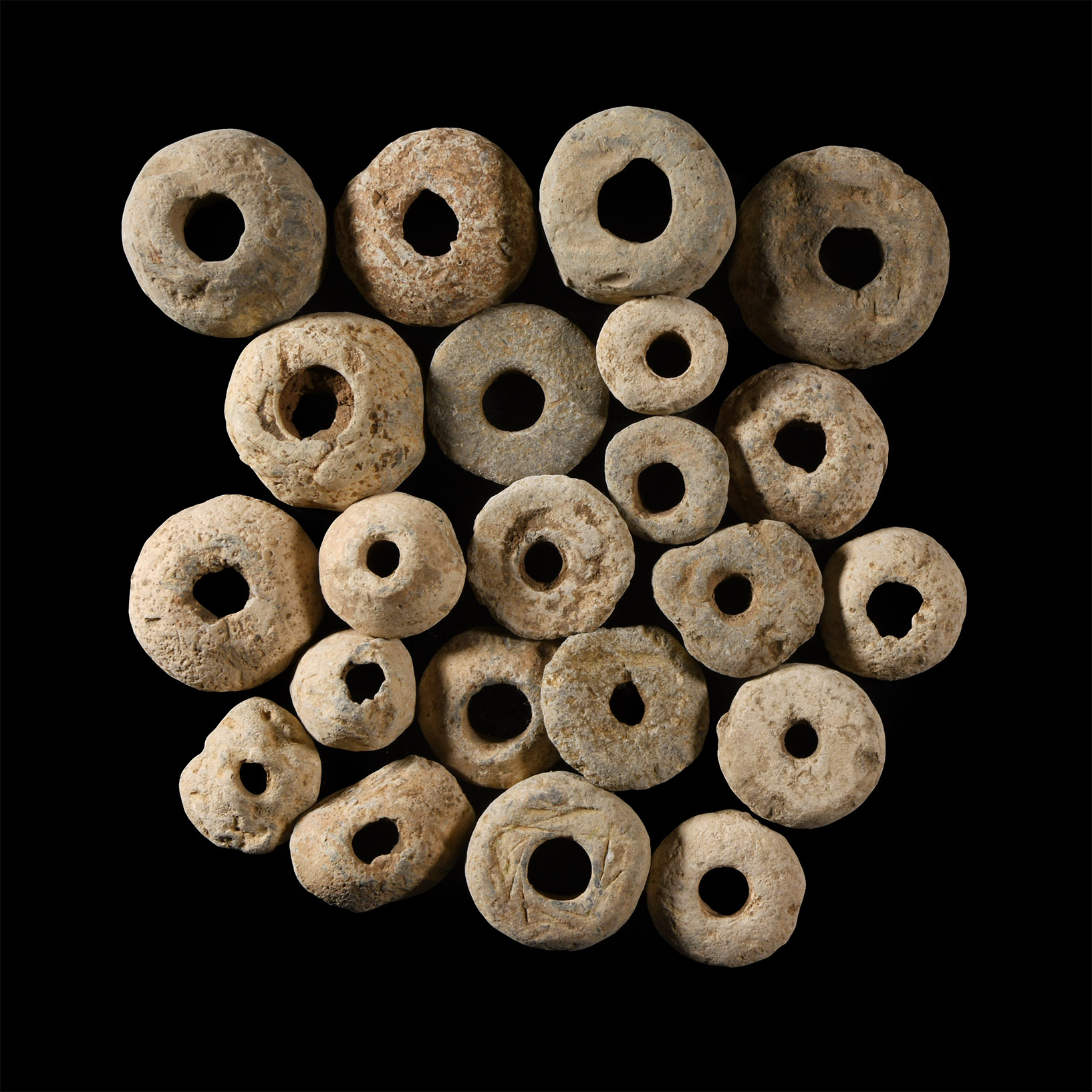
Medieval Lead Spindle Whorl Weight Group
CIRCA 14TH-16TH CENTURY A.D.
3/4 - 1 in. (696 grams total, 18-29 mm).
Annular, biconvex, plano-convex and other types. [22, No Reserve]
ProvenanceFound Hertfordshire, UK.
CONDITIONTimeLine Auctions follows a vetting process to ensure the authenticity and legality of all items, reinforcing our commitment to integrity and responsible trading. Each antiquity, antique, and coin lot undergoes thorough examination by a vetting committee of at least ten external specialists, professional trade association members, scientists, and archaeologists: Our Vetting Process
AUCTIONS:
TimeLine is a leading auction house specialising in antiquities, ancient art, collectables, natural history, coins, medals, and books. Our auctions offer museums, collectors, historians, and enthusiasts the opportunity to acquire unique and historically significant pieces.
-
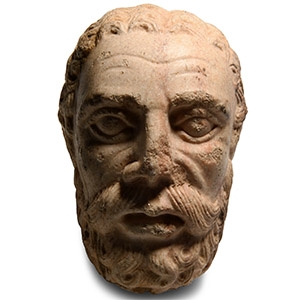
Medieval Romanesque Marble Head of a Saint
Late 12th-13th century A.D.Estimate: £3,500 - 4,500 (‡+bp*)
Opening Bid: £1,750
Carved naturalistically in the round as a mature male figure with short wavy hair, full beard and moustache, his brow furrowed and mouth held slightly ajar; repaired. 3.8 kg, 18 cm
Acquired in Europe before 1996. Accompanied by an academic report by Dr Raffaele D’Amato. This lot has been checked against the Interpol Database of stolen works of art and is accompanied by search certificate no.11809-206816.
The head was carved as an image of a saint, Apostle or a prophet. The accomplished and sophisticated style of carving on this head can be compared to some of the most celebrated Romanesque buildings of Southern France. The carving of the head resembles the representations of heads and faces of 12th century French Romanesque art, for example those of Saint Trophime in Arles. This imposing head once served as an important architectural part of a lavishly decorated church, possibly in western France. Its form and the size suggest that the head was not only decorative but that it would have been structurally important – perhaps part of a row of statues of apostles and prophets like those depicted on the Saint Trophime façade. -
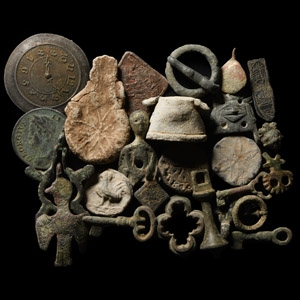
Medieval and Later Bronze and Lead Artefact Group
Circa 14th-19th century A.D.Sold for (Inc. bp): £286
Mixed group including a harness pendant, figural Limoges mount, miniature pail, pilgrim's flask and other items. 191 grams total, 13-48 mm
Found Hertfordshire, UK. -
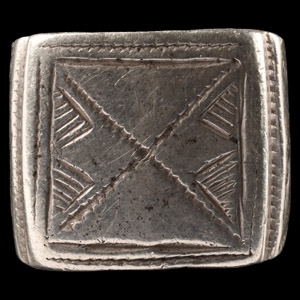
Medieval Silver Ring with Hourglass
Circa 15th-16th century A.D.Sold for (Inc. bp): £124
With a wide flat-section hoop and square bezel, chevron motifs to the shoulders, bezel with a stylised hourglass or X-motif flanked by two pairs of hatched triangles. 8.47 grams, 20.83 mm overall, 19.14 mm internal diameter (approximate size British S, USA 9, Europe 20, Japan 19)
UK private collection before 2000. On the UK art market. Property of a London gentleman.
