
Loading, please wait...
LOT 1877
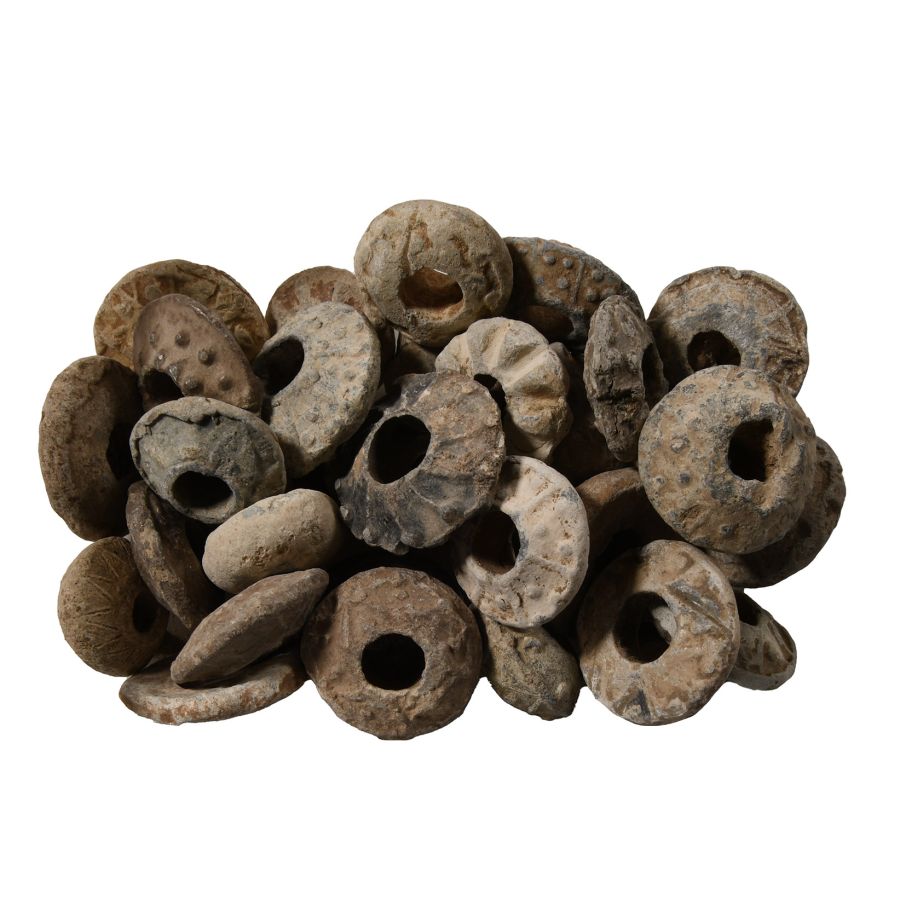
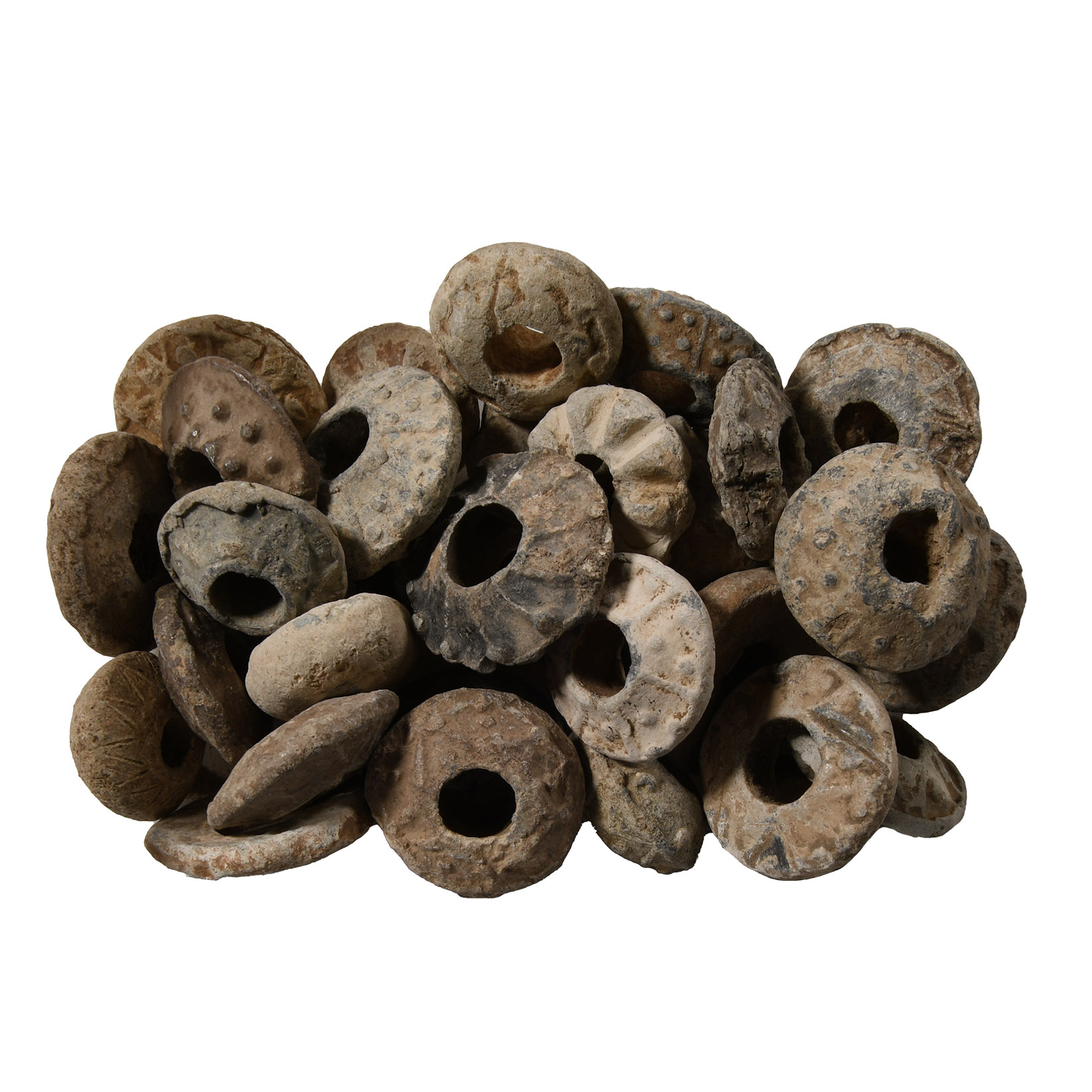
Medieval Lead Spindle Whorl Collection
12TH-16TH CENTURY A.D.
7/8 - 1 1/4 in. (1.3 kg total, 23-32 mm).
Mainly biconvex in profile with raised pellet and other detailing; many of these objects are published in the Detector Finds book series. [34, No Reserve]
ProvenanceFrom the collection of the famous author, writer and speaker, Gordon Bailey, Essex, UK; formed since 1968.
CONDITIONTimeLine Auctions follows a vetting process to ensure the authenticity and legality of all items, reinforcing our commitment to integrity and responsible trading. Each antiquity, antique, and coin lot undergoes thorough examination by a vetting committee of at least ten external specialists, professional trade association members, scientists, and archaeologists: Our Vetting Process
AUCTIONS:
TimeLine is a leading auction house specialising in antiquities, ancient art, collectables, natural history, coins, medals, and books. Our auctions offer museums, collectors, historians, and enthusiasts the opportunity to acquire unique and historically significant pieces.
-
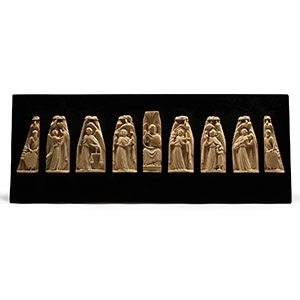
Medieval Archangels and Other Carved Bone Plaques by the Embriachi Workshop
Italy, Florence, circa 1400 A.D.Sold for (Inc. bp): £7,800
Group of nine carved bone panels from a casket, most with a tapering upper third and openwork vegetation at the top; comprising: young man resting his hands on a teardrop shield, beside a fir-tree, looking right; winged nimbate angel in floor-length robe reaching upwards towards a three-horned crown; winged nimbate angel in floor-length robe holding a naked sword in her right hand and scales in her left; winged nimbate figure in floor-length robe holding a serpent in each hand, with three faces conjoined; winged angel in floor-length robe sitting on a dais, holding a discoid object with a bifid handle (perhaps a lute); winged nimbate angel in floor-length robe holding a chalice in her right hand and cross in her left; winged nimbate angel in floor-length robe holding a flaming torch in her right hand and grasping the raised hands of a child with her left; winged nimbate angel in floor-length robe with two ewers, pouring liquid from one to the other; young man resting his hands on a teardrop shield, beside a fir-tree, looking left; mounted on a wooden display stand. 1.08 kg total, 48.5 cm wide including stand
Acquired Delchar, London, 2011. Private collection, Suffolk, UK. This lot has been checked against the Interpol Database of stolen works of art and is accompanied by a search certificate number no.12291-221716.
The Bottega degli Embriachi was an important producer of artworks carved in bone (and occasionally ivory) in a framework of inlaid wood. It was active in Northern Italy from circa 1375 A.D. until circa 1433. It relocated from Florence to Venice about 1395. The Bottega was especially known for 'marriage caskets' with tall columnar lids, with carved bone figural panels. Some of the panels here are evidently Christian (the figure with the cross and chalice) while others are perhaps purely symbolic (Justice with sword and scales) and some are simply puzzling (e.g. the three-faced figure with serpents). -
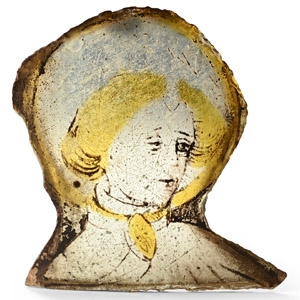
Medieval Stained Glass Head of a Saint
Western France, 15th century A.D.Sold for (Inc. bp): £494
Portrait bust of John the Evangelist with vesica-shaped brooch at the chest, nimbus behind the head. 62.3 grams, 10.7 cm
Ex central London gallery. -
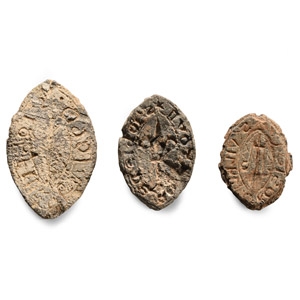
Medieval Lead Seal Matrix Collection
13th century A.D.Sold for (Inc. bp): £33
Each vesica-shaped, with central fleur-de-lys or other motif and surrounding legend. 53.1 grams total, 29-42 mm
From the collection of the famous author, writer and speaker, Gordon Bailey, Essex, UK; formed since 1968.
