
Loading, please wait...
_900x900.jpg "Medieval Lead Gregory X Papal Bulla")
_200x200.jpg "Medieval Lead Gregory X Papal Bulla")
_900x900.jpg "Medieval Lead Gregory X Papal Bulla")
_200x200.jpg "Medieval Lead Gregory X Papal Bulla")
.jpg "Medieval Lead Gregory X Papal Bulla")
.jpg "Medieval Lead Gregory X Papal Bulla")
LOT 0348
Medieval Lead Gregory X Papal Bulla
1271-1276 A.D.
1 3/8 in. (34.4 grams, 37 mm).
The obverse depicting the busts of St Peter and St Paul each within a compartment defined by pellets; cross pattee supported on a staff between the busts; at the top of the bulla in the centre, legend 'SPASPE' (abbreviations for St Paul and St Peter); reverse inscribed in Lombardic script in three lines 'GRE/GORIVS./PP. X', with an omega above the letters 'PP' and curlicue after 'X'; both obverse and reverse faces with a pelletted perimeter.
ProvenanceFound Norfolk, UK.
Accompanied by an illustrated report from Andy Flowers KLMD dated November 2013.
Pope Gregory IX, born Ugolino di Conti, was the 178th Pope of the Catholic Church, reigning from 1227 to 1241. He is known for his strong defence of papal authority, his role in the Crusades, and his establishment of the Papal Inquisition.
CONDITIONTimeLine Auctions follows a vetting process to ensure the authenticity and legality of all items, reinforcing our commitment to integrity and responsible trading. Each antiquity, antique, and coin lot undergoes thorough examination by a vetting committee of at least ten external specialists, professional trade association members, scientists, and archaeologists: Our Vetting Process
AUCTIONS:
TimeLine is a leading auction house specialising in antiquities, ancient art, collectables, natural history, coins, medals, and books. Our auctions offer museums, collectors, historians, and enthusiasts the opportunity to acquire unique and historically significant pieces.
-
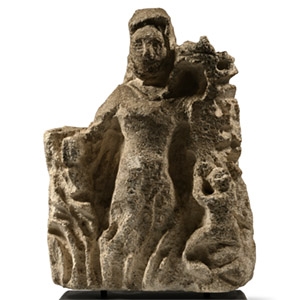
Medieval 'Our Lady of the Flames' Limestone Figural Scene
15th century A.D. or laterEstimate: £400 - 600 (+bp*)
Opening Bid: £180
Carved in the half-round frieze fragment or devotional sculpture of the Madonna del Fuoco, facing female in wimple and long robe with her right arm bent forward, left arm extended above a child gripping the folds of her robe; billowing flames surrounding the pair; mounted on a custom-made stand. 10.55 kg total, 37.7 cm including stand
Acquired Lukas Pearsie, Suffolk, 2012. Property of a Kent collector. From the N.J. collection, Leicester, UK. -
.jpg)
Medieval Limestone Corbel of Jesus with Crown of Thorns
Circa 14th-15th century A.D.Sold for (Inc. bp): £221
Rectangular corbel with head of Christ modelled in the half-round, turned slightly with the eyelids drooping and lank hair framing the face; crown of thorns to the brow. 31.9 kg, 39 cm deep
From Lancashire, UK. From a collection acquired on the UK art market. Property of a West Midlands, UK, private collector. -
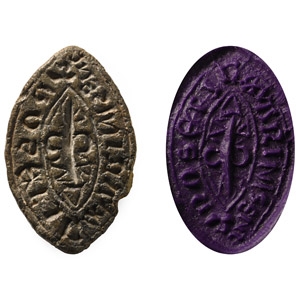
Medieval Lead Seal Matrix for Roberti Marinissni
13th century A.D.Sold for (Inc. bp): £46
Vesica-shaped with strap and loop to reverse; central field with incuse fleur-de-lys, border with legend 'S* ROBERTI MARINISSNI'. 16.6 grams, 38 mm
Ex Paul Moore, 1990s. Accompanied by a laminated Paul Moore identification card.
