Loading, please wait...
Details
LOT 1827
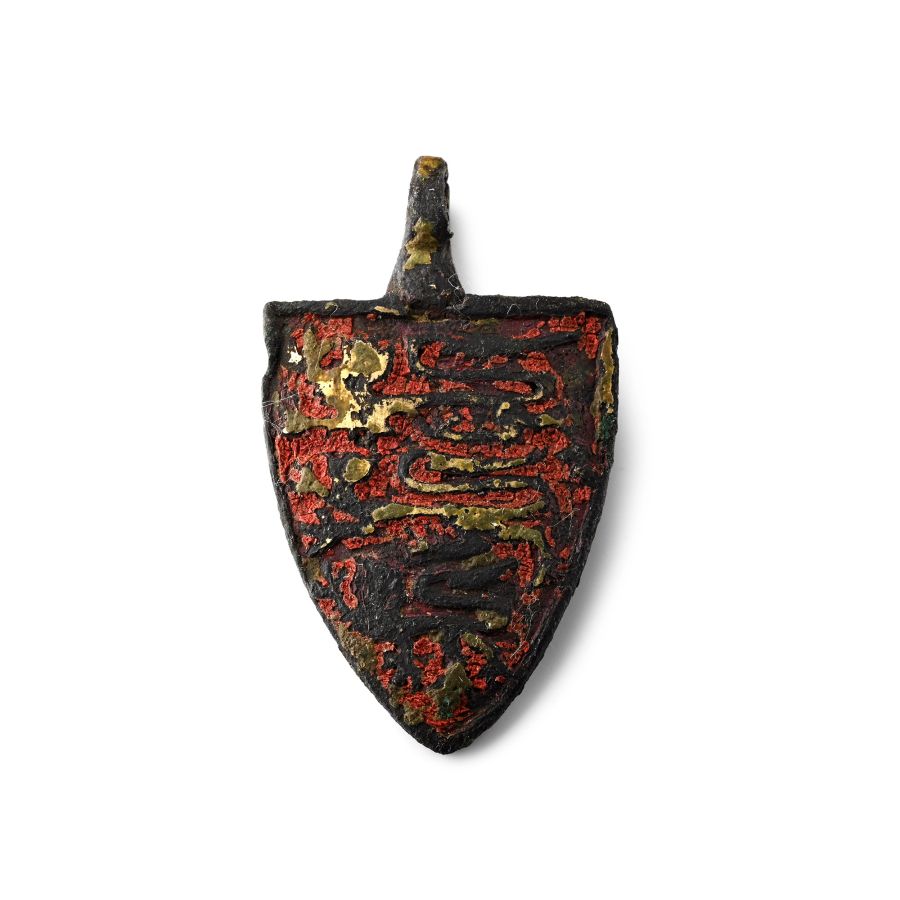
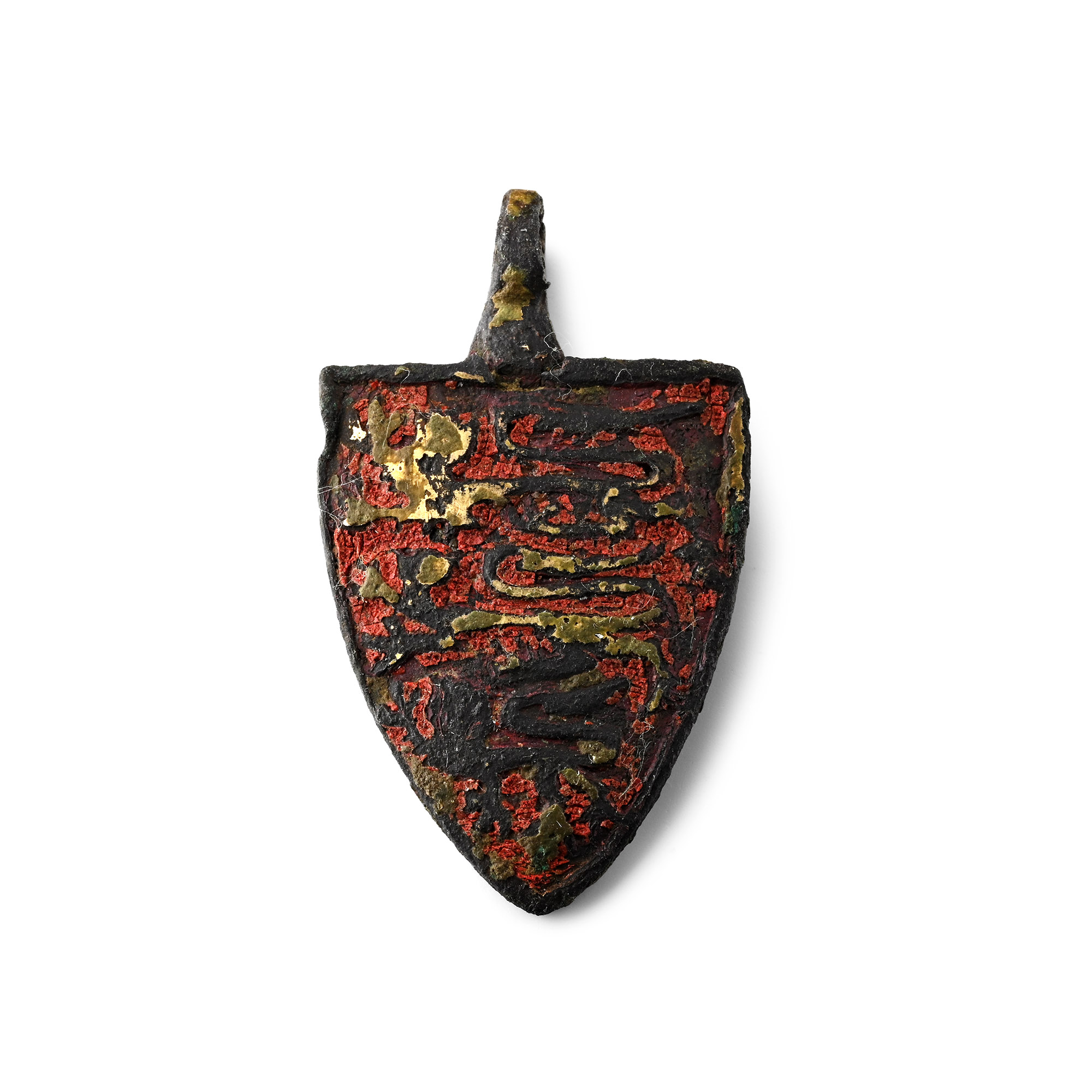
Medieval Knight's Gilt Bronze Royal Heraldic Horse Harness Pendant with Three Lions
CIRCA 14TH CENTURY A.D.
1 5/8 in. (10.7 grams, 42 mm).
Heater-shaped with pierced lug above; reserved border and three lions passant gardant on a red enamelled field. [No Reserve]
Provenance
Acquired on the UK art market in the 1980s.
From an East Anglian private collection.
Literature
Cf. Ashley, S., Medieval Armorial Horse Furniture in Norfolk, East Anglian Archaeology 101, Dereham, 2002, item 55, for type, and 238, for arms.
CONDITIONVETTING:
TimeLine Auctions follows a vetting process to ensure the authenticity and legality of all items, reinforcing our commitment to integrity and responsible trading. Each antiquity, antique, and coin lot undergoes thorough examination by a vetting committee of at least ten external specialists, professional trade association members, scientists, and archaeologists: Our Vetting Process
AUCTIONS:
TimeLine is a leading auction house specialising in antiquities, ancient art, collectables, natural history, coins, medals, and books. Our auctions offer museums, collectors, historians, and enthusiasts the opportunity to acquire unique and historically significant pieces.
LOT 1827
Medieval Knight's Gilt Bronze Royal Heraldic Horse Harness Pendant with Three Lions
Sold for (Inc. bp): £143
RELATED LOTS
-
Medieval Reliquary Bust of Saint John the Baptist
15th century A.D.Sold for (Inc. bp): £4,420
Reliquary bust of Saint John the Baptist carved in walnut wood with applied pigments and gilding; inset glass panels to brow and chest with ink on vellum; the inscriptions (i) in the chest; ‘En cette teste a des cheveux nostre du [anet?] [chef?] lame Jehan baptiste …Et ces reliques… [dente?] saincte [agnes? agneau?]’ (in this head are some hairs from [...] John the Baptist ... and these holy relics'; (ii) In the head; ‘ap…e sancti joha(n)nis bap… (...of Saint John the Baptist)’; separate shoulders partly detached; mounted on a custom-made stand. 2.8 kg total, 33 cm including stand
Private collection, France, 2013. Accompanied by a previous cataloguing document. This lot has been checked against the Interpol Database of stolen works of art and is accompanied by search certificate number no.12991-246401.
According to the Gospels of Matthew (14:6–12) and Mark (6:21–29), Saint John was arrested for criticising the incestuous marriage of King Herod and Herodias, the wife of his slain half-brother Philip. Herodias’s daughter, Salome, danced for Herod during his birthday banquet, and as a reward, she was offered whatever she wished. In an act of revenge against John, Herodias had her daughter ask for his head on a platter. Though reluctant, Herod was bound by his promise, and he ordered the saint’s execution by beheading. Early accounts suggest that the saint’s remains were being venerated as early as the fourth century, having been purportedly rediscovered in a grave located some thirty miles north of Jerusalem. They remained in the Holy Land until 1206, when Saint John’s skull was stolen by crusaders returning to France after the Sack of Constantinople. It was taken by one of the crusaders, Walo of Sarton, to Amiens, where it remains to this day in the cathedral built to house it. The saint came to be invoked by sufferers of headaches and was thought to guard against insanity. The latter belief may even have informed the prominent inclusion of the saint as a young boy on the Goldenes Rössl, which was given to the continually insane King Charles VI by his wife in 1405 as a reminder of his royal duties. By the end of the Middle Ages, the saint’s relics had such famous, reputed healing powers that it led to his widespread devotion, and images of the saint (and especially those focusing on his head and the associated significance of his surviving skull) were produced in large numbers right across Europe. Few, however, contain actual relics, and fewer still have intact and undisturbed compartments incorporating original inscribed parchment labels. This marvellous bust is an anomaly and almost unique in having its relics well preserved. The stylistic treatment of our figure is extremely close to that of a bearded head on a capital with two figures formerly in the collection of the North Carolina Museum of Art at Raleigh (inv. G.57.14.16, now deaccessioned). Dated to the late fourteenth century, it was clearly carved in the same artistic orbit as our bust. -
Medieval Bronze Sun, Moon and Star Retainer's Badge
14th century A.D.Sold for (Inc. bp): £20
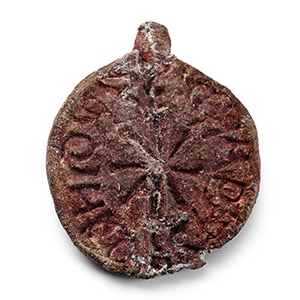
Lancastrian retainer's badge or mount with 'sun, moon and star' emblem. 6.15 grams, 33 mm
Found Gloucestershire, UK.
The 'star and crescent' (sun, moon and star) symbols were a traditional badge of the Plantagenets during the period from Richard I to Edward I and were also popular in the 14th century. -
Medieval Lead Cross
12th-13th century A.D.Estimate: £350 - 450 (‡+bp*)
Opening Bid: £175
Flat-section cruciform mount with stub arms and attachment point at one end; high-relief saltires, hoops and other detailing. 357 grams, 21.5 cm
Acquired in the mid 1980s-1990s. From the family collection of Mr S.A., Switzerland, thence by descent. Private collection since the late 1990s.