
Loading, please wait...
LOT 1442
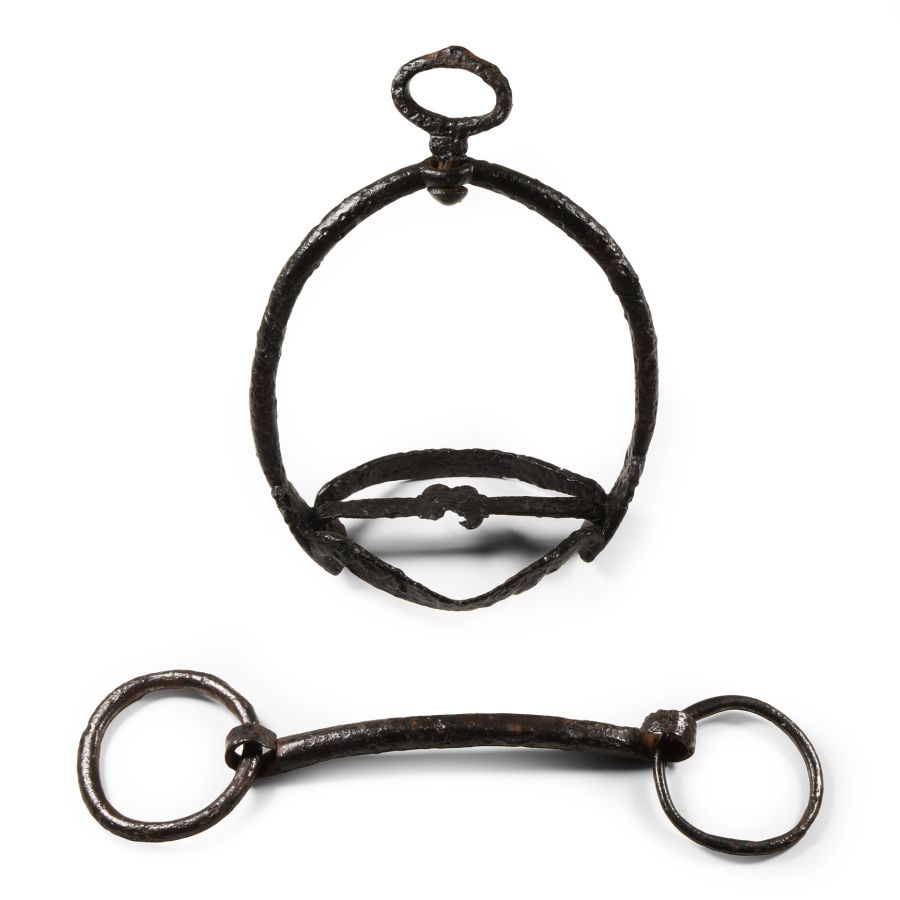
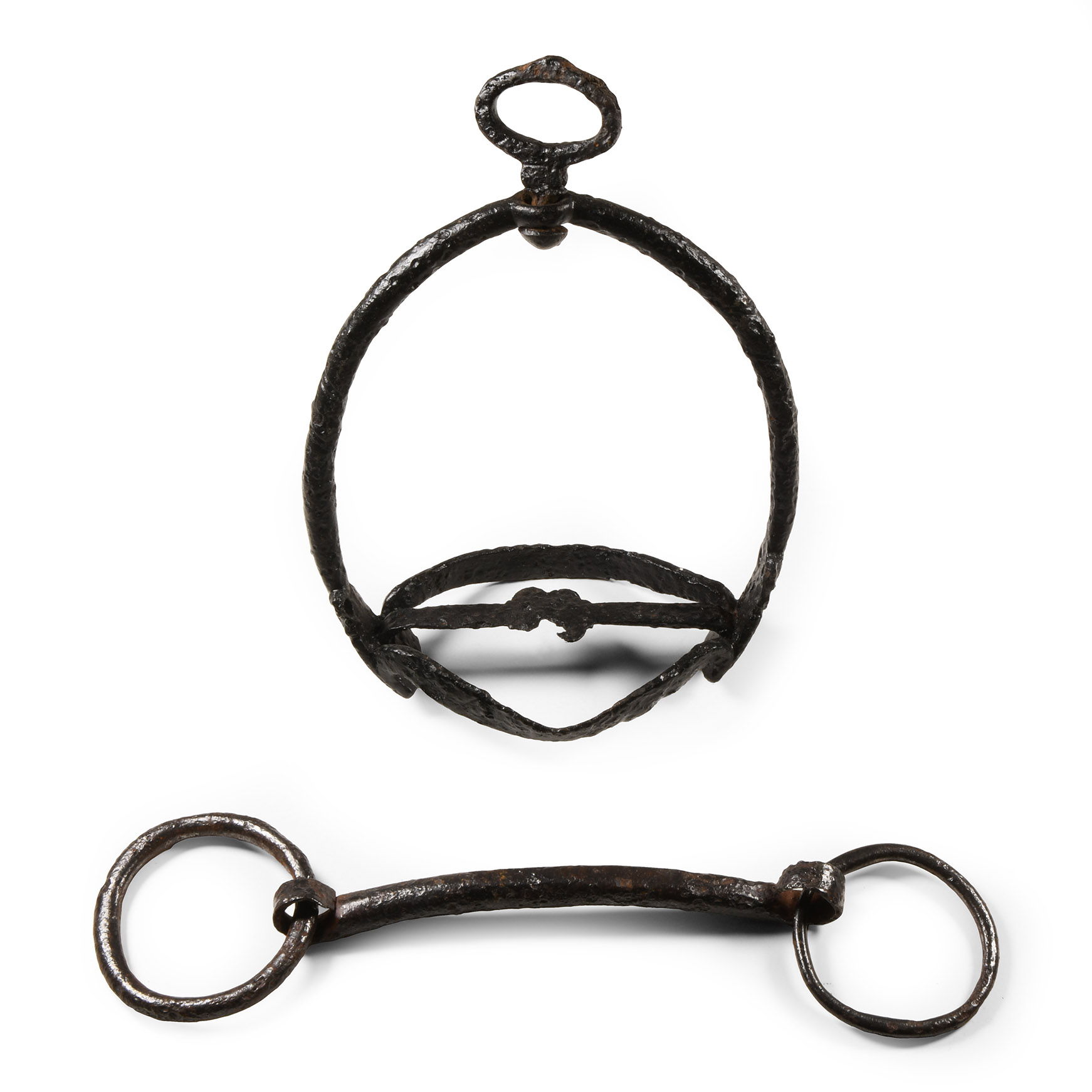
Medieval Iron Stirrup and Horse Bit
14TH-16TH CENTURY A.D.
7 1/4 - 10 1/4 in. (467 grams total, 18.5-26 cm).
Comprising: a snaffle bit with single bar and an iron stirrup in a form of elongated D, with an oval-shaped loop at the top, wide openwork footrest slightly curved forward, with decoration at the sides. [2, No Reserve]
ProvenanceFrom the collection of the famous author, writer and speaker, Gordon Bailey, Essex, UK; formed since 1968.
LiteratureCf. Bailey, G., Detector finds 5, Witham, 2002, fig.7, p.31, for the 14th century snaffle bit; fig.5a-b-c, p.39, for the 15th-16th iron stirrup.
FootnotesSnaffle bits have not altered very much in their design over the centuries. Medieval snaffle bits have survived in reasonable numbers, although they are still rare. A number of different designs are known for them. Some had a plain straight bar serving as the mouth piece, like our example. The 15th-16th century stirrup shows an interesting decoration at the sides of the footrest.
CONDITIONTimeLine Auctions follows a vetting process to ensure the authenticity and legality of all items, reinforcing our commitment to integrity and responsible trading. Each antiquity, antique, and coin lot undergoes thorough examination by a vetting committee of at least ten external specialists, professional trade association members, scientists, and archaeologists: Our Vetting Process
AUCTIONS:
TimeLine is a leading auction house specialising in antiquities, ancient art, collectables, natural history, coins, medals, and books. Our auctions offer museums, collectors, historians, and enthusiasts the opportunity to acquire unique and historically significant pieces.
-
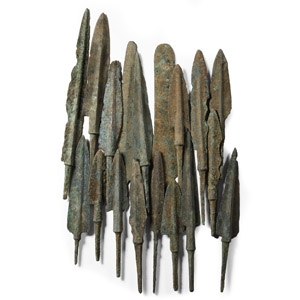
Luristan Bronze Arrowhead Collection
Circa 2nd millennium B.C.-9th century B.C.Sold for (Inc. bp): £234
Including triangular, leaf-shaped, barbed, square-section, and other types. 446 grams total, 10-17.5 cm
Ex London, UK, collection, 1990s.
It is significant to remember that the use of winged and barbed heads in Anatolia was common since the second millennium B.C., but apparently their employment began earlier in this area, where types like these occur alongside the non-barbed, predominantly ribbed and tanged types. -
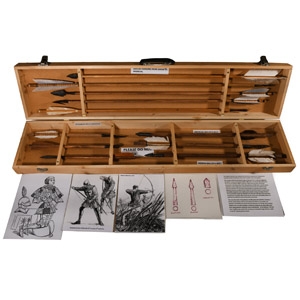
Cased Roman to Medieval Arrow Teaching Aid Collection
1st century A.D.-15th century A.D.Sold for (Inc. bp): £260
Comprising: a Roman ballista bolt with a pyramidal head; a 15th century iron swallowtail arrowhead; three iron medieval crossbow bolts, with pyramidal point, square-section shaft, tubular socket; two medieval ballista bolts with pyramidal point, square-section shaft, tubular socket; two triangular-shaped arrowheads, with pyramidal head; a triangular Eastern Roman bladed arrowhead with a slightly raised mid-rib; a small Anglo-Saxon arrowhead with lozenge form blade and round socket; all mounted on reconstructed modern shafts with their feathered directional lugs, and presented in a wooden display box. 3.83 kg total, 104 x 22 x 9.5 cm including case
From the collection of the famous author, writer and speaker, Gordon Bailey, Essex, UK; formed since 1968.
Crossbow and bows were the protagonist of the 100 Years War between France and England. The crossbow, a bow fixed at its centre to a wooden stock, was a formidable weapon used by the Genoese crossbowmen, mainly in French service; its heavy bolt could easily penetrate a shield or armour breast plate at close range. The longbow, mainly used by the Welsh archers, was able to pierce armours at greater distance. During the reign of Edward III, the long bow distance was estimated to be 400 yards. The capability of the English and Welsh archers enabled the English to secure a victory over the powerful French Cavalry at the battles of Crecy, Poitiers and Agincourt. -
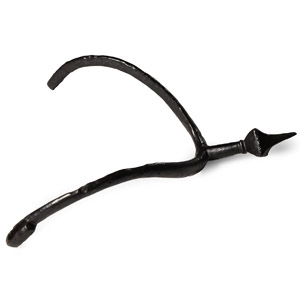
Norman Iron Prick Spur
11th-12th century A.D.Sold for (Inc. bp): £195
With abruptly curved arms ending in two loops, the prick with biconvex bulb. 52 grams, 12 cm
From the collection of the famous author, writer and speaker, Gordon Bailey, Essex, UK; formed since 1968.
The spur belongs to Western specimens of the 12th century, with more or less strongly curved spurs and short, strong, lowered spikes, whereby the majority of the spurs already have loops instead of rivet plates.
