
Loading, please wait...
LOT 1029
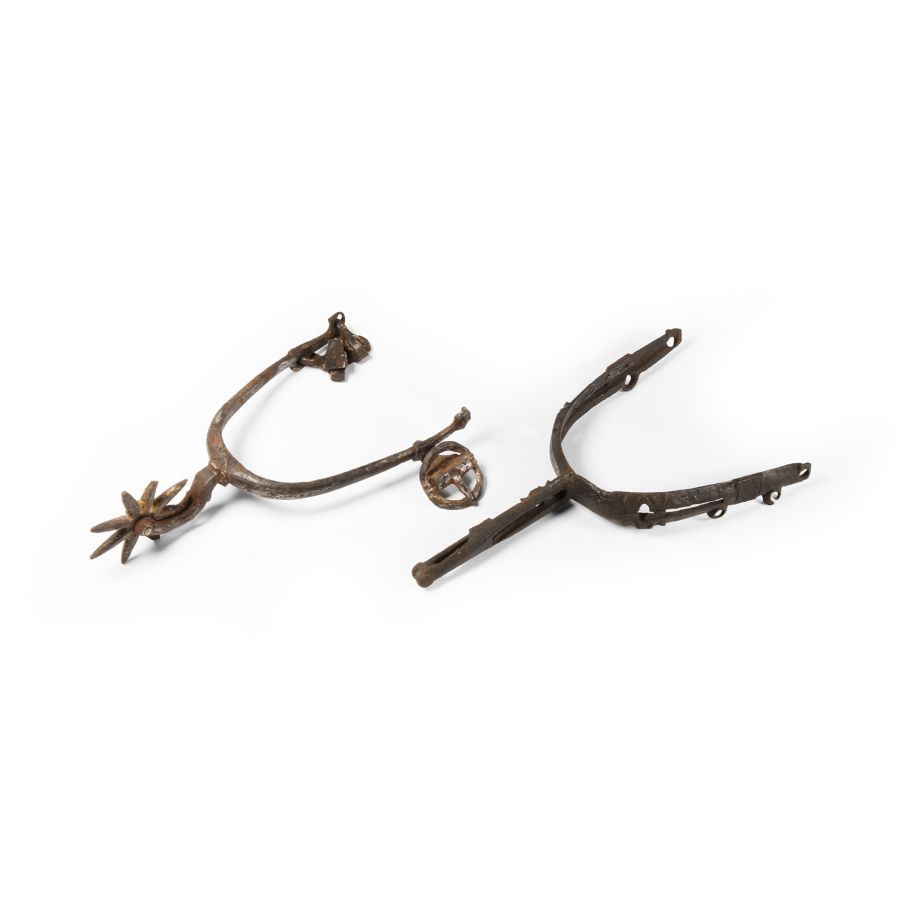
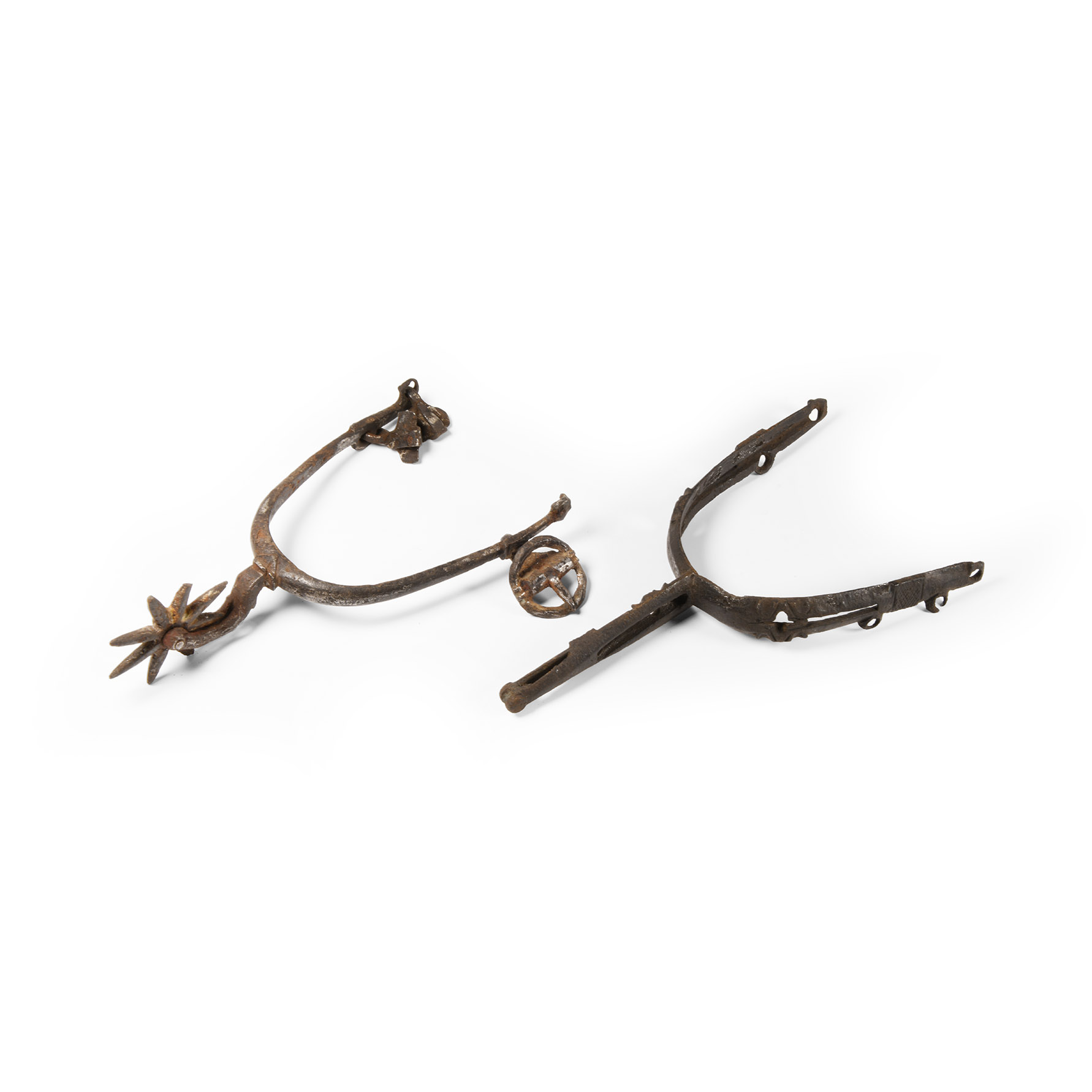
Medieval Iron Spur Group
13TH-15TH CENTURY A.D.
6 1/4 - 7 in. (215 grams total, 16-18 cm).
Comprising: one rowel spur with tapering D-section heelband, short shank and arched rowel box with articulated eight-armed rowel, attachment buckle with tongue suspended from integral loop on one arm, two lobed plaques with loops on reverse suspended from integral loops on the other; a spur with D-section heelband and lentoid-section shank, rectangular and quatrefoil openwork, sections of hatching and raised designs to the outer faces. [2, No Reserve]
ProvenanceEuropean collection, 1990s.
Property of a Cambridgeshire, UK, gentleman.
TimeLine Auctions follows a vetting process to ensure the authenticity and legality of all items, reinforcing our commitment to integrity and responsible trading. Each antiquity, antique, and coin lot undergoes thorough examination by a vetting committee of at least ten external specialists, professional trade association members, scientists, and archaeologists: Our Vetting Process
AUCTIONS:
TimeLine is a leading auction house specialising in antiquities, ancient art, collectables, natural history, coins, medals, and books. Our auctions offer museums, collectors, historians, and enthusiasts the opportunity to acquire unique and historically significant pieces.
-
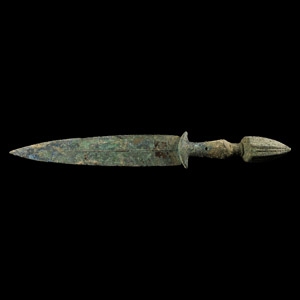
Luristan Bronze Dagger
3rd millennium B.C.Estimate: £300 - 400 (+bp*)
Opening Bid: £150
Composed of a leaf-shaped blade, central slightly raised midrib, separately casted hilt with crescentic guard, rivet hole and lozenge-shaped grip. 147 grams, 26.5 cm
Ex German collection, Cologne, 1980-1990s.
Early bronze daggers from Luristan and Elam had separate casted hilt. Some scholars suggest that arsenic bronze was used in their production, and the handle was separately cast and rivetted to the hilt. Most scholars (Moorey, Mahboubian, Slotta, Vatandust, Khorasani) agree on a 3rd millennium B.C. dating based on the decoration of the hilt. -
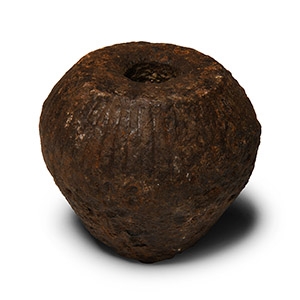
Medieval Eastern European Iron Macehead
14th-15th century A.D.Sold for (Inc. bp): £117
Displaying shallow striations running vertically around the body; cylindrical socket. 828 grams, 64 mm wide
Acquired 1990s-early 2000s. East Anglian private collection.
This kind of later maces, typical of 15th century, had irregularly shaped heads, with spheres having holes for the insertion of the shaft. Incised, parallel strips formed a cross ornament running horizontally and vertically. Grooved lines were carved in the fields between. -
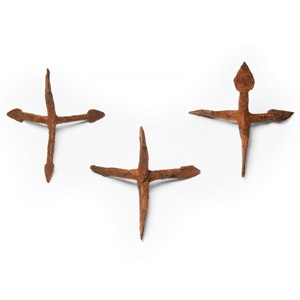
Byzantine Iron Anti-Cavalry Caltrop Trivoloi Group
11th-14th century A.D.Sold for (Inc. bp): £169
Comprising three caltrops, hand-forged with square-section in the form of four welded arrowheads. 34 grams total, 50 mm each
Acquired on the German art market around 2000. From the collection of Surrey, UK, gentleman.
Caltrops were a kind of 'landmine' of the ancient world an mentioned in the Classical period. Nevertheless, they turned into real military weapons only in Dark Ages. Their systematic and wide use by the Eastern Romans, who called it tribolos, is noticeable. In 1082, Emperor Alexios Komnenos used caltrops against the Norman cavalry in the Balkans. Anna Komnena tells us in detail of her father’s intentions: ‘He marched against Bohemond with a new idea for victory. He had iron caltrops made and since he expected the battle to take place on the next day, the evening before scattered them over the plain between the two armies at the point where he guessed that the Kelts (the Normans) would make a heavy cavalry attack. The plan was to frustrate the first and irresistible charge when the caltrops pierced the horses’ hooves.’ Unfortunately for the Romans the Normans avoided battle on the ‘minefield’, outflanked the enemy and gained victory.
