
Loading, please wait...
LOT 1149
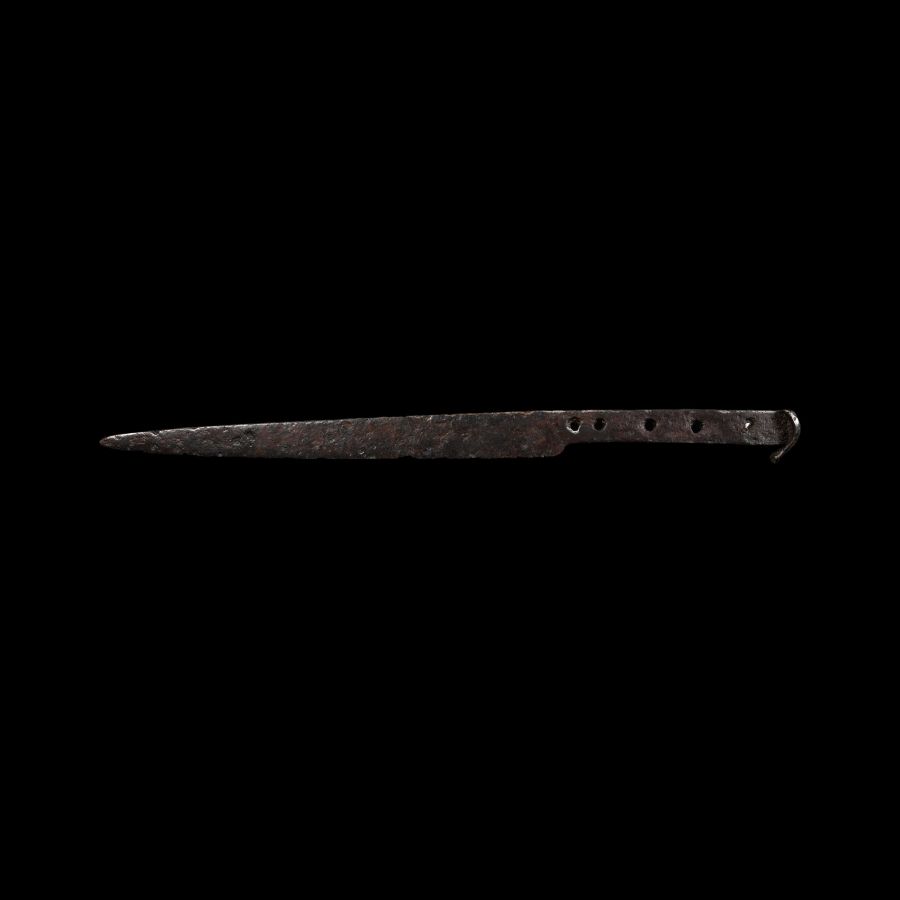
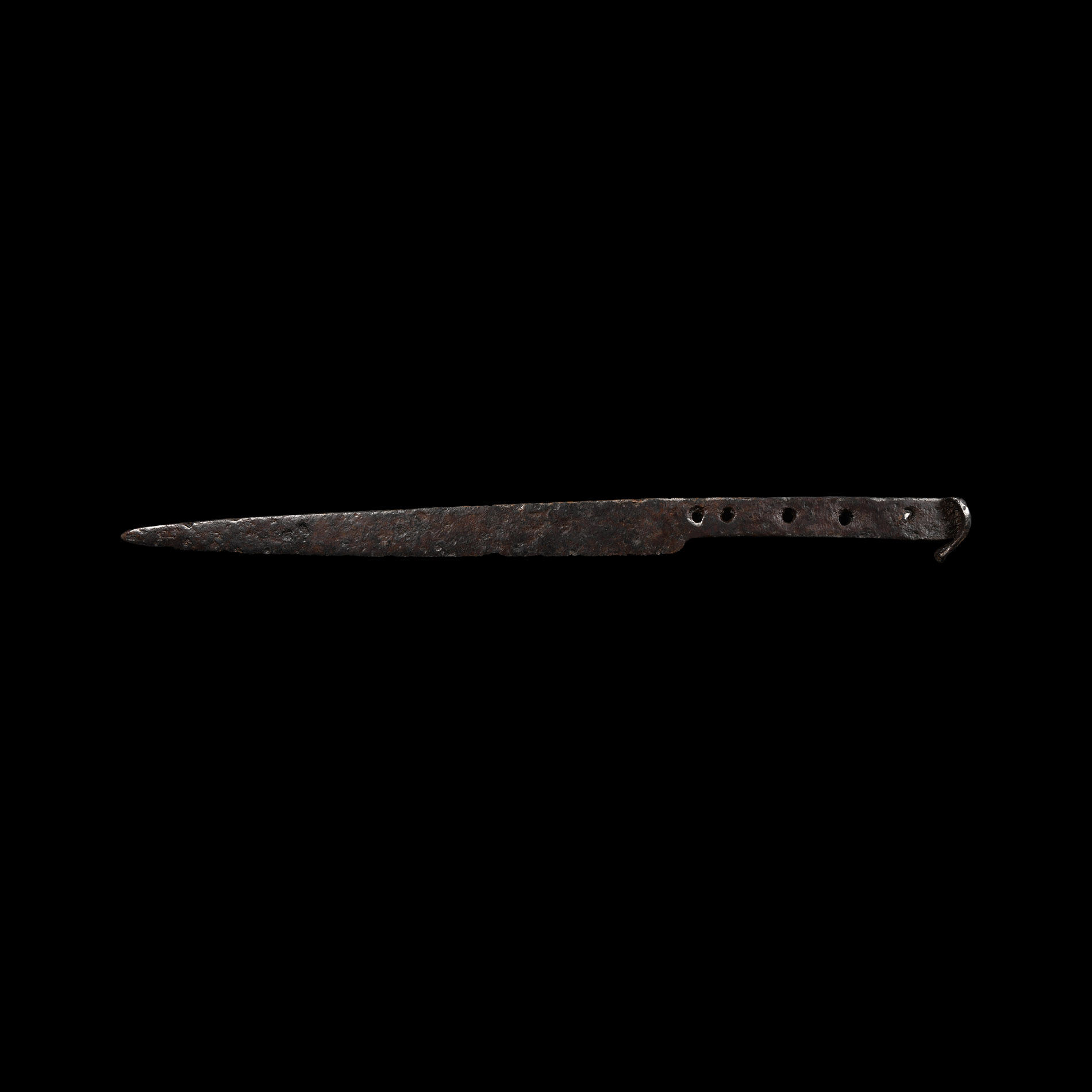
Medieval Iron Single-Edged Dagger
15TH-16TH CENTURY A.D.
12 3/8 in. (131 grams, 31.5 cm).
The blade with a tapering, triangular cross-section and tang with rivet holes; wedge-shaped domed pommel.
ProvenanceAcquired 1960s-1990s.
From the late Alison Barker collection, a retired London barrister.
Cf. Michalak, A., Arma confinii, przemiany późnośredniowiecznej broni na rubieżach Śląska, Wielkopolski, Branderburgii i Łużyc (Arma confinii, transformations of late medieval weapons on the borders of Silesia, Wielkopolska, Brandenburg and Lusatia, in Polish), Zielona Gora, 2019, pl.54, nos.9 and 12, for a similar single-edge dagger.
FootnotesThis is a weapon rather than a domestic knife, and is depicted as a sidearm for soldiers and knights alike in various iconography. This type of dagger was in use from the 14th to mid 16th century, and this example finds similarities with Hauswehrs used in the Eastern Europe during the 15th-16th century A.D.
CONDITIONTimeLine Auctions follows a vetting process to ensure the authenticity and legality of all items, reinforcing our commitment to integrity and responsible trading. Each antiquity, antique, and coin lot undergoes thorough examination by a vetting committee of at least ten external specialists, professional trade association members, scientists, and archaeologists: Our Vetting Process
AUCTIONS:
TimeLine is a leading auction house specialising in antiquities, ancient art, collectables, natural history, coins, medals, and books. Our auctions offer museums, collectors, historians, and enthusiasts the opportunity to acquire unique and historically significant pieces.
LOT 1149
Medieval Iron Single-Edged Dagger
Estimate £120 - 170€140 - 200 (for guidance only)$160 - 230 (for guidance only)
-
.jpg)
Greek Bronze Illyrian Helmet
6th-4th century B.C.Estimate: £15,000 - 20,000 (+bp*)
Opening Bid: £8,333
Of domed Illyrian typology IIIA, variant 3, raised from a single sheet with protective cheek-pieces, two parallel corrugated raised ridges to the upper face, running over the crown from front to back, square-cut frontal opening with smooth edges, short curved rear flange developing from behind towards the forward curving cheek-protectors, the latter having two holes at the extremities for the fastening of a chin-strap; button pin at the centre of the back for attachment of a crest, pierced hole in the front for the corresponding pin. 2.7 kg total, 31 cm high including stand
Ex Mr G. Grimm collection. Acquired from a French auction house. Ex important London gallery. The Kusmirek Collection, UK. Accompanied by an academic report by Dr Raffaele D'Amato This lot has been checked against the Interpol Database of stolen works of art and is accompanied by search certificate number no.10194-167379.
This helmet was probably fitted with a high crest, attached with animal glue and composed of horsehair. It was positioned inside a holder worn between the raised ridges and fastened to the front and back pins, one of them still visible. The recent finds of Illyrian helmets without reinforced edges have suggested that the variants of this typology of helmet could have evolved as their own group, during the late period of its employment (from mid 6th to 4th century B.C.). The earlier specimens have been found in Olympia and Trebeniste (North Macedonia), although the neck protection of these helmets was still in the style of archaic Illyrian types. The helmets from Sindos introduced the characteristics of such late evolution. The diffusion of this typology shows that it was preferred by Macedonian warriors, by the Illyrian fighters and by the Greeks in Sicily and Peloponnesos, considering that the finds are concentrated in the corresponding areas. -
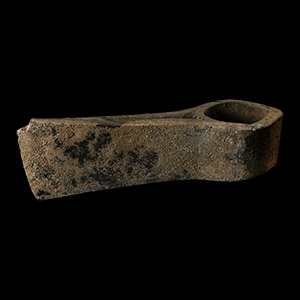
Luristan Bronze Axehead
12th-11th century B.C.Estimate: £100 - 140 (+bp*)
Opening Bid: £40
With elliptical socket and slightly flaring cheeks with cutting edge. 939 grams, 17.5 cm
Acquired 1990s-early 2000s. East Anglian private collection.
The axe corresponds to the Maxwell-Hyslop Type 20A, similar to specimens from Ordu and purely Asiatic in inspiration. An axe from Giyan has a distinct shaft tube which is not present on the Ordu axe, but the shape of the blade is similar and it is probable that smiths travelling over the Eastern Anatolian and Persian trade routes were responsible for making these typologies of axes. -
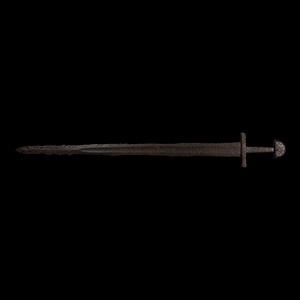
Viking Age Iron Sword of Petersen Type X
10th-11th century A.D.Sold for (Inc. bp): £3,380
Comprising a fine double-edged tapering blade, shallow fullers and defined cutting edges showing traces of employment; short, rectangular-section lower guard and tapering tang, tea-cosy pommel of early type; some restoration. 1.2 kg, 92.5 cm
Acquired 1990s-early 2000s. East Anglian private collection. Accompanied by an academic report by Dr Raffaele D'Amato.
The sword is Petersen type X (Petersen, 1919, pp.158ff) and Oakeshott type XI (1991, pp.53ff.), finding good parallels in various similar Viking and Norman age specimens (Peirce, 2002, pp.115 ff.). The overall proportions of our specimen are eye-catching and it is strikingly similar to a pattern-welded sword found with a large number of other objects, at Camp de Péran, Côtes-d'Armor, France, in a 10th century context, probably linked with the early Norman settlers in Normandy or Norman raids in Brittany (Roesdhal, Wilson, 1992, p.321, cat. n.359; Renaud, 2000, p.100).
